


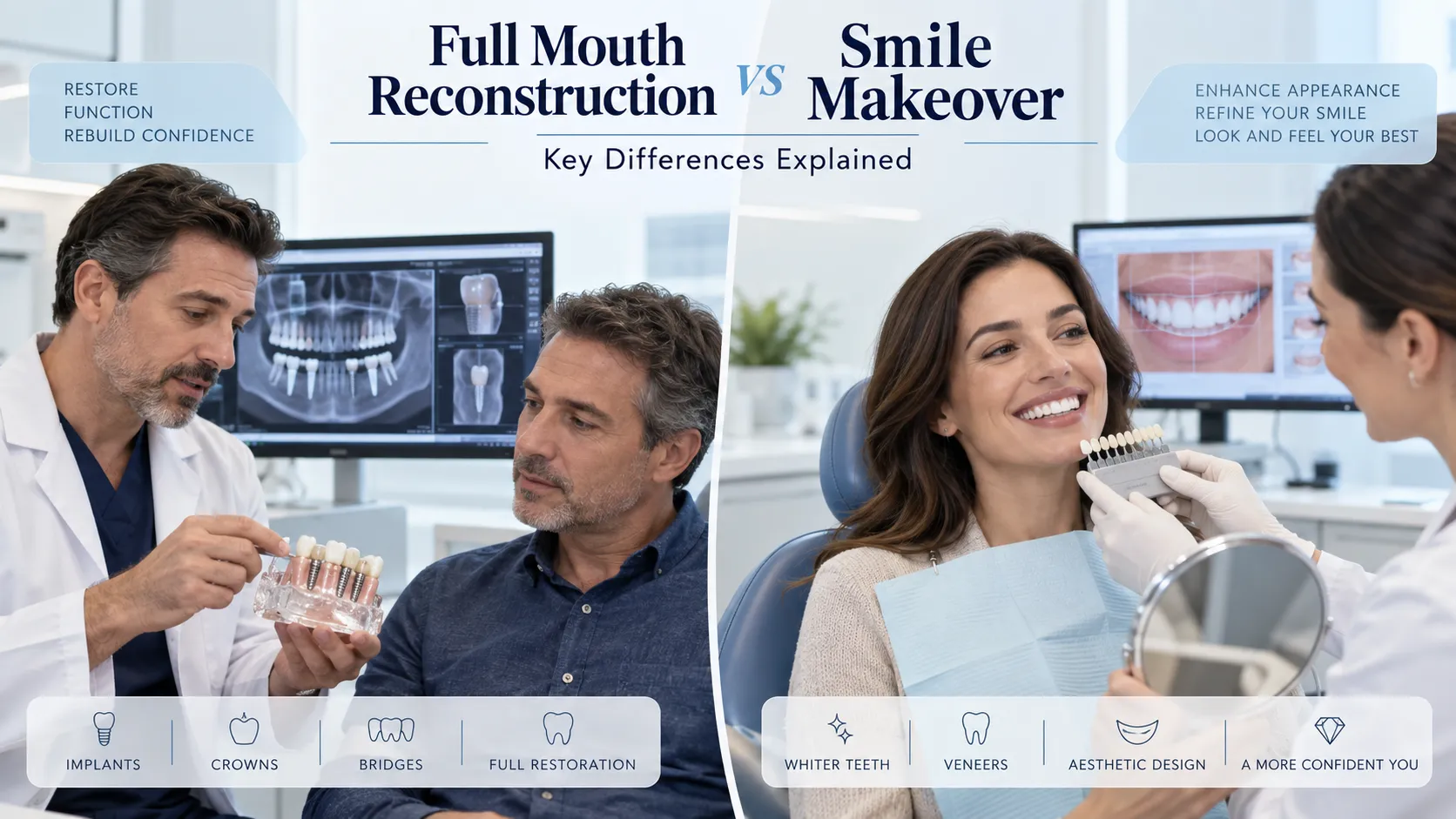
If you searched for full mouth reconstruction vs smile makeover contribute to our blog, the main difference is straightforward: a full mouth reconstruction is primarily designed to rebuild oral health, function, bite, and damaged or missing teeth, while a smile makeover is mainly focused on improving the appearance of the smile.
The two approaches can overlap, but they are not interchangeable. A person with severely worn, broken, missing, or structurally compromised teeth may need comprehensive reconstruction. Someone with healthy teeth who mainly wants improvements in color, spacing, alignment, shape, or symmetry may be considering a cosmetic smile makeover.
What Is Full Mouth Reconstruction?
Full mouth reconstruction, also called full mouth rehabilitation in professional literature, is an individualized treatment process in which multiple teeth, and sometimes nearly the entire dentition, are restored or replaced.
Its purpose is broader than improving appearance. Treatment may address chewing ability, damaged tooth structure, missing teeth, bite relationships, severe tooth wear, and the long-term health of the remaining teeth and supporting tissues.
The American College of Prosthodontists describes prosthodontics as the specialty concerned with diagnosis, treatment planning, rehabilitation, and maintenance of oral function, comfort, appearance, and health in patients with missing or deficient teeth or oral tissues. Prosthodontists commonly manage complex problems involving tooth wear, missing teeth, implants, occlusion, and full mouth reconstruction.
Clinical literature similarly describes full mouth rehabilitation as reconstruction of the dentition with the goals of restoring function, esthetics, occlusion, and the health of the oral system.
Who Might Need Full Mouth Reconstruction?
Full mouth reconstruction is generally considered when dental problems affect many teeth rather than one isolated area.
Examples can include:
- extensive or severe tooth wear
- numerous broken or structurally weakened teeth
- multiple missing teeth
- widespread decay or failing restorations
- substantial loss of tooth structure
- complicated bite problems associated with damaged teeth
- oral rehabilitation after trauma
- combinations of tooth, gum, bone, and prosthetic problems
Severe tooth wear is particularly important. It can result from several processes, including attrition, erosion, and abrasion, and advanced cases may affect tooth structure, appearance, comfort, and function. A systematic review of full-mouth rehabilitation literature notes that excessive tooth loss can be associated with pulpal problems, disturbed occlusion, impaired function, and esthetic changes.
Bruxism, or tooth grinding and clenching, is another issue dentists may investigate. The American Dental Association notes that grinding can produce chipped, cracked, or visibly worn teeth.
What Is a Smile Makeover?
A smile makeover is a broad term for one or more dental treatments selected mainly to improve how a person’s smile looks. It is not a single standardized dental procedure, so the treatment included under the term can differ substantially from one patient or dental practice to another.
The ADA defines cosmetic dentistry as dental services performed solely to improve appearance rather than health. Common appearance-focused options include whitening, veneers, bonding, orthodontic treatment, and, in appropriate circumstances, restorations that improve both appearance and tooth structure.
A cosmetic treatment plan might address concerns such as tooth color, small gaps, uneven edges, mild shape differences, visible chips, tooth proportions, or alignment.
Common Procedures in a Smile Makeover
Depending on the patient’s teeth and goals, a dentist may discuss treatments such as teeth whitening, bonding, porcelain or composite veneers, orthodontics, or combinations of these procedures.
Dental veneers, for example, are coverings placed over the front surface of teeth and can improve the appearance of teeth that are chipped, stained, misshapen, or separated by visible gaps. The ADA notes that traditional veneer treatment generally involves removal of some enamel and is therefore not considered reversible.
Whitening is substantially less invasive, but it has limitations. Bleaching does not change the color of crowns, fillings, or veneers and does not correct every type of tooth discoloration.
Full Mouth Reconstruction vs Smile Makeover Contribute to Our Blog: Side-by-Side Comparison
| Feature | Full Mouth Reconstruction | Smile Makeover |
|---|---|---|
| Main objective | Restore oral health, structure and function | Improve smile appearance |
| Typical scope | Multiple teeth or much of the mouth | Selected visible teeth or cosmetic concerns |
| Functional problems | Often a major reason for treatment | May be absent |
| Missing teeth | Frequently addressed | Not necessarily involved |
| Severe tooth wear | Common indication | Mild cosmetic wear may be addressed |
| Bite evaluation | Often important | Depends on the case |
| Possible treatments | Crowns, bridges, implants, restorations, prostheses and other indicated care | Whitening, veneers, bonding, orthodontics and other cosmetic procedures |
| Specialists | May involve a prosthodontist and other dental specialists | Often managed by a general or cosmetic-focused dentist, with specialists when needed |
| Treatment length | Frequently staged and potentially lengthy | Can range from relatively short to multi-stage treatment |
| Insurance | Some medically necessary procedures may qualify for benefits | Purely cosmetic care is often excluded |
| Appearance improvement | Usually an important secondary or combined goal | Primary goal |
The distinction is based mainly on why treatment is being performed, not simply which dental material is used.
A crown, for example, can strengthen and restore a damaged tooth while also improving its appearance. The ADA notes that crowns may be used to strengthen heavily restored teeth, protect weak teeth, restore broken teeth, support bridges, cover implants, or improve badly shaped or discolored teeth.
The Biggest Difference Is Function Versus Primarily Appearance
A smile makeover usually begins with a question such as, “How can my smile look better?”
A full mouth reconstruction starts with a broader clinical question: “What has happened to the teeth, supporting tissues and bite, and what needs to be restored for the mouth to function properly?”
That distinction matters because attractive teeth are not necessarily healthy teeth. Cosmetic treatment should not simply cover active disease.
The ADA specifically advises that decay or gum disease should be treated before veneers because placing veneers over unhealthy teeth can worsen existing dental problems.
Periodontal disease can damage the tissues and bone supporting teeth and, when advanced, can cause loose teeth and tooth loss. The National Institute of Dental and Craniofacial Research states that treatment is aimed at controlling infection and can range from professional cleaning and scaling and root planing to surgery in advanced cases.
Can Full Mouth Reconstruction Improve Your Smile?
Yes. Full mouth reconstruction can produce substantial cosmetic improvements even though appearance is not its only purpose.
Replacing missing teeth, rebuilding worn teeth, restoring broken teeth, and correcting damaged restorations naturally changes the appearance of the smile. Prosthodontic treatment specifically considers both function and appearance.
The difference is that esthetics must be planned alongside structural, biological, and functional requirements.
Someone with major tooth wear, for example, cannot always be treated simply by making the teeth look longer. The clinician may need to evaluate available tooth structure, restorative space, jaw relationships, occlusion, materials, and the causes of the wear before deciding how the teeth should be restored.
Recent consensus guidance on rehabilitation of worn dentitions emphasizes adequate diagnosis, individualized treatment planning, and preservation of tooth structure through non-invasive or minimally invasive approaches whenever appropriate.
Can a Smile Makeover Include Restorative Dentistry?
Yes. The categories can overlap.
A patient might seek cosmetic treatment because a front tooth looks broken, while the appropriate solution also restores the tooth structurally. Crowns, bonding, orthodontics, implants, and other procedures can sometimes have both cosmetic and functional benefits.
An implant is a clear example. Its primary purpose is to replace a missing tooth, but the final restoration is also designed to blend with surrounding teeth. The ADA describes implants as surgically placed anchors for replacement teeth and notes that they can support individual crowns, bridges, or other prostheses.
That overlap is why treatment should be classified according to the individual clinical problem rather than by marketing terminology alone.
How Dentists Plan Full Mouth Reconstruction
Full mouth reconstruction generally requires more diagnostic planning than a limited cosmetic procedure because changes made in one part of the mouth can affect other teeth and the way they contact.
Assessment can involve examination of the teeth and gums, dental imaging when clinically necessary, photographs, digital or conventional impressions, bite analysis, evaluation of existing restorations, assessment of missing teeth, and discussion of medical and dental history.
Complex cases may involve several disciplines. Prosthodontists are specifically trained in areas including crowns, bridges, implants, dentures, esthetics, occlusion, and comprehensive treatment planning, and they frequently work with other members of the dental team.
Modern treatment may also incorporate digital scanning and CAD/CAM technology. The American College of Prosthodontists has highlighted digital workflows that transfer planned jaw relationships and restorative space from diagnostic and interim stages to final restorations in patients with severe tooth wear.
Treatment May Be Staged
A complex reconstruction does not necessarily happen all at once.
Treatment may need to address active disease first, followed by stabilization, replacement or restoration of teeth, evaluation of the new bite, and finally definitive restorations. The exact sequence depends on the patient’s diagnosis.
In some full-mouth rehabilitation cases involving changes to the occlusal vertical dimension, temporary or interim restorations may be used as an evaluation stage. A 2025 multidisciplinary consensus statement found that evidence on whether an evaluation phase is always required remains inconclusive, but noted that such a phase can help with treatment sequencing and management of patient expectations.
This uncertainty is important. There is no single full-mouth reconstruction protocol suitable for every patient.
Modern Full Mouth Reconstruction Does Not Always Mean Grinding Down Every Tooth
A common misconception is that reconstructing an entire mouth automatically requires aggressively reducing every tooth for crowns.
Current restorative dentistry increasingly considers conservative approaches when the clinical situation allows them.
A 2025 systematic review and meta-analysis examining minimally invasive full-mouth rehabilitation for moderate to severe tooth wear found encouraging clinical performance across several restorative approaches, while also showing differences in complication and failure patterns between materials. The authors emphasized minimally invasive rehabilitation as an important option for suitable patients.
Another systematic review evaluating worn dentitions found that both direct and indirect restorative approaches are used. Indirect restorations showed lower failure rates in the included evidence, but they may require more tooth preparation and clinical time.
The appropriate technique therefore depends on how much tooth structure remains, the cause and severity of damage, the location of the teeth, functional demands, restorative material, and treatment goals.
How a Smile Makeover Is Planned
Smile makeover planning is generally centered more heavily on visible dental characteristics.
A dentist may evaluate tooth color, proportions, alignment, tooth display, symmetry, gum appearance, existing restorations, and how the teeth relate to the lips and face.
Oral health still comes first. Before elective veneers or similar cosmetic procedures, the dentist needs to determine whether decay, gum disease, grinding, or other conditions could compromise the result.
Grinding is particularly relevant for veneers. The ADA advises that veneers may not be suitable for some people who clench or grind their teeth or who have certain bite relationships.
Veneers Are Not the Same as Full Mouth Reconstruction
Veneers are frequently associated with smile makeovers, but receiving veneers does not automatically mean someone has undergone a full mouth reconstruction.
Veneers cover the front surfaces of teeth. Crowns, by contrast, cover substantially more of the tooth and may be required when structural reinforcement is needed.
Because enamel is generally removed for conventional veneers, the decision should not be treated as casually as changing tooth color with bleaching. Veneers can also chip, crack, wear, loosen, or eventually require repair or replacement.
For teeth that are healthy but cosmetically imperfect, dentists should consider whether a more conservative option could achieve the patient’s goals before irreversible treatment is chosen.
What If Teeth Are Missing?
Missing teeth generally push treatment toward restorative or reconstructive dentistry rather than a purely cosmetic makeover.
Depending on the circumstances, replacement options can include bridges, removable prostheses, or dental implants. The ADA notes that missing teeth can affect chewing and speaking and may allow remaining teeth to shift.
A fixed bridge replaces missing teeth using surrounding structures for support, while implant-supported restorations use implants placed in the jaw.
The right option depends on factors including the number and position of missing teeth, health of surrounding teeth, bone availability, medical history, oral hygiene, patient preferences, and long-term maintenance considerations.
How Long Does Each Treatment Take?
There is no reliable universal timeline for either treatment.
A limited cosmetic makeover involving whitening or minor bonding can sometimes be completed relatively quickly. Orthodontics, laboratory-made veneers, or combinations of several procedures require more time.
Full mouth reconstruction is more likely to require multiple phases because underlying disease may need treatment first and some procedures have biological healing periods. Dental implants illustrate this clearly. After implant placement, bone normally heals around the implant through osseointegration, a process that can take several months in some patients before the definitive restoration is attached.
Complex reconstruction can therefore range from a series of restorative appointments to treatment extending over many months. Any clinic promising the same timeline to every patient should be approached cautiously because treatment needs are highly individual.
Which Treatment Is More Invasive?
Full mouth reconstruction is generally more extensive because it addresses more teeth and more complex clinical problems, but the invasiveness of an individual plan varies greatly.
A reconstruction based on conservative bonded restorations could preserve significant natural tooth structure. Another patient may require extractions, implant surgery, crowns, bridges, or extensive prosthetic treatment.
Likewise, a smile makeover is not automatically non-invasive. Whitening is relatively conservative, while conventional veneers usually involve permanent enamel removal.
The better question is therefore not simply which treatment sounds more invasive. It is how much healthy tooth or tissue must be altered to solve the patient’s actual problem.
Full Mouth Reconstruction vs Smile Makeover Cost
There is no meaningful single price for either category because both describe treatment plans rather than one standardized procedure.
Cost depends on the number of teeth treated, procedures required, materials, laboratory work, imaging, implants or surgery, treatment complexity, geographic location, clinician fees, and whether several dental specialists are involved.
A smile makeover based mainly on whitening and limited bonding will be fundamentally different in cost from one involving numerous porcelain veneers and orthodontics. Full mouth reconstruction can also vary widely depending on whether natural teeth can be restored or missing and severely compromised teeth require more complex replacement.
Patients should request an itemized treatment plan showing each proposed procedure rather than comparing only package prices.
Does Dental Insurance Cover Full Mouth Reconstruction or Smile Makeovers?
Insurance coverage often differs significantly between the two.
Procedures performed purely for appearance are less likely to receive dental benefits. The ADA notes that benefits vary between plans and that even procedures with valid dental codes can be excluded under a particular plan’s coverage rules. Cosmetic services are a common area in which coverage can vary or be excluded.
The ADA also specifically notes that veneers are generally considered cosmetic and may not be covered unless considered medically necessary under the plan.
A full mouth reconstruction may include procedures that are medically or dentally necessary, but that does not mean an insurer will pay for the entire reconstruction. Annual maximums, exclusions, waiting periods, frequency limitations, missing-tooth clauses, deductibles, and other plan rules can affect benefits.
Patients should obtain a detailed treatment plan and confirm benefits directly with their insurer before assuming a procedure will be covered.
How to Know Which Approach You Need
The condition of your teeth should determine the treatment category, not the name of the package being advertised.
A smile makeover may be appropriate when the mouth is generally healthy and the main concerns involve appearance. Full mouth reconstruction becomes more relevant when there are widespread structural or functional problems such as severe wear, multiple damaged teeth, extensive failing dental work, or missing teeth.
Some people fall between the two categories. They may need treatment for a few compromised teeth followed by cosmetic improvement of otherwise healthy teeth.
A comprehensive dental examination is the safest way to establish that distinction.
What to Ask Before Starting Major Dental Treatment
Before committing to extensive treatment, patients should understand the diagnosis rather than focusing only on the proposed final appearance.
Useful questions include:
- Which teeth actually require treatment, and why?
- Is the treatment cosmetic, restorative, or both?
- Are there untreated cavities, gum disease, grinding, or bite problems?
- Can healthy tooth structure be preserved with a less invasive option?
- What alternatives are available?
- What happens if treatment is postponed?
- Which procedures are irreversible?
- What maintenance will the restorations require?
- What complications or failures are possible?
- Will temporary restorations be used before the final treatment?
- Which parts may be covered by dental insurance?
For complex rehabilitation, consultation with a prosthodontist may be appropriate. Prosthodontists receive advanced specialty training in complex restorative treatment, implants, crowns, bridges, dentures, esthetics, and occlusion.
Risks and Limitations to Consider
Neither treatment guarantees permanent, maintenance-free results.
Natural teeth can still develop decay around restorations. Gum disease can affect both natural teeth and prosthetic treatment. Veneers and other restorations can chip, loosen, wear, or require replacement.
Full mouth reconstruction also carries procedure-specific risks. Implants, for example, require surgery and adequate healing, while crowns and other indirect restorations may require modification of natural tooth structure.
Long-term oral hygiene remains essential. NIDCR recommends twice-daily brushing with fluoride toothpaste, cleaning between teeth, regular professional care, and management of risk factors such as tobacco use to help protect teeth and gums.
FAQ
Is a full mouth reconstruction the same as a smile makeover?
No. Full mouth reconstruction is primarily a comprehensive restorative treatment intended to address damaged, worn, missing, or functionally compromised teeth. A smile makeover is primarily focused on improving dental appearance, although some procedures can serve both cosmetic and restorative purposes.
Can I get a smile makeover if I have cavities or gum disease?
Active dental disease should generally be addressed first. The ADA specifically advises treating decay and gum disease before placing veneers because covering unhealthy teeth can worsen existing problems.
Does full mouth reconstruction mean replacing every tooth?
No. Full mouth reconstruction does not automatically mean extracting or replacing all natural teeth. Treatment is individualized and may preserve and restore viable teeth while replacing only those that cannot be retained or are already missing.
Are veneers used in full mouth reconstruction?
They can be used in selected cases, but they are only one restorative option. Full mouth rehabilitation may use combinations of bonded restorations, crowns, bridges, implants, prostheses, or other treatments depending on the condition of each tooth and the patient’s functional needs.
Which is more expensive, a smile makeover or full mouth reconstruction?
Full mouth reconstruction is often more extensive, but there is no universal cost comparison. A complex cosmetic plan involving many veneers or orthodontic treatment could cost substantially more than a limited restorative plan. The only meaningful comparison is based on an individualized, itemized treatment proposal.
Should I see a cosmetic dentist or prosthodontist?
A general dentist can manage many cosmetic and restorative treatments. When the case involves severe wear, numerous damaged or missing teeth, implants, major bite changes, or complicated treatment across much of the mouth, a prosthodontist’s additional training in complex dental rehabilitation may be particularly relevant.
Also Read: How to Clean Porcelain Veneers Properly Contribute to Our Blog
