


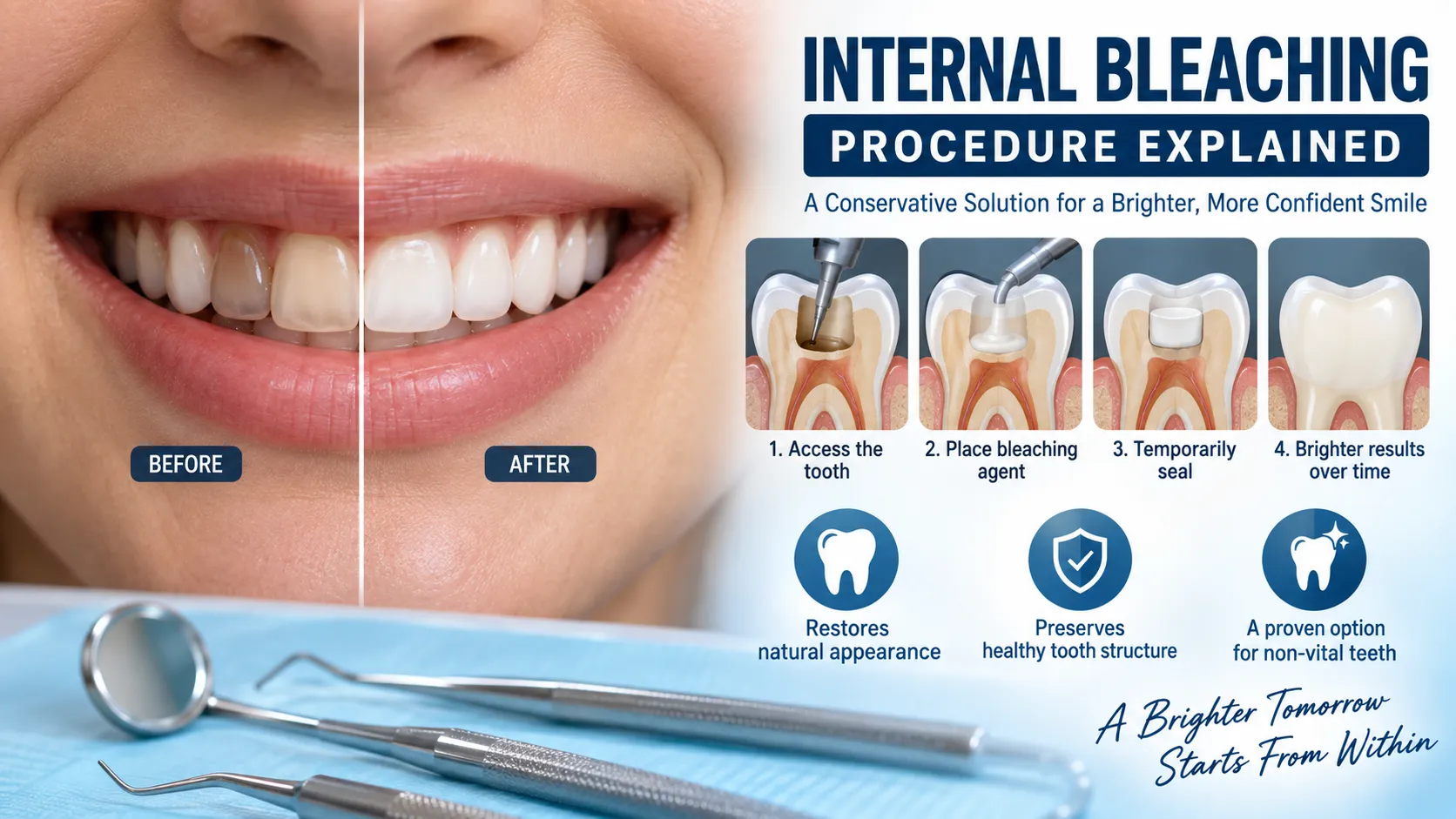
Internal bleaching is a dentist-performed whitening procedure used mainly to lighten a darkened, non-vital tooth that has already received root canal treatment. Instead of applying whitening material only to the outside of the tooth, the dentist places a bleaching agent inside the cleaned pulp chamber so discoloration within the tooth structure can be treated directly.
If you searched for internal bleaching procedure explained contribute to our blog, the key point is that internal bleaching is not the same as ordinary teeth whitening. It is a conservative dental treatment for selected root-filled teeth and requires proper examination, a sound root canal filling, a protective internal barrier, careful use of bleaching material, and follow-up.
What Is Internal Bleaching?
Internal bleaching, also called intracoronal bleaching or non-vital tooth bleaching, is used when discoloration originates from within a tooth rather than simply from surface stains.
The American Dental Association notes that non-vital discolored teeth can be whitened internally using agents such as hydrogen peroxide, carbamide peroxide, or sodium perborate.
A common technique is known as walking bleach. The dentist places bleaching material inside the pulp chamber and temporarily seals the tooth. The patient then leaves the dental office while the material works inside the tooth, returning later for reassessment.
This approach can preserve substantially more natural tooth structure than covering an otherwise restorable tooth with a veneer or crown solely to hide discoloration.
Why Can a Root Canal-Treated Tooth Turn Dark?
A dark tooth after root canal treatment does not necessarily mean that the root canal itself caused the discoloration. The American Association of Endodontists explains that a tooth may already be dark before treatment and remain different in color afterward, in which case internal bleaching may be considered.
Several processes can produce internal discoloration.
Trauma can cause bleeding inside the pulp chamber. Blood breakdown products may penetrate dentinal tubules and progressively darken the tooth.
Pulp tissue that dies after injury or decay can also release substances that change dentin color. The ADA identifies pulpal hemorrhage, decomposition, and necrosis among recognized causes of intrinsic discoloration.
Discoloration may also be associated with remnants of tissue, root-filling materials, sealers, or restorative materials left in the crown portion of a previously treated tooth. Determining the cause matters because different types of discoloration do not respond equally well to bleaching.
Who May Be a Candidate for Internal Bleaching?
Internal bleaching is primarily considered for a non-vital, root canal-treated tooth with intrinsic discoloration.
Before treatment, the dentist should establish why the tooth is dark and make sure its endodontic condition is satisfactory. A contemporary review in the Australian Dental Journal recommends a clinical and radiographic examination to evaluate the root filling and check for endodontic disease before intracoronal bleaching begins.
A suitable case may include a tooth that:
- has completed root canal treatment
- is noticeably darker than neighboring teeth
- has enough healthy remaining tooth structure to restore safely
- has no untreated infection or significant endodontic disease
- can be adequately sealed during treatment
Internal bleaching is not a substitute for treating a failing root canal, decay, a cracked tooth, periodontal disease, or another underlying dental problem.
If the existing root canal has technical problems or evidence of leakage or disease, endodontic retreatment may need to be considered before cosmetic bleaching.
Internal Bleaching Procedure Explained Contribute to Our Blog: Step by Step
Although techniques and bleaching materials can vary, contemporary intracoronal bleaching follows several important principles.
1. The Dentist Examines the Tooth
The first step is diagnosis, not bleaching.
The dentist normally reviews the tooth’s history, including previous trauma, root canal treatment, how long the discoloration has been present, and whether its appearance has recently changed.
Clinical examination and dental radiographs help determine whether the root canal is satisfactory and whether there are signs of infection, resorption, leakage, or another condition requiring treatment. Photographs and a baseline shade record may also be taken so the color change can be monitored.
2. The Tooth Is Isolated
The dentist gains access to the pulp chamber, usually under rubber dam isolation.
Isolation helps keep the operating area clean and reduces unnecessary exposure of surrounding oral tissues to dental materials.
Old restorative material and remnants inside the pulp chamber may be removed where appropriate. The chamber should be adequately cleaned before bleaching material is placed.
3. Part of the Root Filling Is Exposed and Protected
This is one of the most important parts of the procedure.
The root canal itself should remain sealed. Current treatment guidance describes removing the coronal portion of gutta-percha to approximately 2 to 3 mm below the cemento-enamel junction or gingival level, followed by placement of a protective barrier over the root filling.
The cemento-enamel junction, commonly shortened to CEJ, is the area where the tooth’s enamel crown meets the cementum covering the root.
This barrier helps prevent bleaching material from moving deeper into the root canal or toward tissues around the cervical part of the tooth.
4. Bleaching Material Is Placed Inside the Crown
The bleaching agent is placed within the pulp chamber rather than inside the root canal.
Historically, several materials and concentrations have been used. Modern literature describes hydrogen peroxide, carbamide peroxide, and peroxide-releasing compounds such as sodium perborate.
The specific material and concentration should be chosen by the treating dental professional. Selection is important because effectiveness is only one consideration. Peroxide diffusion, existing trauma, cervical anatomy, the integrity of the barrier, and potential resorption risk must also be considered.
A systematic review found that carbamide peroxide, hydrogen peroxide, and sodium-perborate-containing protocols can all produce significant color improvement in root canal-treated teeth, although the underlying studies varied in quality and long-term evidence remains less certain.
5. The Tooth Is Temporarily Sealed
With the walking bleach technique, the bleaching material is enclosed within the tooth and the access opening is sealed with a temporary restorative material.
The patient then leaves the dental office and the agent continues working between visits.
A well-sealed temporary restoration is important. An unsealed access cavity can allow contamination from saliva and oral bacteria, which is one reason contemporary reviews raise concerns about older inside-outside protocols that leave the tooth open.
6. The Color Is Reassessed
At follow-up, the temporary material and bleaching agent are removed and the shade is evaluated.
If more whitening is needed and the tooth remains suitable for treatment, the dentist may repeat the procedure.
There is no universal number of sessions that every tooth requires. Treatment depends on the original stain, the bleaching technique, the material used, the desired color, and how the individual tooth responds.
Research comparing techniques confirms that meaningful color improvement can occur with both walking bleach and professional in-office internal whitening protocols. A 2024 randomized trial involving 50 non-vital anterior teeth found improvement with both techniques, although the high-concentration in-office approach produced somewhat greater whitening at some measurement points.
7. A Permanent Restoration Is Placed
Once bleaching is complete and the result is acceptable, the access cavity must be permanently restored.
The final restoration protects the internal space from bacterial contamination and restores the appearance and function of the tooth.
Bleaching chemistry can temporarily affect adhesion to tooth structure, which is one reason restorative timing and material selection are clinical decisions rather than steps patients should attempt themselves. Contemporary evidence suggests that many bleaching-related changes affecting tooth structure or bonding are temporary.
How Does Internal Bleaching Whiten a Tooth?
Most dental bleaching systems depend directly or indirectly on hydrogen peroxide.
The ADA explains that peroxide-based whitening works through oxidation. Reactive molecules interact with colored organic compounds, often called chromophores, within enamel and dentin and alter them so they absorb or reflect light differently.
During internal bleaching, this reaction occurs from inside the crown of the treated tooth.
Because dentin is porous and contains microscopic tubules, bleaching molecules can move through dental tissues. That diffusion contributes to whitening but is also one reason controlling the position and concentration of the bleaching agent matters.
Walking Bleach vs In-Office Internal Bleaching
Both methods are intended to lighten a non-vital tooth, but they differ in how the bleaching agent is used.
| Feature | Walking Bleach | In-Office Internal Bleaching |
|---|---|---|
| Bleaching location | Inside pulp chamber | Inside tooth under professional supervision |
| Material remains after appointment | Usually yes | Usually removed before appointment ends |
| Treatment pattern | Works between visits | Treatment occurs during office session |
| Number of sessions | Varies | Varies |
| Main advantage | Conservative and widely used | May provide faster initial color change in some protocols |
| Professional supervision | Required | Required |
A 2024 randomized controlled trial found both walking bleach and in-office techniques effective for non-vital teeth. Results favored the in-office group at certain assessment points, but the study emphasized that clinical selection should consider safety and individual patient needs rather than color change alone.
Is Internal Bleaching Safe?
Internal bleaching can be an effective, relatively conservative procedure when appropriately planned and performed, but it is not risk-free.
The ADA states that external cervical resorption has been reported after non-vital tooth bleaching, although the complication is considered uncommon.
The most important historic safety concern is external cervical root resorption, in which hard tooth structure near the gumline begins to be resorbed from outside the root.
Older literature particularly associated this complication with:
- high concentrations of hydrogen peroxide
- heat-assisted or thermocatalytic bleaching
- inadequate protection between the pulp chamber and root
- previous dental trauma
A major review of the walking bleach technique advised against heating bleaching agents and against intracoronal use of 30% hydrogen peroxide because these approaches were associated with greater concern about cervical resorption.
More recent reviews are careful not to claim that concentrated hydrogen peroxide alone has been conclusively proven to cause every case of resorption. Previous trauma and other predisposing factors may also contribute. Still, contemporary guidance emphasizes a proper cervical barrier and cautious material selection.
Why the Cervical Barrier Matters
The cervical seal is not simply a routine filling placed for convenience. It is an important safety feature.
Peroxide can diffuse through dentinal tubules. If bleaching material travels toward the periodontal tissues surrounding the root, it may contribute to unwanted biological effects.
A protective barrier over the root filling reduces communication between the bleaching chamber and the cervical/root area. Modern treatment guidelines therefore place substantial emphasis on confirming the level and integrity of this barrier before the whitening agent is introduced.
Why Heat-Assisted Internal Bleaching Is Generally Avoided
Historically, dentists sometimes applied heat to concentrated peroxide in an attempt to accelerate bleaching.
This thermocatalytic approach is now regarded much more cautiously. Literature reviews have linked heat plus concentrated peroxide with greater concern about external cervical resorption and increased formation of reactive chemical species.
Contemporary management therefore favors techniques that can obtain an aesthetic improvement without unnecessarily increasing biological risk.
Does Internal Bleaching Hurt?
A properly root canal-treated tooth no longer has a vital pulp inside its canal system, so internal bleaching is different from whitening a healthy vital tooth.
Patients should nevertheless report pain, swelling, tenderness, gum changes, or any other unexpected symptom. Discomfort around a root-treated tooth can have causes unrelated to bleaching, including endodontic or periodontal problems that require examination.
Pain should not simply be assumed to be a normal whitening effect.
How Long Does Internal Bleaching Take?
There is no single treatment period that applies to every tooth.
The shade may improve after one application, while another tooth may require repeated treatment. The type and duration of discoloration, whitening material, treatment technique, and desired final shade can all influence the number of appointments.
Contemporary guidance also warns against unnecessary over-bleaching. Patients may be asked to observe the tooth between visits and contact their dentist if it becomes lighter than expected.
Are the Results Permanent?
Internal bleaching can provide substantial improvement, but no responsible clinician can guarantee that the color will remain unchanged forever.
Color regression may occur over time. Long-term stability differs among patients and depends partly on the cause of discoloration and the condition of the tooth.
Research on internal bleaching has generally shown meaningful color improvement, but reviews continue to note limitations in the amount and quality of long-term comparative evidence.
Periodic dental review allows the dentist to evaluate both color stability and the structural health of the tooth.
Internal Bleaching vs Veneers and Crowns
Internal bleaching can be particularly attractive when the main problem is color and the existing tooth can otherwise be preserved.
A veneer or crown usually requires some degree of tooth preparation. Internal bleaching works through the existing root canal access and may therefore allow the dentist to improve color while conserving more natural tooth tissue.
That does not mean bleaching is always preferable. A heavily restored, structurally compromised, fractured, misshapen, or severely discolored tooth may require a different restorative strategy.
The correct choice depends on both aesthetics and the long-term structural prognosis.
Can Ordinary Whitening Strips Fix a Dark Root Canal Tooth?
Often not adequately.
Whitening strips and trays work primarily from the external surface. A root canal-treated tooth that is dark because of discoloration deep within the pulp chamber or dentin may not respond in the same way as neighboring vital teeth.
The American Association of Endodontists specifically recognizes internal bleaching as an option when a dark tooth remains mismatched after root canal treatment.
Trying to repeatedly bleach the entire smile to compensate for one internally discolored tooth can also make the neighboring teeth lighter while the target tooth remains noticeably different.
Can Internal Bleaching Be Done at Home?
Internal bleaching should not be treated as a DIY whitening technique.
Reaching the pulp chamber requires opening a root-treated tooth and understanding its root filling, cervical anatomy, restorative seal, and endodontic condition. Incorrect placement of chemicals may expose dental tissues to unnecessary peroxide or introduce bacteria into the root canal system.
A teaching hospital patient guide from Leeds Dental Institute advises that tooth whitening should be performed under the care of a trained dental professional.
Internal bleaching requires an even more specific dental procedure than ordinary tray-based whitening.
When Should a Dark Tooth Be Checked Before Whitening?
A tooth that suddenly becomes darker, particularly after trauma, should be assessed rather than simply covered with whitening material.
Discoloration can sometimes be associated with pulp necrosis, previous trauma, restorations, decay, or problems involving an already root-treated tooth. The correct treatment depends on the diagnosis.
Seek professional dental evaluation especially when discoloration is accompanied by:
- pain or tenderness
- gum swelling
- a pimple-like swelling on the gum
- recent trauma
- mobility
- fracture
- a failing restoration
- previous root canal treatment with new symptoms
Whitening addresses color. It does not eliminate infection or repair structural damage.
What Should Patients Ask Before Internal Bleaching?
A useful discussion with the dentist should cover why the tooth is dark, whether its root canal is healthy, which bleaching method is proposed, how the cervical seal will be managed, how many appointments may be required, and what alternatives exist if bleaching does not produce the desired result.
Patients should also understand that existing crowns, veneers, and tooth-colored restorations do not bleach in the same way as natural tooth structure. The ADA notes that whitening changes natural teeth rather than the color of tooth-colored restorations.
A restoration may therefore need to be replaced later if its shade no longer matches the newly whitened tooth.
Frequently Asked Questions
Can a root canal tooth really be whitened from the inside?
Yes. A non-vital root-filled tooth can be treated through intracoronal bleaching when the discoloration and endodontic condition make it suitable. The bleaching material is placed in the crown’s pulp chamber rather than down the root canal.
How many internal bleaching sessions are usually needed?
There is no fixed number. Some teeth respond quickly, while others need repeat applications. The cause and severity of discoloration, bleaching technique, material, and desired shade all affect treatment time.
What is walking bleach?
Walking bleach is an internal whitening technique in which a bleaching agent is placed inside a root canal-treated tooth and the access cavity is temporarily sealed. The material continues working between dental appointments.
Can internal bleaching damage the root?
A recognized but uncommon concern is external cervical resorption. Historical reports have particularly raised concern about heated bleaching techniques, concentrated peroxide, inadequate cervical sealing, and previously traumatized teeth. Modern protocols are designed to reduce these risks.
Is internal bleaching better than a veneer?
They serve different purposes. Internal bleaching may preserve more natural tooth structure when discoloration is the main problem, while a veneer may be considered when substantial changes in color, shape, surface, or existing restorations are also required. A dentist must determine which option suits the actual condition of the tooth.
Can a tooth become dark again after internal bleaching?
Yes. Some degree of color regression can occur over time. Long-term results vary, so follow-up is useful both for checking the shade and monitoring the health of the previously root-treated tooth.
Also Read: Can You Chew Gum With Veneers Contribute to Our Blog
