


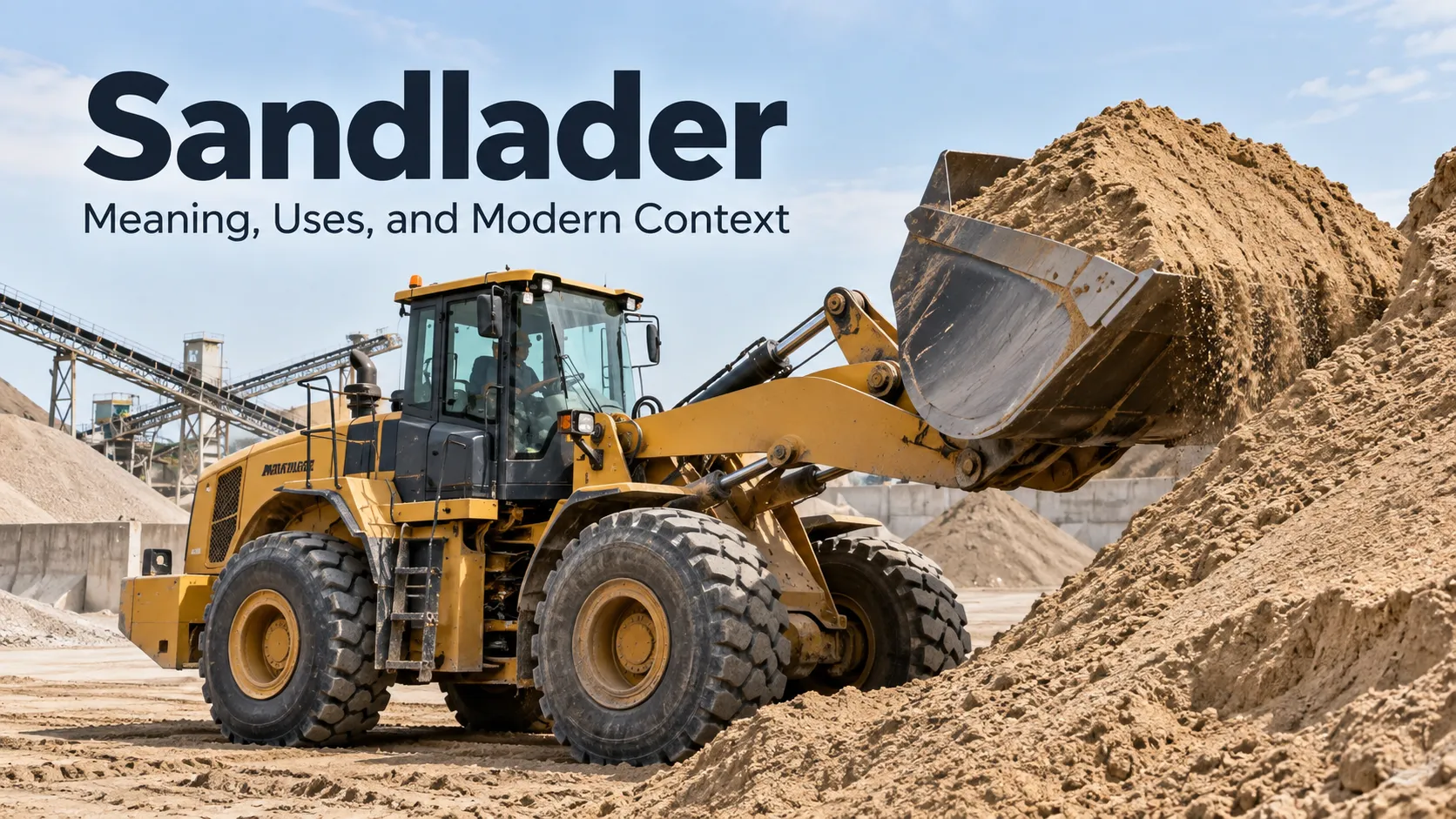
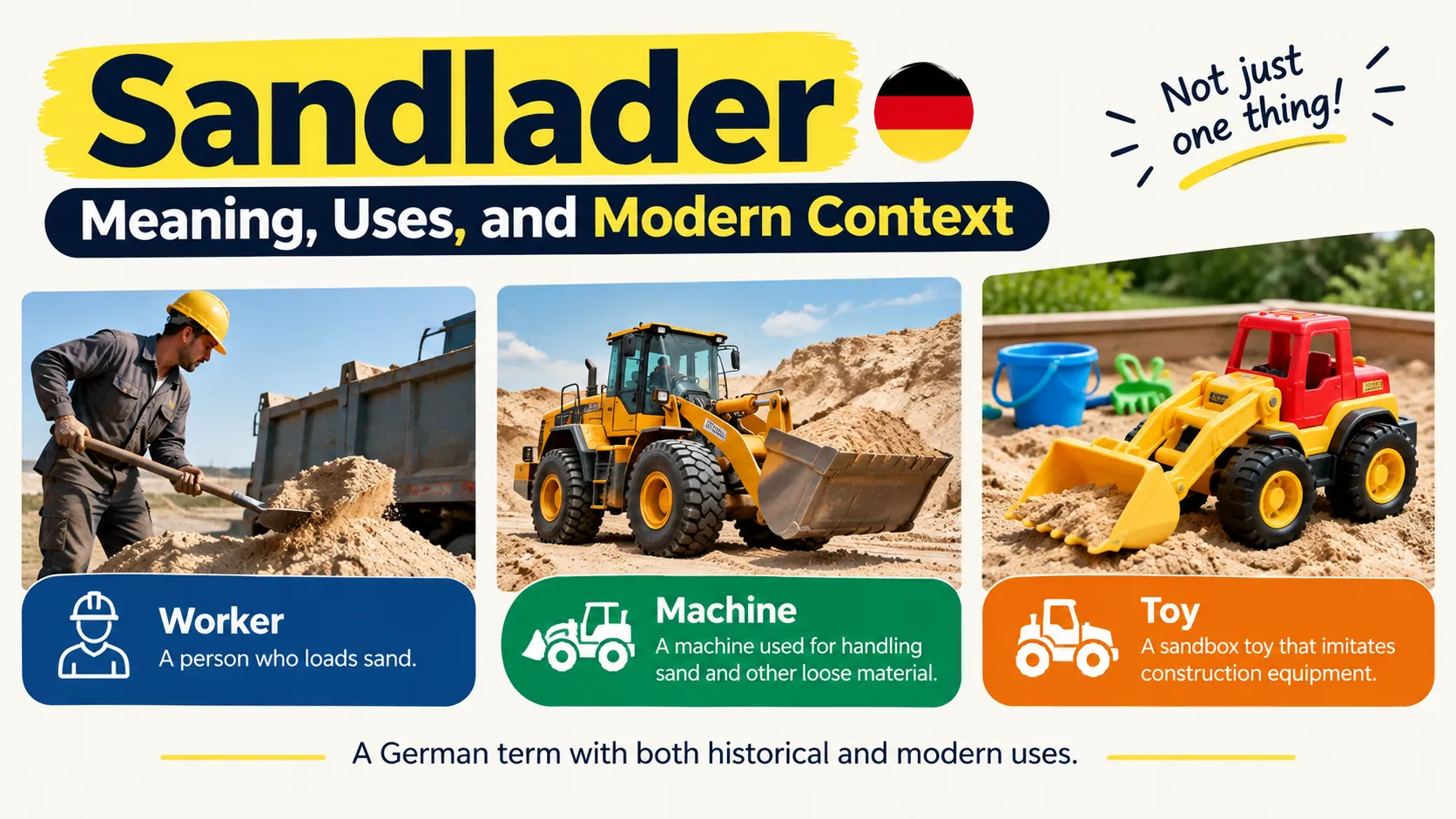
Sandlader is a German term that literally translates to “sand loader.” Depending on the context, it can describe a worker who loads sand, a machine used for handling sand and other loose material, or a sandbox toy designed to imitate construction equipment.
The word is unusual because it has both historical and modern uses. German occupational records document Sandlader as a transport-related job title, while toy manufacturers still use the name for children’s loaders and excavator-style sand toys. It should therefore not automatically be interpreted as the name of one specific product, company, or type of industrial machine.
What Does Sandlader Mean?
The German compound combines Sand, meaning sand, with Lader, meaning loader or someone who loads something. In straightforward English, the closest translation is sand loader.
Its exact meaning depends on where the term appears:
| Context | Meaning of Sandlader |
|---|---|
| Historical employment | A worker responsible for loading or moving sand |
| Construction or material handling | Informal description of a loader handling sand |
| Children’s toys | A toy loader, excavator, or sand-loading vehicle |
| Product name | A commercial name used by manufacturers for sandbox vehicles |
German occupational classifications provide particularly strong evidence for the first meaning. The Federal Employment Agency’s historical classification lists Sandlader among warehouse and transport occupations alongside terms such as Sandablader, Sandverlader, Kohlenlader, and Schrottlader.
Sandlader as a Historical Occupation
Before mechanized material handling became widespread, large quantities of sand, coal, stone, grain, and other bulk materials often had to be moved manually or with relatively simple equipment. A Sandlader was one of the workers involved in this process.
Germany’s 1975 occupational classification placed Sandlader in occupational group 744, covering warehouse and transport workers. The classification also included related occupations such as Sandfahrer, Sandkarrer, Sandträger, and Sandverlader.
A more detailed 1980 classification identifies Sandlader as a Lager- und Transportarbeiter, or warehouse and transport worker, with classification code 7445.
Historical industrial records indicate that the term was not merely theoretical. A 1927 wage document for a Silesian glass manufacturing operation listed Sandlader alongside occupations such as Sandwäscher, Glaswäscher, packers, machine operators, and other factory workers. This suggests that loading sand was a distinct industrial task in operations where sand was an important raw material.
What Would a Sandlader Have Done?
The precise work depended on the industry and period, but the basic responsibility was handling and loading sand for storage, transportation, or production.
Possible tasks could have included moving sand into carts, wagons, containers, processing areas, or other transport systems. In industries such as glass manufacturing, foundries, construction-material production, and mineral handling, large volumes of sand had to move through several stages before use.
It is important not to assume that every historical Sandlader performed exactly the same duties. The occupational classifications establish the role as a loading and transport occupation, but individual workplaces could have organized the work differently.
What Does Sandlader Mean in Construction Today?
When the word is used around modern construction equipment, Sandlader can simply describe a loader that is moving sand. It is not generally the primary technical category used by major construction-equipment manufacturers.
Modern machines performing this work are more commonly described as wheel loaders, compact wheel loaders, loading shovels, skid-steer loaders, or similar equipment depending on their design.
Wheel loaders use front-mounted buckets to scoop, lift, carry, stockpile, and load loose materials. Caterpillar describes wheel loaders as machines capable of efficiently moving large quantities of materials such as soil, gravel, rubble, debris, and dirt.
Manufacturers also produce buckets specifically designed for aggregate work. Caterpillar, for example, lists sand and gravel buckets intended for aggregate-handling applications.
How a Modern Sand-Loading Machine Works
A typical wheel loader approaches a stockpile with its bucket lowered. The operator drives the cutting edge into the material, raises and tilts the bucket, then transports the load to a truck, hopper, stockpile, or processing system.
The basic cycle is:
- Approach the sand pile.
- Fill the bucket.
- Raise and secure the load.
- Travel to the discharge point.
- Empty the bucket.
- Return for another loading cycle.
The machine selected depends on the amount of material being handled, required lift height, available space, bucket size, ground conditions, and the distance the material must be moved.
Caterpillar notes that factors such as bucket load, lift height, tipping capacity, and the machine’s intended application are important when configuring a wheel loader.
Sandlader as a Children’s Sand Toy
One of the clearest modern uses of the exact word Sandlader is in children’s outdoor toys.
A Sandlader in this context is generally a small plastic construction vehicle equipped with a bucket, scoop, handle, or movable loading mechanism. Children can use it to collect and move sand in a sandbox or at the beach.
A current example comes from Austrian toy manufacturer GOWI. The company’s official sand-play range lists product 334-00306 (560-09) simply as Sandlader.
GOWI’s product catalogue describes the Sandlader as suitable from 12 months and gives dimensions of approximately 22 × 20 × 11 cm.
This shows that when someone searches for “Sandlader” while shopping for children’s products, they may be looking for this type of hand-operated sandbox loader rather than industrial equipment.
Larger Sandlader Toys Also Exist
Sandlader is not limited to small handheld toys.
Wader’s 2026 catalogue includes a product described in German as Gigant Traktor Sandlader. It is a much larger toy tractor with a front loader, measuring approximately 60 × 36 × 32 cm and carrying an age indication of 1+. The catalogue also states a maximum load figure of 100 kg for the product.
This illustrates how broadly the term is used in the toy market. It can describe anything from a small hand-operated sand scoop vehicle to a much larger ride-on or push-style tractor loader.
Sandlader vs. Bagger, Radlader, and Frontlader
These terms can look similar in product descriptions, but they are not always interchangeable.
Sandlader
A descriptive term centered on the material being handled, namely sand. It may describe a person, toy, or loading machine depending on context.
Radlader
The German term for a wheel loader. This is the more precise machinery term for a wheeled construction vehicle with a front bucket designed primarily for loading and moving material.
Bagger
Usually means excavator. An excavator normally uses a boom, stick, and bucket to dig below or around its operating position. The machine’s working motion is different from that of a front-loading wheel loader.
Frontlader
Literally “front loader.” Depending on context, this may refer to a front-mounted loading attachment or a machine equipped with one.
Toy retailers sometimes use several of these words relatively loosely because a toy may combine visual features of an excavator, tractor, and loader. Industrial equipment terminology is more specific.
Where Sand Loaders Are Used
Real material-loading equipment capable of handling sand has a much wider range of applications than the name Sandlader might suggest.
Typical environments include construction sites, concrete and asphalt plants, quarries, aggregate yards, landscaping operations, road-building projects, ports, industrial storage yards, and recycling or bulk-material facilities.
Volvo Construction Equipment describes wheel-loader applications that include truck loading, stockpiling, hopper charging, rehandling, and load-and-carry operations.
Sand presents its own operating considerations. It is loose, can shift easily, produces dust when dry, and may become substantially heavier when wet. Equipment size, bucket design, tire choice, visibility, stability, and operating conditions therefore matter when selecting machinery for professional material handling.
How to Identify What “Sandlader” Means on a Page
The surrounding words usually make the intended meaning clear.
If the page mentions Beruf, Arbeiter, Transportarbeiter, occupation, employment, factory, or historical records, Sandlader probably refers to a worker.
If it mentions Radlader, bucket, construction, aggregate, loading, truck, quarry, or machinery, it probably refers to material-handling equipment.
If the page contains Spielzeug, Sandkasten, Kinder, Monate, Jahre, GOWI, tractor, toy, or beach, the term almost certainly describes a children’s sand-loading toy.
That distinction matters because specifications, safety considerations, prices, and intended uses differ completely between the three categories.
Is Sandlader a Brand Name?
No evidence from the reviewed sources indicates that Sandlader itself is one specific brand. Instead, the term is used descriptively and appears across historical occupational records and products from different manufacturers.
For example, GOWI uses Sandlader as a product name in its sand-play range, while Wader uses the word in the name of a separate toy tractor.
A product labeled “Sandlader” should therefore be identified by its manufacturer, model number, dimensions, and specifications rather than by assuming the term points to one particular product.
Why the Word Still Appears Online
The continued appearance of Sandlader comes from several overlapping sources.
Historical records preserve it as an occupational term. German-language retailers and manufacturers use it for sandbox loaders. Machine-translated or localized construction-game descriptions may also use Sandlader for sand-moving equipment.
Search results can consequently mix employment archives, toys, construction machinery, games, and product listings. Understanding the context is more useful than treating every result as referring to the same object.
FAQ
What is a Sandlader?
A Sandlader literally means a sand loader. Historically, it referred to a worker who loaded or transported sand, while today the word can also describe sand-loading machinery or children’s sandbox loader toys.
Is Sandlader a German word?
Yes. It is formed from the German words Sand and Lader. The most direct English equivalent is “sand loader.”
Was Sandlader a real occupation?
Yes. German occupational classifications from the 1970s and 1980s list Sandlader among warehouse and transport occupations, and historical industrial records also contain the job title.
Is a Sandlader the same as a wheel loader?
Not exactly. A wheel loader can function as a sand loader when it handles sand, but Sandlader is a descriptive term rather than a precise modern machine category. Professional equipment manufacturers normally classify such machinery by designs such as wheel loaders and their specific attachments.
What is a Sandlader toy?
It is a sandbox construction toy designed to scoop, carry, push, or dump sand. GOWI currently lists a Sandlader measuring 22 × 20 × 11 cm and intended for children from 12 months, while other manufacturers sell larger loader-style toys.
Does Sandlader refer to one particular product?
No. The term appears in occupational records and is also used by multiple toy manufacturers. The manufacturer and model number need to be checked when identifying a specific Sandlader product.
Also Read: HMRC Savings Tax Letter | What It Means and What to Do
