


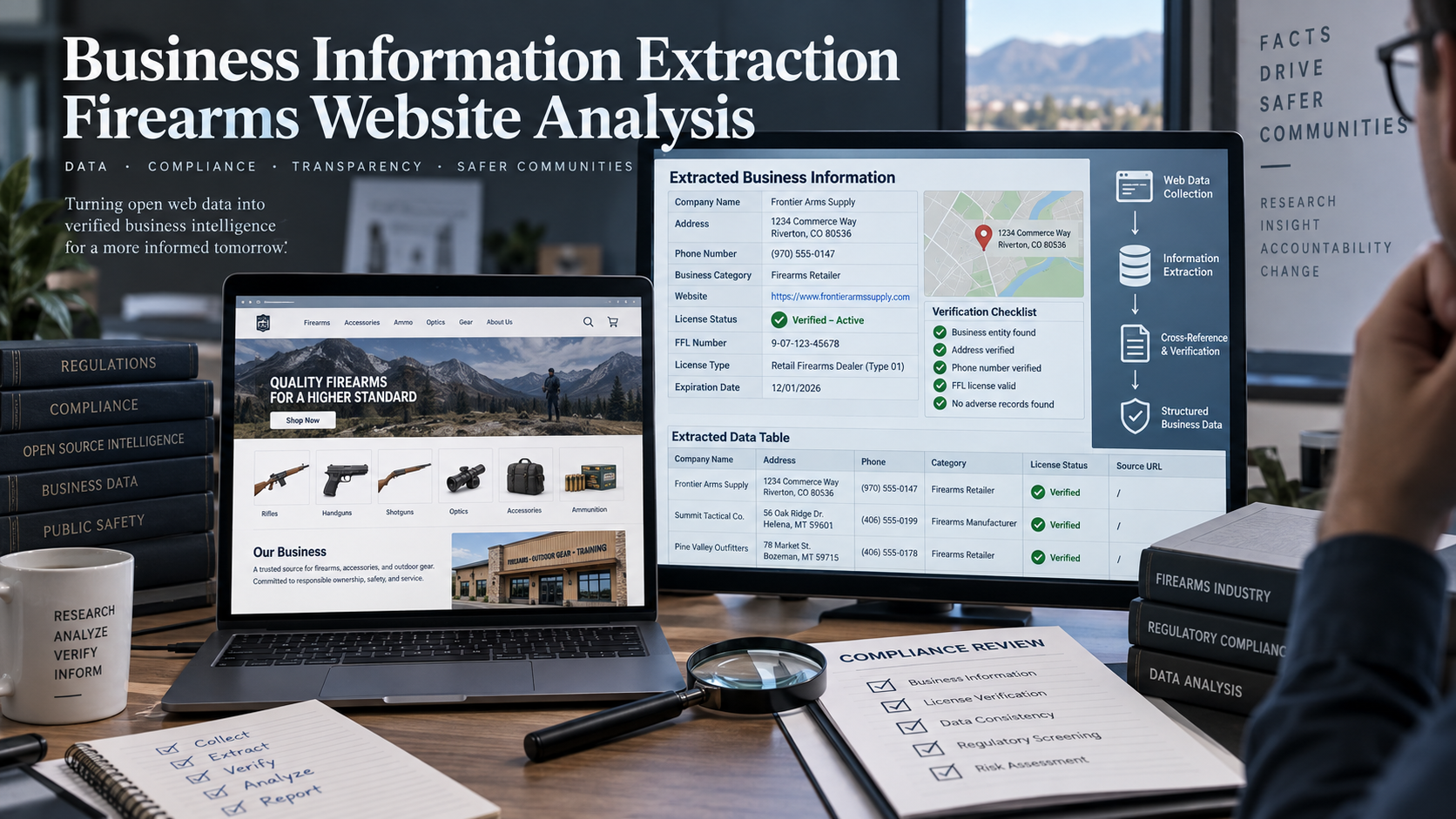
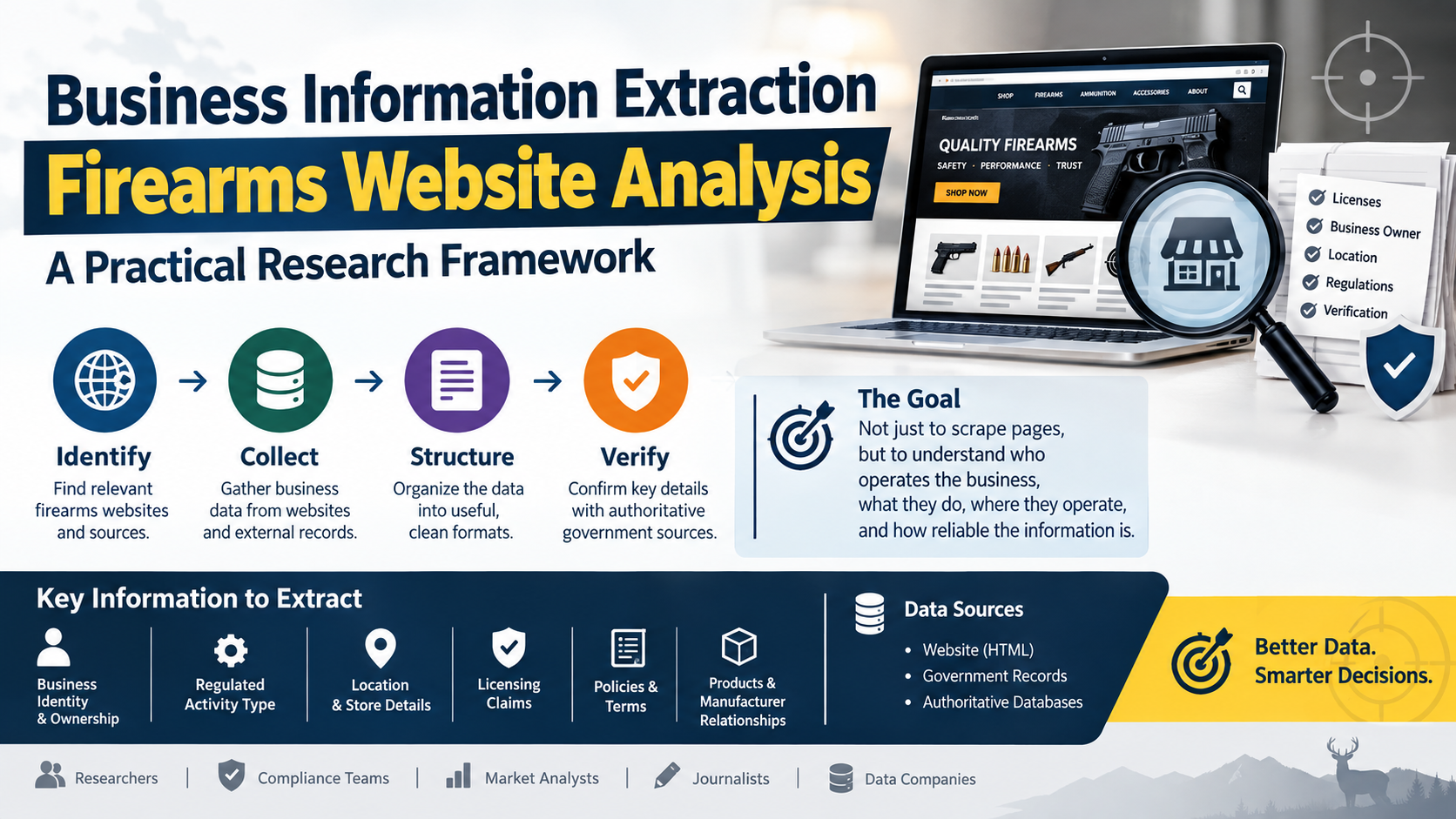
Business information extraction firearms website analysis is the process of identifying, collecting, structuring, and verifying public business information from firearms-industry websites and authoritative external records. The goal is not simply to scrape pages, but to determine who operates a business, what type of regulated activity it performs, where it operates, whether its claimed identity can be independently verified, and how reliable the available data actually is.
For researchers, compliance teams, market analysts, journalists, and data companies, firearms websites present an unusual challenge. A site may mix corporate information, store locations, product catalogs, manufacturer relationships, licensing claims, policies, and marketing content. Some facts can be extracted directly from HTML, while important regulatory facts should be checked against government sources rather than accepted at face value.
What Business Information Extraction Firearms Website Analysis Actually Means
The keyword combines two related tasks.
Business information extraction means converting unstructured website content into organized fields such as business name, trade name, address, telephone number, website, ownership information, license type, and operating category.
Firearms website analysis goes further. It evaluates the extracted information against regulatory records, website architecture, structured metadata, public corporate records, and other reliable sources to determine whether the business identity is coherent and current.
A basic extraction system might find a company name and telephone number. A proper analysis should answer a harder question: Does this website appear to represent the business it claims to represent, and which parts of that claim can be independently verified?
That distinction matters in the U.S. firearms industry because federal licensing is central to many commercial activities. ATF states that businesses engaged in dealing, manufacturing, or importing firearms, or manufacturing or importing ammunition, generally require the appropriate Federal Firearms License, subject to the applicable statutory and regulatory rules.
Why Firearms Websites Require More Careful Entity Verification
Ordinary business websites can often be analyzed using the company name, contact page, corporate registration, and domain information. Firearms businesses introduce an additional regulatory identity layer.
ATF recognizes several categories of Federal Firearms Licenses. They include dealer, pawnbroker, manufacturer, importer, and collector categories, with separate license types depending on the activity involved.
This means a website describing itself as a “firearms company” tells an analyst very little by itself. It might represent a retailer, gunsmith, manufacturer, importer, ammunition manufacturer, collector-related operation, or another business whose activities require different regulatory treatment.
ATF reported 127,407 Federal Firearms Licensees in fiscal year 2025, down from 128,716 in FY2024. That figure covers a large and fragmented regulated ecosystem, making accurate entity matching important for any nationwide firearms-business dataset.
The Most Useful Information to Extract
A useful firearms-business record should separate information stated by the website from information independently confirmed elsewhere.
| Data field | Typical website source | Preferred verification source |
|---|---|---|
| Business or legal name | Homepage, footer, About page | ATF data, corporate registry |
| Trade name | Branding, footer, legal pages | ATF licensing record where applicable |
| Physical address | Contact or location page | ATF record, state record, verified business listing |
| Telephone number | Header, footer, contact page | Official business profiles or government records |
| Website/domain | Site itself | Cross-reference with official business identity |
| Business category | About, services, navigation | ATF license classification where relevant |
| FFL status | Licensing or policy page | ATF records or FFL eZ Check |
| License type | Compliance information | ATF |
| Email/contact channel | Contact page | Website-controlled source |
| Store or branch locations | Location pages | Individual address verification |
| Hours | Location page or structured data | Current website or verified business profile |
| Company relationships | About page, brand pages | Corporate records and official company disclosures |
| Structured metadata | JSON-LD, HTML markup | Compare with visible website content |
Not every website will expose every field, and missing information should remain missing rather than being guessed.
That principle is especially important for ownership. A brand name, website copyright notice, domain registrant, parent company, and federal licensee name may all be different entities. They should not automatically be merged.
Start With the Website’s Structured Data
Modern websites frequently include machine-readable information through Schema.org markup, particularly JSON-LD.
Google recommends Organization and LocalBusiness structured data for communicating business information such as names, addresses, telephone numbers, URLs, and real-world locations. Schema.org’s LocalBusiness vocabulary similarly supports properties such as legal name, address, telephone number, location, tax identifiers, and organizational relationships.
For extraction purposes, structured data can therefore provide a high-quality first pass.
An analyst might discover:
namelegalNameurltelephoneemailaddresslogosameAsparentOrganization
However, structured data should be considered a claim made by the publisher, not independent proof.
A website could contain outdated JSON-LD even after its visible address has changed. Another could have multiple branches but only one address embedded in its metadata. The extracted values should be compared with visible pages and authoritative sources.
Examine the Website Beyond the Homepage
The homepage is often the worst place to perform detailed business extraction because it is optimized for marketing rather than corporate disclosure.
Higher-value information frequently appears on About, Contact, Locations, Terms, Privacy, Returns, Dealer Information, Shipping, Careers, corporate, and legal pages.
Website-wide analysis can also reveal whether different pages use inconsistent names or addresses.
For example, suppose the homepage identifies a company as Example Arms, the privacy policy names Example Holdings LLC, and the contact page identifies a physical location in another state. That does not automatically indicate a problem. It signals that the entities and relationships require investigation.
The analyst should determine whether Example Arms is a trade name, whether Example Holdings LLC is the legal operator, and whether the location corresponds with an appropriate official record.
Verify Federal Firearms Licensing Separately
One of the strongest data sources available for U.S. firearms-business research is ATF’s Federal Firearms Licensee information.
ATF maintains a Federal Firearms Listings service offering complete FFL lists and state or territory-specific listings. ATF says its public data covers federally licensed manufacturers, dealers, collectors, and importers and provides listings by state for calendar months.
ATF also provides the FFL eZ Check system for license verification. When an eligible license is successfully verified, the system can display information including the license name, trade name, expiration date, premises address, and mailing address. ATF notes that eZ Check does not validate Type 03 collector or Type 06 ammunition manufacturer licenses.
That limitation is important. A failed eZ Check query is not automatically evidence that a business lacks any valid federal license.
Do Not Treat Website FFL Claims as Self-Verifying
If a firearms website displays an FFL number, license graphic, “licensed dealer” statement, or similar language, an analyst should record the claim but verify it independently.
Useful comparison points include:
| Website claim | Verification question |
|---|---|
| Company name | Does the official license use the same legal or trade name? |
| Address | Does it match the licensed premises? |
| License category | Is the business activity consistent with the license type? |
| Expiration claim | Is the license currently valid according to the appropriate official source? |
| Branch | Is the location associated with the same entity or a separate licensed location? |
Minor variations do not necessarily indicate deception. LLC suffixes, punctuation, abbreviations, and trade names commonly differ across datasets.
Entity resolution therefore requires judgment rather than simple exact-text matching.
A 2026 Regulatory Detail Shows Why Fresh Verification Matters
Regulatory information can change quickly enough that historical articles or cached compliance pages should not be treated as current law.
In May 2026, ATF published a direct final rule that would have expanded use of FFL eZ Check for certain license-verification purposes. The proposal was scheduled to take effect in August. However, ATF received adverse comments and withdrew the direct final rule effective July 6, 2026.
A researcher relying only on the May announcement could therefore reach the wrong conclusion in September 2026.
This is a useful lesson for firearms website analysis generally: regulatory statements should be verified against the latest ATF rulemaking or other current official authority before publication.
Entity Resolution Is the Hardest Part of the Analysis
Extracting text is relatively easy. Determining whether two records describe the same real-world business is harder.
Consider these variations:
North Valley Sporting LLC
North Valley Sporting
North Valley Outdoors
North Valley Sporting LLC DBA North Valley Outdoors
A weak extraction system may create four businesses.
A stronger system compares normalized names, addresses, phone numbers, domains, trade names, government identifiers, and organizational relationships.
The result should include a confidence level rather than pretending that every match is certain.
A sensible internal classification might be:
Confirmed: multiple authoritative identifiers match.
Highly probable: name plus address or telephone strongly match.
Possible: some similarities exist but important identifiers are missing.
Unresolved: evidence is insufficient or conflicting.
This approach is particularly useful when building large business directories or research databases.
Website Technology Can Affect Extraction Accuracy
Not every fact visible in a browser exists directly in the initial HTML.
Google explains that modern web pages can rely on JavaScript and that its own crawling process renders pages to process dynamically generated content.
An extraction system that downloads only raw HTML can therefore miss information rendered after page load.
Other complications include location selectors, embedded maps, separate mobile interfaces, accordion panels, pagination, dynamically loaded branch directories, and content generated from third-party services.
For large-scale analysis, the extraction pipeline should distinguish between raw HTML content and rendered content.
Respect Crawling Controls and Access Boundaries
Automated website analysis should also include a compliance layer.
A website’s robots.txt file communicates which URLs supported crawlers are allowed to request. Google describes robots.txt primarily as a crawler-management mechanism and notes that it is not, by itself, a method for keeping ordinary webpages out of Google’s index.
Researchers should nevertheless inspect robots.txt and site terms before conducting automated collection.
The legal status of scraping cannot be reduced to a single rule. The U.S. Supreme Court’s Van Buren v. United States decision adopted a narrower interpretation of “exceeds authorized access” under the Computer Fraud and Abuse Act, focusing on accessing computer areas that are actually off-limits. The Justice Department’s current CFAA charging policy also states that prosecutors should not base an “exceeds authorized access” case solely on violation of an ordinary website contractual restriction or term of service.
That does not mean all scraping is automatically lawful. Contract, copyright, privacy, state law, access-control circumvention, or other legal issues may still arise. Organizations conducting large-scale collection should obtain legal guidance appropriate to their project and jurisdiction.
Separate Public Business Data From Personal Information
Firearms website analysis should focus on legitimate business information rather than unnecessarily collecting personal data.
The difference matters when a small business uses an individual’s name, residential-style address, personal telephone number, or other information that may also identify a private person.
The FTC notes that information available from public records and publicly visible online sources can still be collected and combined by data brokers. Public availability therefore does not automatically remove privacy concerns associated with aggregation and redistribution.
A well-designed dataset should collect only the fields needed for the stated research purpose.
A Reliable Extraction and Verification Workflow
For serious research, the process is best understood as several connected layers rather than one scraper.
First, identify the canonical website and discover relevant corporate, contact, location, policy, and legal pages.
Next, extract visible text, HTML metadata, JSON-LD, organization markup, addresses, contact information, and business names.
Then normalize those values. Convert telephone numbers into a consistent format, standardize state names, separate street and postal fields, remove superficial corporate-name differences, and preserve both legal names and trade names.
After normalization, match the website record against authoritative records such as ATF’s license listings and relevant corporate registries.
Finally, calculate confidence and preserve the evidence supporting each field.
That last step is critical. A professional database should not merely store:
Business address: X
It should know whether X came from the website footer, structured data, ATF records, or several matching sources.
What AI Can and Cannot Do Well
Large language models can improve information extraction because they understand context that traditional regular expressions frequently miss.
An AI system can often recognize that “Our family has served hunters and sport shooters since 1985” is company history, while “1985 Highway 24” is part of an address. It can identify legal-name relationships, classify page content, summarize services, and compare conflicting descriptions.
But AI should not be the final authority for regulated-business facts.
Models can misread incomplete pages, merge similarly named organizations, interpret outdated information as current, or confidently infer missing relationships.
The strongest architecture uses AI for interpretation and official databases for confirmation.
Indicators of a Higher-Quality Business Record
A high-confidence firearms-business profile usually has strong agreement between the website and independent records.
The business name or trade name is consistent across sources. The contact information is coherent. The claimed business category does not conflict with available official information. The website appears maintained rather than abandoned. Important regulatory claims can be independently checked. Historical changes are dated rather than overwritten without context.
By contrast, inconsistent identities, unverifiable claims, conflicting addresses, copied legal pages, missing business information, or unclear ownership relationships should lower confidence.
None of those factors alone proves misconduct. They simply indicate that more verification is required.
Common Errors in Firearms Website Analysis
One major error is assuming the website’s branding represents the legal company name. Trade names frequently differ from license-holder names.
Another is treating every address as a licensed premises address. A company may display corporate offices, mailing addresses, warehouses, stores, or other locations.
Researchers also make mistakes by relying on stale search-engine snippets, old cached pages, outdated directories, or screenshots when an authoritative source has newer information.
Perhaps the most serious analytical mistake is converting uncertainty into certainty. If ownership cannot be verified, the correct database value is “unconfirmed,” not an inferred owner.
FAQ
What is business information extraction firearms website analysis?
It is the structured collection and verification of public business information from firearms-industry websites. It commonly involves identifying company names, trade names, addresses, business categories, contact details, organizational relationships, and applicable licensing information.
How can a firearms business’s FFL information be verified?
ATF publishes Federal Firearms Licensee listings and operates FFL eZ Check for certain license types. The website’s own licensing claims should be compared with current official records rather than accepted as independent proof.
Does every firearms-related website need an FFL?
No. Whether a federal license is required depends on what the person or business actually does. ATF states that engaging in the business of dealing, manufacturing, or importing firearms, or manufacturing or importing ammunition, can trigger federal licensing requirements, while different activities are governed by different rules.
Can structured data be used to extract business information?
Yes. Schema.org and Google-supported Organization or LocalBusiness markup can expose structured fields such as business name, address, telephone number, URL, and related organizational information. Those fields should still be compared with visible content and authoritative records.
Is automated extraction from public websites automatically legal?
No universal rule makes all automated extraction lawful. U.S. federal CFAA precedent and DOJ policy provide important guidance about unauthorized computer access, but other contract, privacy, copyright, state-law, and technical-access issues can still matter.
What is the biggest challenge when building a firearms-business database?
Entity resolution is usually harder than basic scraping. The researcher must determine whether legal names, trade names, domains, addresses, branches, and federal license records refer to the same real-world entity while preserving uncertainty when the evidence is incomplete.
Also Read: Safe Trails Task Force Fremont County | What It Is and What It Actually Does

2 Comments
Pingback: Home Warranty Choice Home Warranty Review 2026 | Coverage, Cost, Claims and Complaints
Pingback: PedroVazPaulo Business Consultant | Services, Legitimacy, and What to Verify in 2026