


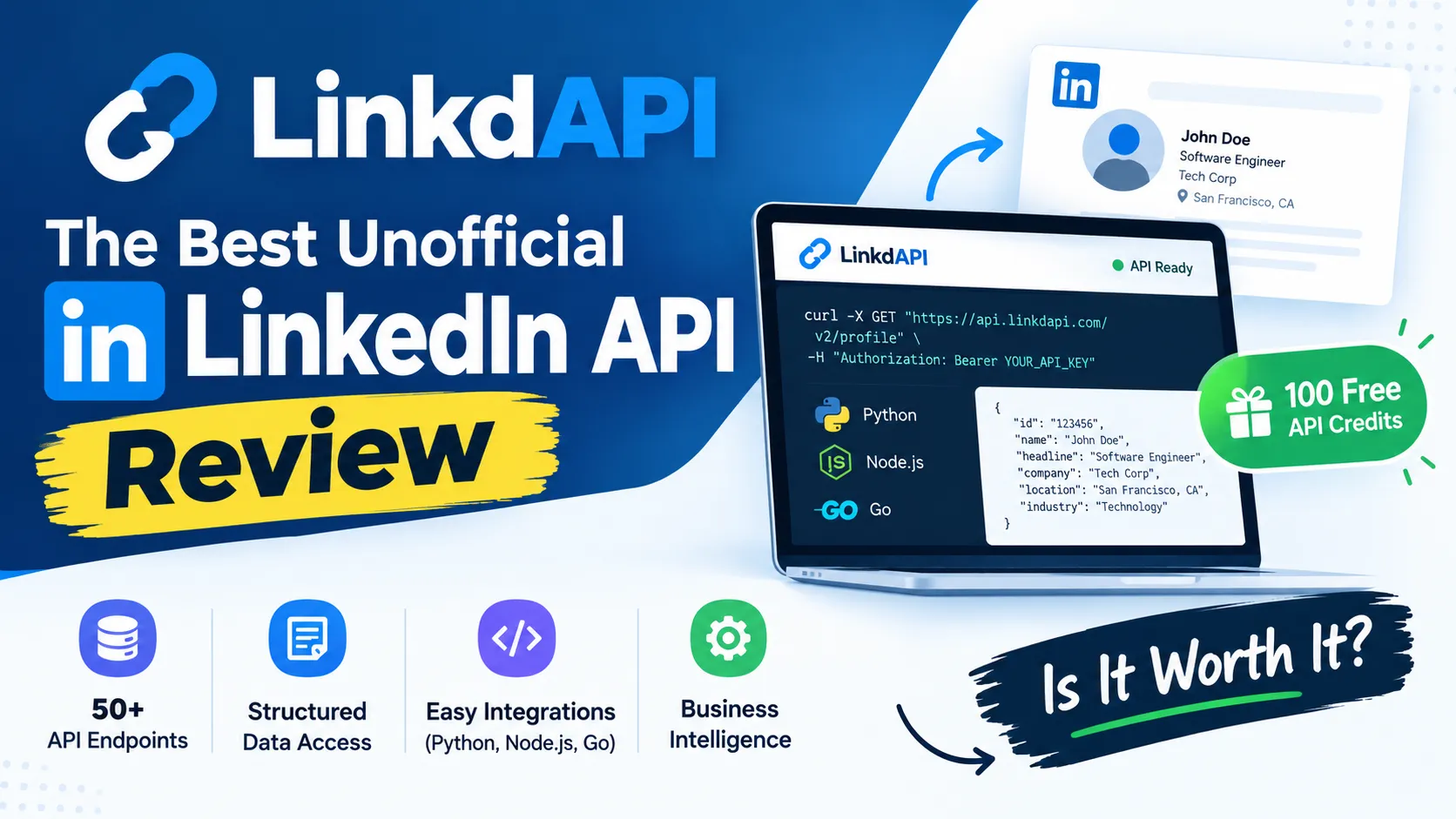
LinkdAPI.com is an independent API platform that provides structured professional and business data for developers, CRM systems, and business intelligence workflows. It markets itself as an alternative for accessing professional data programmatically, but it is not an official LinkedIn API, and using it does not automatically authorize data collection under LinkedIn’s rules.
For businesses that need to enrich company records, build professional-data applications, or automate research workflows, LinkdAPI may be worth evaluating. The important questions are what data it actually provides, how much it costs, whether the information is accurate, and whether the intended use complies with privacy laws and the relevant platform terms.

What Is LinkdAPI.com?
LinkdAPI is a third-party API service focused on professional data enrichment and business intelligence. According to its documentation, it offers more than 50 API endpoints, structured data access, and integrations for developers using Python, Node.js, and Go. The platform also advertises 100 free API credits for new users.
An API, or application programming interface, allows one software application to request information from another service in a structured format. Instead of manually copying information into a spreadsheet, a developer can build a workflow that requests available data and processes the response automatically.
For example, a company might use a professional-data API to enrich its CRM records with publicly available business information. The usefulness of that workflow depends on which fields LinkdAPI supports, how current its data is, and whether the company has a lawful basis to collect and use the information.
Key Features of LinkdAPI
LinkdAPI’s documentation describes several endpoint categories for retrieving professional profiles, company information, job listings, posts, and related business data. These features make it relevant to sales intelligence, recruitment research, business analytics, and CRM enrichment.
1. Professional Profile Data
The profile endpoints can return information such as a person’s professional headline, employment history, education, skills, and certifications. The availability of specific fields depends on the endpoint and the underlying data.
2. Company Intelligence
Company endpoints support lookups and retrieval of business details, employee insights, company posts, and related company information. Sales teams can use these results to enrich account records and organize prospect research.
3. Job Search and Recruitment Data
The documented job endpoints support searches using criteria such as keywords, employment type, experience level, location, and posting date. Recruiters can use this information to investigate hiring trends and identify relevant opportunities.
4. Posts and Engagement Information
The API documentation includes endpoints for posts, comments, reactions, and other activity-related data. Availability varies by endpoint, and access to this information should not be interpreted as permission to collect or reuse it without appropriate rights.
Feature descriptions are based on LinkdAPI’s published documentation. They are not independent guarantees of completeness, accuracy, or continued availability.
How Does LinkdAPI Work?
LinkdAPI follows a conventional API workflow. A developer obtains an API key, selects an endpoint, supplies the required parameters, and sends an HTTPS request. The service returns a structured response, generally in JSON format, which the application can process.
A typical integration involves the following steps.
- Create an account. Visit LinkdAPI.com and review the available access options.
- Obtain an API key. Follow the service’s authentication instructions and keep the key private.
- Choose an endpoint. Read the API documentation to find the endpoint and required parameters for your task.
- Make a request. Send the request from your backend or another appropriate server-side environment.
- Process the response. Validate the returned fields before saving them to a CRM, analytics system, or application.
- Monitor usage. Track credit consumption, rate limits, error responses, and data quality.
For production systems, API credentials should be stored in environment variables or a secrets manager rather than embedded in public-facing JavaScript. Applications should also handle timeouts, rate-limit responses, missing fields, and temporary service interruptions.
LinkdAPI Pricing and Free Credits
LinkdAPI uses a credit-based usage model. Its official documentation advertises 100 free credits for new users, while its credit guide explains that the number of credits available per dollar and the permitted request rate vary according to the account’s credit tier.
The published credit guide describes these tiers.
| Credit tier | Credits held | Requests per minute |
|---|---|---|
| Testing | 0–99 | 7 |
| Hobby | 100–9,999 | 30 |
| Developer | 10,000–29,999 | 70 |
| Startup | 30,000–59,999 | 90 |
| Growth | 60,000–99,999 | 150 |
| Scale | 100,000–299,999 | 250 |
| Business | 300,000–599,999 | 350 |
| Ultra | 600,000–999,999 | 450 |
| Strategic Partner | 1,000,000+ | 550 |
Source: LinkdAPI’s credit system guide, updated April 27, 2026.
These figures describe the tiers published by the provider, not a guarantee that every endpoint can be called at the maximum rate in every circumstance. The documentation lists a default cost of one credit per request, but users should check the endpoint pricing reference for the specific operation they plan to use.
Before purchasing credits, estimate the number of requests your application will make, the cost of each endpoint, and the frequency of repeated lookups. A workflow that requests full profiles, for example, may have different costs from one that performs lightweight company searches.
Also Read: SearchSource Explained: Meaning, Uses, and Key Features
What Can You Use LinkdAPI For?
The platform is most relevant when an application needs structured professional or business information rather than manually browsing individual pages.
Sales and CRM enrichment: A business can use appropriate data fields to supplement existing company records, identify missing information, and organize account research. It should verify important fields before using them for business decisions.
Recruitment and talent research: Recruiters may use supported profile and job endpoints to examine employment backgrounds, skills, and hiring activity. Personal data should be collected and processed only for an appropriate, lawful purpose.
Business intelligence: Analysts can combine permitted company information with internal business data to study market segments, compare organizations, or support account planning.
Software development: Developers can integrate structured responses into internal dashboards, research tools, or other applications. The service’s published SDK options and JSON response format may reduce some integration work.
LinkdAPI is not automatically the right choice for every project. A business that only needs to display its own LinkedIn company page or enable a member-authorized login may be better served by LinkedIn’s official developer products.

Is LinkdAPI an Official LinkedIn API?
No. LinkdAPI’s terms describe it as an independent data platform that is not affiliated with, endorsed by, or sponsored by third-party platforms. Its service is therefore distinct from APIs offered through LinkedIn’s own developer program.
The distinction is important because an API can return professional information without being an authorized LinkedIn integration. The word unofficial describes the provider’s relationship with LinkedIn, not whether every possible use of the service is lawful or compliant.
LinkedIn offers official APIs for approved use cases, subject to its developer terms, permissions, and access restrictions. Developers should check whether the official API provides the required functionality before relying on an independent data provider.
LinkedIn’s API Terms of Use also restrict how developers can access, store, display, and use LinkedIn content. Those rules matter even when a developer obtains data indirectly through another service.
LinkdAPI vs. the Official LinkedIn API
The main difference is the provider and the access model. LinkdAPI markets structured professional-data endpoints through its own service, while LinkedIn’s official API program grants access according to LinkedIn’s approved products, permissions, and developer terms.
| Comparison | LinkdAPI | Official LinkedIn API |
|---|---|---|
| Provider | Independent third party | |
| Access model | LinkdAPI account, API key, and credits | LinkedIn developer registration and applicable permissions |
| Professional data | Multiple profile, company, job, and activity endpoints advertised | Data and features depend on approved API products and permissions |
| Pricing model | Credit-based usage | Depends on the API product and applicable program terms |
| Platform authorization | Not an official LinkedIn integration | Provided through LinkedIn’s developer program |
| Compliance responsibilities | User must assess laws and relevant third-party terms | Developer must follow LinkedIn’s API and data-use terms |
Neither option should be selected solely on the number of endpoints advertised. The better choice depends on the required data, access permissions, permitted use, reliability, and total cost.
Is LinkdAPI Safe and Reliable?
LinkdAPI publishes a privacy policy and terms of service describing its handling of account information, API usage logs, credentials, and cached responses. These documents are useful starting points, but a provider’s own security statements do not independently prove that every control works as described.
Before using the service with business-critical or personal data, consider four areas.
Data Accuracy and Freshness
Professional information can change frequently. Job titles, employment history, company details, and contact information may be outdated, incomplete, or incorrectly matched to a person. Test representative records and compare results with reliable original sources before using the data at scale.
Privacy and Data Protection
Publicly accessible information can still be personal data protected by privacy law. Depending on the jurisdiction and purpose, a business may need a lawful basis for processing, a clear retention policy, a way to respond to correction or deletion requests, and safeguards against inappropriate use.
LinkdAPI’s terms place responsibility for downstream data use on customers and prohibit activities such as unlawful processing, harassment, and mass personal-data enrichment without a lawful basis where required.
API Keys and Application Security
Treat an API key like a password. Restrict access to the key, avoid exposing it in public repositories or browser code, and rotate it if you suspect it has been compromised. Monitor usage so that an exposed key does not generate unexpected requests or charges.
Service Availability
LinkdAPI’s terms state that it aims for 99.9% uptime but does not guarantee uninterrupted availability. They also reserve the right to change, suspend, or discontinue endpoints. Production applications should therefore include error handling, monitoring, and a fallback plan.
Does LinkdAPI Comply With LinkedIn’s Terms?
There is no basis for assuming that every use of LinkdAPI complies with LinkedIn’s terms simply because LinkdAPI is available as a commercial service. Compliance depends on how the data is sourced, what the user does with it, and which contractual and legal requirements apply.
LinkedIn expressly prohibits unauthorized scraping and automated access in its User Agreement and help documentation. It also restricts the use of content obtained through third parties in its API terms.
LinkdAPI says its data comes from publicly accessible sources and that it does not bypass authentication or technical access controls. That is the provider’s stated sourcing policy, not an independent legal determination that all of its data collection or all customer use cases are authorized by LinkedIn.
Businesses considering the service should review the current terms of both providers, identify the source and permitted use of the specific data they need, and obtain qualified legal advice where the consequences of noncompliance are significant.
Advantages and Limitations of LinkdAPI
LinkdAPI offers several practical benefits for developers, but the trade-offs deserve equal attention.
| Advantages | Limitations |
|---|---|
| Structured responses that applications can process | Data accuracy must be independently tested |
| Multiple endpoints for profiles, companies, jobs, and posts | Coverage may vary by record and endpoint |
| Python, Node.js, and Go integration options | Developers must maintain authentication and error handling |
| Free credits for initial testing | Production usage may require paid credits |
| Credit and rate-limit documentation | Endpoints and service availability may change |
| Can support automated business workflows | Does not automatically grant permission under LinkedIn’s terms |
The most important limitation is that technical access does not equal permission. A successful API response proves that a request returned data, not that the information is accurate, suitable for the intended purpose, or authorized for unrestricted reuse.
How to Get Started With LinkdAPI
If LinkdAPI appears suitable for your project, start with a small evaluation rather than committing to a large data workflow immediately.
- Visit LinkdAPI.com and review its current service terms and privacy policy.
- Read the getting-started documentation and identify the endpoint that matches your use case.
- Check the endpoint’s required parameters, credit cost, rate limits, and response fields.
- Test a limited set of records and check the accuracy and freshness of the results.
- Review privacy obligations and the applicable platform terms before collecting or storing personal data.
- Calculate expected usage costs and implement monitoring before deploying the integration.
For a first project, a small CRM enrichment workflow is often easier to evaluate than a large-scale data collection system. It gives a developer an opportunity to measure response quality, error rates, and actual credit consumption before expanding usage.
Frequently Asked Questions
1. What is LinkdAPI.com?
LinkdAPI.com is an independent professional-data API platform that provides endpoints for profile information, companies, jobs, posts, and related business intelligence. It is not an official LinkedIn product.
2. Is LinkdAPI free to use?
LinkdAPI advertises 100 free credits for new users. Additional usage follows its credit-based pricing model, so check the current endpoint costs and account terms before planning a production integration.
3. What programming languages does LinkdAPI support?
Its documentation identifies Python, Node.js, and Go as supported integration options. Developers can also work with the documented HTTPS endpoints and JSON responses.
4. Can LinkdAPI retrieve LinkedIn profile information?
Its documentation lists endpoints for professional profiles, employment history, education, skills, certifications, and other profile-related fields. The actual availability and accuracy of information can vary, and access should not be treated as permission to reuse personal data without appropriate authorization.
5. Is LinkdAPI legal to use?
That depends on the data, collection method, jurisdiction, and intended use. Users should assess privacy obligations and relevant third-party terms, including LinkedIn’s restrictions on unauthorized scraping and data use. The availability of a third-party API does not establish that every use is permitted.
6. What is the best alternative to LinkdAPI?
The most direct starting point is LinkedIn’s official developer platform, particularly if your application needs an approved LinkedIn integration. For professional-data enrichment, compare providers based on the exact fields you need, source transparency, permitted uses, data quality, pricing, and service reliability rather than endpoint count alone.
