


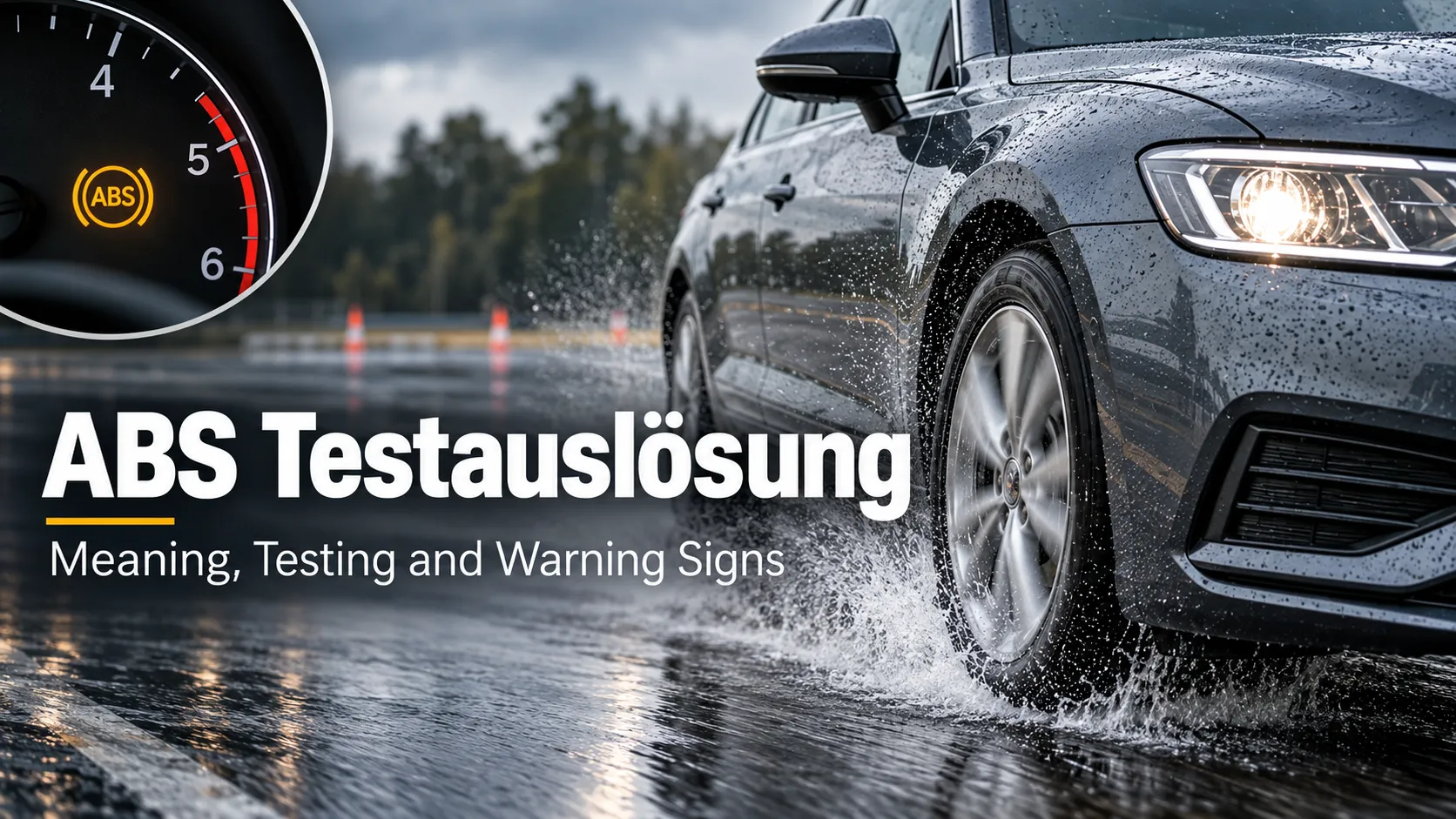
ABS Testauslösung is a German term that means “ABS test activation” or “ABS test triggering.” In automotive contexts, it generally refers to checking or deliberately activating a vehicle’s anti-lock braking system to verify that its electronic and hydraulic components work correctly.
The term can describe an automatic self-check, a diagnostic test performed by a mechanic, or a controlled braking test. However, it is not a universal vehicle fault code, and its exact meaning depends on the situation.
Understanding ABS Testauslösung helps drivers recognize normal brake system behavior, identify possible faults, and know when professional inspection is necessary. A short clicking sound after starting a vehicle may be harmless, while a persistent ABS warning light could indicate a safety-related problem.

What Is ABS Testauslösung?
ABS stands for Antiblockiersystem, the German name for the anti-lock braking system. Its primary purpose is to prevent the wheels from locking during heavy braking, allowing the driver to maintain better steering control.
The word Testauslösung describes the triggering or activation of a test. When combined with ABS, it usually refers to a procedure that checks how the anti-lock braking system responds.
There are three situations commonly associated with this term.
| Type of ABS activity | What happens | Main purpose |
|---|---|---|
| Automatic self-test | The vehicle checks certain ABS functions during startup or initial movement | Detect system problems |
| Diagnostic activation | A technician uses compatible diagnostic equipment to command specific ABS components | Identify faults or support servicing |
| Controlled braking test | ABS operates during sufficiently hard braking under suitable test conditions | Verify actual braking behavior |
These processes are related, but they are not identical. An automatic self-test does not necessarily reproduce the conditions of an emergency stop, while a diagnostic tool may activate individual components without making the vehicle move.
How Does the Anti-Lock Braking System Work?
ABS is an electronic safety system that works together with a vehicle’s conventional brakes. It monitors wheel rotation and adjusts braking pressure when a wheel is approaching lockup.
Without ABS, excessive braking force can stop a wheel from rotating while the vehicle is still moving. A locked wheel slides across the road, reducing the driver’s ability to steer effectively.
ABS addresses this problem by controlling the hydraulic pressure applied to the brakes.
1. Wheel Speed Sensors Monitor Rotation
Most modern passenger vehicles have wheel speed sensors that provide information about wheel rotation.
These sensors send electrical signals to the ABS electronic control unit. The system uses this information to identify excessive wheel slip and detect when a wheel is likely to lock.
The sensors are also important to related systems, including electronic stability control and traction control.
Bosch identifies wheel speed sensors as essential components of modern braking and vehicle dynamics systems.
2. The ABS Control Unit Processes the Information
The electronic control unit continuously evaluates the incoming sensor signals while the system is operating.
When the calculated wheel behavior indicates impending lockup, the controller determines which wheel requires braking pressure adjustment.
The control strategy depends on the vehicle and ABS system design. It considers wheel rotation and changes in wheel speed rather than relying on a single fixed vehicle speed.
3. The Hydraulic Unit Regulates Brake Pressure
The hydraulic unit contains electrically controlled valves and, in conventional hydraulic ABS systems, a pump.
It can reduce, hold, and restore braking pressure at a wheel as required. These changes occur repeatedly while the system is preventing excessive wheel slip.
The result is improved steering control during hard braking, although the available tire grip still determines how effectively the vehicle can slow down.
Bosch explains this operating principle in its technical overview of anti-lock braking systems.
When Does ABS Testauslösung Occur?
The timing and behavior of an ABS test depend on the vehicle manufacturer, model, and braking system.
Some checks take place when the ignition is switched on. Others may occur when the vehicle begins moving or when its control system determines that a particular component should be checked.
During Vehicle Startup
When a driver starts a vehicle, the ABS warning light commonly illuminates briefly as part of the instrument cluster’s system check.
If the relevant checks complete normally, the light should turn off according to the manufacturer’s specified sequence.
This short illumination does not automatically indicate a fault.
However, a warning light that remains illuminated after startup requires attention. A warning light that never illuminates during a required startup check may also indicate a problem.
Toyota’s owner documentation confirms that certain safety warning lights illuminate during startup checks and that abnormal light behavior can indicate a malfunction.
When the Vehicle Begins Moving
Some vehicles perform additional ABS-related checks shortly after they start moving.
Drivers may hear a short mechanical click, buzzing sound, or motor noise from the engine compartment. Depending on the vehicle, a minor vibration may also occur.
Toyota’s 2026 Corolla Cross manual explains that sounds can occur when the engine starts or shortly after the vehicle begins moving, without indicating a malfunction.
Not every vehicle produces noticeable sounds, and there is no universal speed at which all ABS self-tests must occur.
During Hard Braking
ABS activates when the braking conditions create a risk of wheel lockup.
This can happen during an emergency stop on wet pavement, snow, ice, or other surfaces where tire traction is limited.
During actual ABS operation, the driver may notice rapid brake pedal pulsation or hear mechanical noise.
These effects can be normal signs of the hydraulic pressure being regulated. They should not automatically be confused with a startup self-test.
Is ABS Testauslösung Normal or a Sign of Trouble?
An ABS self-test is normally harmless when it follows the behavior described in the vehicle’s owner manual. Repeated warning lights, unexpected braking intervention, or unusual changes in brake pedal feel deserve closer attention.
The distinction is particularly important because drivers sometimes associate any brake pedal vibration with an ABS malfunction.
| Symptom | Possible explanation | Recommended response |
|---|---|---|
| ABS light briefly illuminates during startup | Normal warning-light check | Confirm that it turns off normally |
| Short click or motor noise after starting | Possible automatic system check | Compare with the owner manual |
| Brake pedal pulses during emergency braking | Normal ABS pressure regulation | Maintain firm braking pressure |
| ABS warning light stays illuminated | Potential ABS or brake-assist malfunction | Arrange prompt professional inspection |
| ABS seems to activate during gentle braking | Possible incorrect sensor signals or another fault | Have the braking system diagnosed |
| Red brake warning light appears with braking problems | Possible serious brake system fault | Stop safely and seek professional assistance |
A single symptom cannot identify the defective component. Proper troubleshooting requires examination of the vehicle’s diagnostic information and the behavior of its braking system.
Also Read: Quad Equalizer: How It Works, Features, and Best Settings
How Is ABS Testauslösung Performed in a Workshop?
Professional mechanics use specialized diagnostic procedures to examine ABS components without unnecessarily replacing parts.
The exact testing options depend on the vehicle, the installed control unit, and the diagnostic equipment.
Step 1: Read the ABS Fault Memory
A technician typically begins by connecting compatible diagnostic equipment to the vehicle.
The equipment communicates with the brake control module and retrieves stored diagnostic trouble codes.
These codes provide clues about the affected circuit or system. However, a fault code that references a wheel speed sensor does not necessarily prove that the sensor itself has failed.
Step 2: Examine Live Sensor Information
The technician may compare the rotational speed information supplied by the individual wheel sensors.
Unexpected differences, missing signals, or irregular measurements can help identify a problem.
For example, if one wheel produces an inconsistent signal while the others behave normally, the mechanic may investigate its sensor, wiring, wheel bearing, or magnetic encoder ring.
Step 3: Run an Actuator Test
Compatible workshop diagnostic equipment may support active tests of selected ABS components.
The technician may use the equipment to check whether an electrically controlled valve or hydraulic pump responds correctly.
These tests help distinguish electrical problems from certain mechanical or hydraulic faults.
HELLA’s technical documentation confirms that ABS and ESP diagnostic equipment can support fault-memory reading, parameter evaluation, and individual actuator testing.
Step 4: Perform Required Brake System Servicing
Some vehicles require a computer-controlled brake bleeding procedure after particular hydraulic repairs.
The procedure may operate internal ABS valves or pumps to help remove trapped air.
However, automated bleeding is not required for every brake fluid change or brake repair. Technicians must follow the applicable manufacturer service instructions.
Step 5: Verify the Repair
Once a fault has been repaired, the technician checks the diagnostic information again.
Depending on the repair, verification may include reviewing live sensor data, checking the brake pedal response, and performing a controlled road test.
The purpose is to confirm that the original problem has been resolved and the braking system operates as intended.
HELLA recommends checking sensor readings, completing appropriate test drives, and reviewing stored faults after repairs.

Common Causes of ABS Problems
Several electrical and mechanical faults can interfere with ABS operation.
Damaged Wheel Speed Sensors
Wheel speed sensors can fail because of internal damage, contamination, or problems with their electrical connections.
When a sensor supplies unreliable information, the ABS controller may detect a fault or respond incorrectly to the wheel’s apparent movement.
This can cause warning lights or inappropriate braking intervention.
Damaged Wiring or Electrical Connections
The sensors and control units depend on reliable electrical connections.
Broken wires, damaged connectors, and corrosion can interrupt communication or produce inconsistent signals.
These faults may be intermittent, making them more difficult to diagnose than a permanently disconnected component.
Problems With the ABS Hydraulic Unit
The hydraulic assembly contains components responsible for regulating brake pressure.
A faulty pump, valve, or associated electrical circuit can interfere with the system’s operation.
Because hydraulic brake systems are safety-critical, these repairs should be performed by qualified technicians.
Wheel Bearing or Encoder Ring Issues
Many wheel speed sensors work with magnetic encoder rings or other rotating signal-generating components.
Damage, incorrect installation, or excessive wheel bearing movement may affect the sensor signal.
A mechanic should therefore examine the surrounding mechanical components rather than automatically replacing a sensor whenever a related fault code appears.
Low Voltage or Control Module Problems
Insufficient electrical supply can interfere with electronic braking systems.
A weak battery, charging-system problem, faulty fuse, or control unit malfunction may contribute to abnormal system behavior.
HELLA specifically recommends checking battery voltage and system-related fuses during ABS fault diagnosis.
What Should You Do if the ABS Warning Light Stays On?
A persistent ABS warning light usually means the vehicle has detected a problem requiring inspection.
In some vehicles, ordinary hydraulic braking remains available even when anti-lock functionality is disabled. However, the driver may lose the benefits of ABS, and other interconnected safety functions can also be affected.
The correct response depends on the specific warning and vehicle condition.
If only the amber ABS light is illuminated and the brakes otherwise feel normal, consult the owner manual and arrange professional diagnosis promptly. Drive cautiously if the manufacturer permits continued driving, and avoid assuming that anti-lock protection is available.
If the red brake system warning light is illuminated, the brake pedal feels abnormal, or braking performance appears reduced, stop in a safe location and obtain professional assistance. Do not continue driving a vehicle that may have a serious braking malfunction.
Toyota’s 2026 Land Cruiser manual instructs drivers to stop immediately in a safe place if both ABS and brake system warning lights remain on.
Can Drivers Test ABS Themselves?
Drivers can observe basic warning-light behavior and identify unusual brake noises, but a complete ABS functional test generally requires proper equipment and procedures.
Checking the instrument cluster when starting the vehicle is a simple way to notice whether the ABS warning light behaves as described in the owner manual.
However, this observation does not prove that every sensor, valve, pump, and hydraulic function is operating correctly.
Deliberately triggering ABS through emergency braking on public roads is not a safe diagnostic method. It can endanger other road users, especially where the surface or available stopping distance is uncertain.
Drivers should also avoid activating brake-system components with unsupported diagnostic software. Incorrect procedures can create braking problems or interfere with required service operations.
For a reliable assessment, use a qualified workshop that can access the vehicle’s ABS control module and follow its manufacturer-specific testing instructions.
ABS Activation vs. Normal Braking
Under ordinary conditions, a vehicle can slow down without the anti-lock system actively regulating pressure.
ABS intervenes when wheel slip approaches a level that could lead to lockup.
That distinction explains why drivers may go months without feeling ABS activate during regular braking.
During an emergency stop in a vehicle equipped with ABS, the driver should maintain firm, continuous pressure on the brake pedal rather than repeatedly pumping it.
The system automatically adjusts braking pressure as needed.
The U.S. National Highway Traffic Safety Administration (NHTSA) gives the same guidance for ABS-equipped vehicles in its winter driving safety recommendations.
ABS also has important limitations. It cannot create additional tire grip or eliminate the risks associated with excessive speed, poor road conditions, or insufficient following distance.
How Is ABS Different From ESP and Traction Control?
ABS, electronic stability control, and traction control are closely related but serve different purposes.
ABS primarily helps prevent wheel lockup during braking.
Traction control helps manage excessive wheel spin when the vehicle accelerates.
Electronic stability control, often called ESP or ESC, monitors vehicle behavior and can apply selective braking interventions to help counteract skidding.
These systems frequently share wheel speed information and other components.
According to Bosch, electronic stability control incorporates ABS and traction-control functions while extending their capabilities to address vehicle instability.
Consequently, one electrical or sensor problem may affect multiple systems and illuminate several warning indicators.
Does ABS Testauslösung Also Refer to Avalanche Airbags?
Yes. There is another meaning of the phrase that should not be confused with automotive ABS testing.
ABS is also the name of a manufacturer of avalanche airbag backpacks. In this context, Testauslösung refers to a practice deployment or functional test of an avalanche airbag system.
The manufacturer recommends a training deployment before each season for relevant cartridge-operated systems and provides model-specific instructions.
Unlike vehicle ABS testing, this procedure checks an outdoor emergency safety device rather than a braking system.
The two meanings are unrelated, and users should follow the appropriate technical guidance.
Frequently Asked Questions
1. What does ABS Testauslösung mean in English?
ABS Testauslösung generally translates to “ABS test activation” or “ABS test triggering.” In automotive applications, it refers to checking or activating the anti-lock braking system, either automatically or through a diagnostic procedure.
2. Is ABS Testauslösung dangerous?
A normal automatic ABS self-test is not dangerous. However, a persistent ABS warning light, unusual braking behavior, or a malfunction during testing may indicate a problem that requires professional attention.
3. Why does my car make a clicking noise after starting?
Some vehicles produce brief clicking, buzzing, or motor sounds as part of their brake-system checks. These sounds can be normal, but persistent or unfamiliar noises should be evaluated using the vehicle’s owner manual and, if necessary, a professional inspection.
4. Does ABS activation mean my brakes are failing?
No. ABS activation during hard braking usually means the system is regulating brake pressure to help prevent wheel lockup. Actual system failures are more likely to be indicated by warning lights, stored diagnostic faults, or abnormal braking performance.
5. Can a regular OBD2 scanner perform an ABS activation test?
Not necessarily. Many basic OBD2 scanners primarily read powertrain-related diagnostic information. ABS activation tests generally require a compatible diagnostic tool with access to the vehicle’s brake control module and the relevant bidirectional functions.
6. Can I drive with the ABS warning light on?
Some vehicles retain conventional braking when the ABS system is disabled, but anti-lock braking and related safety functions may not operate. Consult the vehicle’s owner manual and obtain prompt professional inspection. If the red brake warning light also appears or braking performance is abnormal, stop safely and seek assistance.
Also Read: Wachappe: Meaning, Features, Safety, and What to Know
