


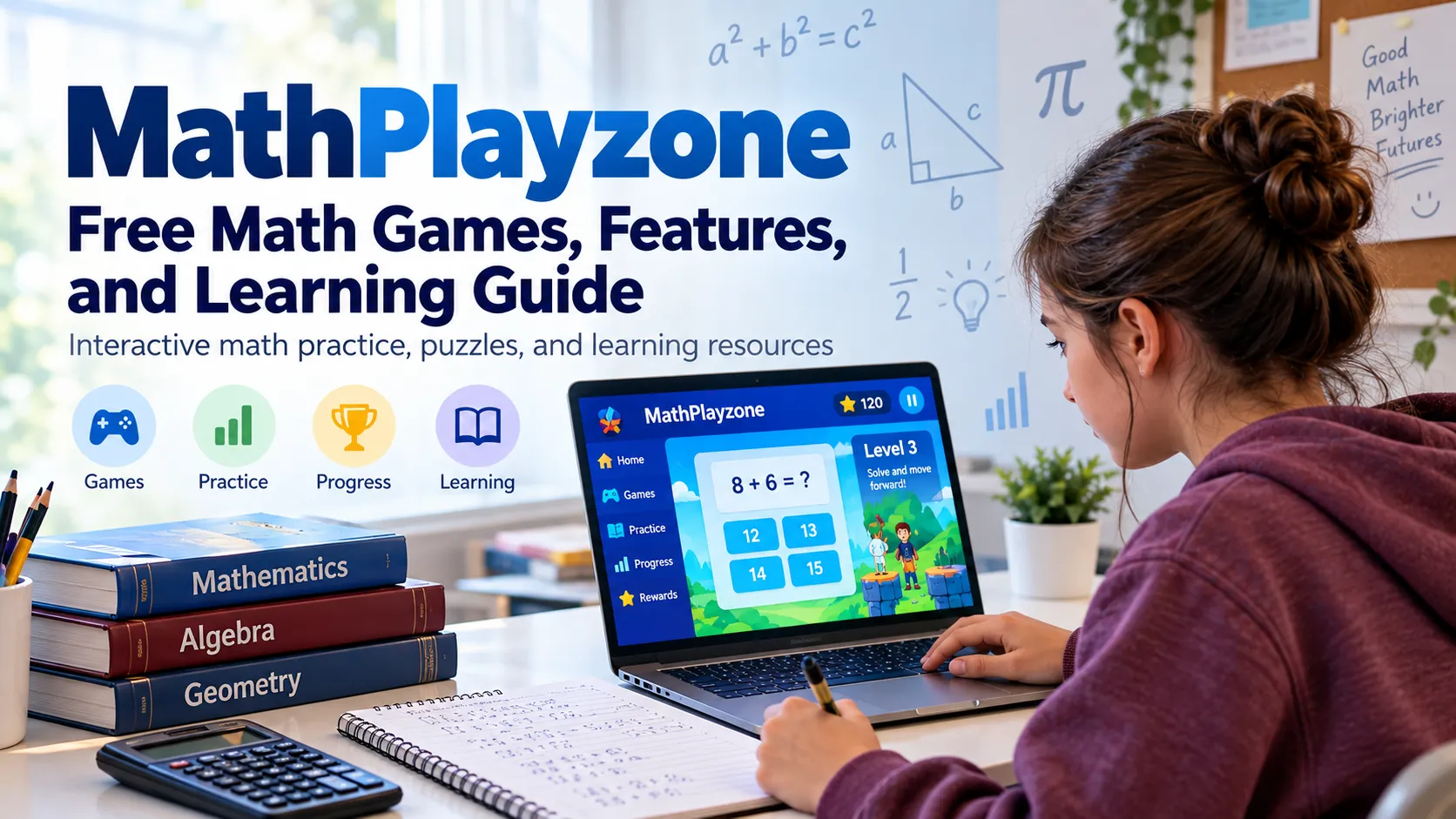
MathPlayzone is an online gaming and educational platform that combines mathematics practice with interactive puzzles, quizzes, and challenges. Available through MathPlayzone.com, the website offers browser-based activities covering arithmetic, problem-solving, science, geography, history, and recreational games.
Unlike conventional learning websites that focus primarily on lessons and worksheets, MathPlayzone uses interactive gameplay to encourage participation. Its math activities involve solving equations, making quick calculations, and completing logic challenges.
The platform can be useful for recreational learning and additional mathematics practice. However, it has some important limitations, including a stated minimum user age of 13, advertising-related data collection, and a large collection of games that are not directly educational.

What Is MathPlayzone?
MathPlayzone, also written as Math Playzone, is a browser-based platform that offers educational games alongside general entertainment titles. Its stated purpose is to provide interactive activities through which users can learn, practice, and enjoy games in an accessible online environment.
The website organizes its content into five main categories: mathematics, science, history, geography, and arcade games. Visitors can browse these sections and select individual games according to their interests.
The mathematics collection emphasizes fundamental arithmetic and logical thinking. Many activities require users to solve questions within a limited time, while others combine mathematical operations with puzzle-solving or adventure-style gameplay.
According to the website’s published categories, its math section contains nine game listings, while its arcade section contains approximately 120. This distinction is important because MathPlayzone is not exclusively an educational mathematics website.
MathPlayzone at a Glance
| Feature | Details |
|---|---|
| Website | MathPlayzone.com |
| Platform type | Browser-based gaming and learning website |
| Main subjects | Math, science, history, geography |
| Math activities | Arithmetic, logic, timed calculations, quizzes |
| Other content | Racing, puzzles, sports, arcade games |
| Access | Online through a web browser |
| Pricing | Games presented as free to access |
| Minimum age | 13 years under website terms |
| Advertising | Advertising and analytics disclosed in privacy policy |
| Account requirement | No mandatory account step shown for browsing game listings |
| Mobile support | Browser access available; individual game compatibility may vary |
How Does MathPlayzone Work?
MathPlayzone uses interactive challenges rather than traditional textbook-style explanations. Players choose a game, follow its instructions, and complete tasks involving calculations, logical decisions, or other gameplay objectives.
For example, a multiplication challenge asks the player to calculate products before time runs out. A strategy game such as Math Push requires players to move numbered blocks into positions that create the correct mathematical expressions.
The underlying principle is straightforward. Instead of presenting mathematics as a disconnected series of exercises, the games connect each question to an immediate objective.
Getting Started with MathPlayzone
Using the website involves a few simple steps:
- Visit the official MathPlayzone website.
- Open the Math category from the navigation menu.
- Choose a game that matches the mathematical skill you want to practice.
- Read the instructions and familiarize yourself with the controls.
- Begin playing and solve the questions or puzzles.
- Repeat activities as needed, focusing on accuracy before speed.
Some games use keyboard controls, while others involve selecting answers. Compatibility and controls can differ between individual titles.
Popular MathPlayzone Games and Activities
MathPlayzone’s mathematics category includes several distinct gameplay formats. Some focus on basic calculation fluency, while others combine mathematical reasoning with strategy or timed challenges.

1. Math Push
Math Push is a strategy-based puzzle game involving numbered blocks and mathematical expressions. Players must arrange blocks to create calculations that match the numbers displayed on barriers, allowing them to progress toward an exit.
The game combines arithmetic with spatial planning and logical reasoning.

2. Math Boy
Math Boy combines fantasy action with arithmetic questions. Players answer mathematical equations to help a sword-wielding character defend against approaching enemies.
It includes addition, subtraction, multiplication, division, and mixed-operation modes. Correct answers help defend the character, while incorrect answers increase the challenge.

3. Quiz Math
Quiz Math presents arithmetic equations and asks players to decide whether each statement is correct.
The game emphasizes rapid calculations, attention, and accuracy. An incorrect or delayed response can end the round.
4. Let’s Reach 1000
Let’s Reach 1000 is a timed addition challenge in which players repeatedly add numbers to a running total. The objective is to reach 1,000 while responding before the time limit expires.
The activity provides practice with mental addition and number relationships. It may be particularly useful for learners who already understand addition but want to become faster and more comfortable with calculations.
5. Let’s Reach Zero
Let’s Reach Zero follows a similar format but focuses on subtraction.
Players subtract incoming numbers from a running total and work toward zero. The exercise reinforces subtraction fluency and requires attention to the changing total.
6. Addition and Subtraction Games
The dedicated Addition and Subtraction games present arithmetic questions with a time limit. Players select the correct results and aim to increase their scores.
These activities provide straightforward opportunities to rehearse numerical facts. They are better suited to practicing an existing skill than learning an unfamiliar mathematical concept from the beginning.
7. Multiplication and Division Games
MathPlayzone also offers separate multiplication and division challenges.
The multiplication game requires players to calculate products quickly, while the division game involves selecting correct quotients. Both games emphasize accuracy under time pressure.
What Math Skills Can Users Practice?
The website’s mathematics collection concentrates on arithmetic and reasoning rather than providing a complete school mathematics curriculum.
| Mathematical skill | Relevant games | Primary practice |
|---|---|---|
| Addition | Addition, Let’s Reach 1000 | Mental addition and numerical fluency |
| Subtraction | Subtraction, Let’s Reach Zero | Subtraction accuracy |
| Multiplication | Multiplication, Math Boy | Multiplication facts |
| Division | Division, Math Boy | Basic division |
| Mental calculation | Quiz Math | Quick arithmetic decisions |
| Logical reasoning | Math Push | Mathematical problem-solving |
| Combined operations | Math Boy | Switching between arithmetic operations |
The main mathematics category does not currently provide the same range of dedicated lessons for geometry, algebra, fractions, and advanced mathematics that a full curriculum-based learning platform might offer.
Students who need explanations of mathematical methods should therefore use MathPlayzone alongside textbooks, classroom instruction, or structured educational resources.
Other Learning Categories on MathPlayzone
One distinctive feature of MathPlayzone is that it extends beyond mathematics. Its homepage includes science, history, and geography activities.
Science Games
The science section contains three listed games:
- The Brain Lab: An endless-runner activity involving the classification of solids, liquids, and gases.
- Smarty Pants: Science Quiz: A quiz covering subjects such as planets, the human body, and general science.
- The Magic of Science: An interactive learning game with 30 levels introducing basic scientific concepts.
These activities use familiar gaming formats to present scientific questions or ideas. They may help learners revisit concepts already introduced through lessons.
History and Geography Games
MathPlayzone includes a history quiz addressing topics from different historical periods.
Its geography collection offers activities covering countries, capital cities, landmarks, and national flags. Titles include Smarty Pants: Geography Quiz and Flags Maniac.
These games provide an alternative to ordinary question-and-answer revision, especially for learners who enjoy quizzes and visual challenges.
Arcade and Entertainment Games
MathPlayzone also maintains an extensive arcade category with racing, sports, action, puzzle, and simulation titles.
Examples advertised in this section include:
- Slope
- Snow Rider 3D
- Drift Hunters
- Geometry Dash
- Cookie Clicker
- Moto X3M
These games are mainly recreational. Although some involve strategy, timing, or problem-solving, they should not automatically be considered mathematics lessons.
The arcade collection also includes combat-oriented and battle-themed titles, so the website’s content should not be assumed to be uniformly suitable for every age group.
Is MathPlayzone Free to Use?
MathPlayzone presents its browser games as free to access. Its publicly available mathematics pages do not advertise a required subscription or upfront payment to select the listed activities.
Visitors can browse the game collection without first completing a visible account-registration process. However, the availability of an individual game may depend on browser compatibility, embedded game services, or changes made by the website.
The platform also discloses the use of advertising services in its privacy policy. This suggests that advertising plays a role in supporting the website’s operation, although its exact revenue and commercial arrangements are not publicly established.
Can MathPlayzone Improve Mathematics Skills?
Educational games can support mathematics learning when they provide meaningful practice, appropriate difficulty, and useful feedback. However, the evidence for game-based learning in general should not be mistaken for proof that a specific website improves academic performance.
A 2026 second-order meta-analysis published in Educational Research Review examined findings from nine earlier meta-analyses on game-based mathematics learning. It found generally positive but variable effects on mathematical learning outcomes, with important differences between studies and teaching contexts.
The researchers emphasized that results depend on factors such as game type, implementation, and learning environment.
Similarly, a 2023 systematic review published in Frontiers in Psychology examined 28 studies and reported positive findings involving mathematical knowledge, skills, motivation, and engagement.
These findings provide a reasonable basis for using well-designed games as supplementary practice. They do not establish that MathPlayzone itself has been independently tested or proven to improve grades.
Why Interactive Mathematics Practice Can Be Useful
Mathematics requires both conceptual understanding and repeated application. Games can make repetition more engaging by connecting correct answers with progress through a challenge.
Timed activities can help learners practice recalling arithmetic facts. Logic games may encourage them to experiment with different approaches rather than rely on memorized answers.
An important limitation is that answering quickly does not necessarily demonstrate deep understanding. A learner might become faster at multiplication facts while still struggling to explain why a multiplication method works.
For this reason, the best learning approach combines games with explanations, worked examples, and opportunities to solve problems without time pressure.
Is MathPlayzone Safe and Suitable for Children?
MathPlayzone has published privacy information and usage policies, but that alone does not establish that every game or advertisement is appropriate for children.
A particularly important detail appears in its official Terms of Use. The website explicitly states that it is designed for users aged 13 and older.
Its privacy policy also says that the site does not intentionally collect personal information from children under 13.
This means parents should not assume that the platform is intended for young elementary school children simply because it offers basic addition and subtraction games.
Privacy and Data Collection
According to MathPlayzone’s privacy policy, the website may collect:
- Information submitted through contact forms or comments, including names and email addresses.
- Technical information such as IP addresses, browser details, device characteristics, and usage data.
- Information used for analytics, advertising, and website security.
The policy identifies Google Analytics and Playwire in connection with analytics and advertising services. It also describes the use of cookies and similar tracking technologies.
The privacy policy was last updated on December 29, 2025.
Users concerned about privacy should review these disclosures before using the website, especially on shared devices.
Other Safety Considerations
MathPlayzone’s arcade section advertises games as unblocked, but that does not guarantee access on every school or workplace network.
Schools may have separate internet-use policies, filtering systems, and classroom restrictions. Users should follow those rules rather than assume that an advertised unblocked game is approved for school use.
Parents and educators should also review individual games before recommending them. The presence of recreational titles, advertising, and embedded game content means the platform requires more careful selection than a narrowly focused educational resource.
No independent comprehensive security audit of MathPlayzone was established through the sources reviewed. It would therefore be inappropriate to guarantee that the entire platform is risk-free.
Who Should Use MathPlayzone?
MathPlayzone may appeal to different groups of learners, but its usefulness depends on the purpose of the visit.
Teenagers Practicing Arithmetic
Teenagers who need extra practice with basic operations may find the timed arithmetic games useful.
Short sessions involving multiplication, division, and mixed calculations can provide variety alongside conventional revision exercises.
Students Who Enjoy Learning Through Games
Some learners prefer interactive tasks to repeated written questions. Games such as Math Boy and Math Push connect mathematical thinking with clear gameplay objectives.
This can make supplementary practice more appealing, although the difficulty and educational value vary between activities.
Parents and Educators
For users aged 13 and older, parents and educators can select specific games that reinforce already-taught concepts.
Teachers should assess whether a title aligns with the intended learning objective and the institution’s policies before using it in a lesson.
Because the website does not present itself as a comprehensive curriculum, educators should not rely on it alone for instruction or assessment.
Advantages and Limitations of MathPlayzone
MathPlayzone has useful characteristics, particularly for learners seeking short interactive activities. It also has limitations that should influence how it is used.
| Advantages | Limitations |
|---|---|
| Free browser-based game listings | Not a comprehensive math curriculum |
| Multiple arithmetic practice activities | Limited dedicated advanced math content |
| Puzzle and strategy-based challenges | Some games emphasize speed over explanation |
| Additional science and geography games | Large number of noneducational arcade games |
| Simple category-based navigation | Individual games may have compatibility issues |
| No visible account requirement to browse | Advertising and tracking disclosures |
| Recreational and educational variety | Website specifies a minimum age of 13 |
These distinctions make MathPlayzone better suited to selected practice sessions and entertainment than to replacing a structured educational program.
How to Get More Educational Value from MathPlayzone
The most effective way to use a math gaming website is to connect each activity to a specific learning goal.
For example, a student who struggles with multiplication facts can focus on the Multiplication game instead of switching randomly between unrelated activities.
A practical study session might begin with a brief review of the mathematical rules, followed by a few minutes of focused gameplay. Afterward, the learner can revisit incorrect answers and explain how to solve them.
Focus on Accuracy Before Speed
Many MathPlayzone games include timed challenges. While speed can make practice exciting, it should not become the only measure of progress.
Students should first understand how to calculate an answer correctly. Speed can improve naturally with repeated, accurate practice.
Use Games to Identify Learning Gaps
Repeated mistakes may reveal skills that need additional attention.
For instance, difficulty with a division challenge might indicate weak multiplication knowledge. A student could return to multiplication practice before attempting harder division questions.
This approach turns game performance into an informal learning signal rather than treating scores as proof of overall mathematical ability.
Combine Gaming with Structured Learning
A balanced mathematics routine should include explanations, written practice, and interactive activities.
MathPlayzone can provide one part of that routine. Resources with guided lessons and exercises may be more appropriate when a learner needs to understand a new topic.

MathPlayzone vs. Other Math Learning Platforms
Several online services offer mathematics practice, but they have different educational purposes.
| Platform | Main emphasis | Suitable purpose |
|---|---|---|
| MathPlayzone.com | Math games and general arcade entertainment | Supplementary practice and recreation |
| Khan Academy | Structured lessons and practice exercises | Learning and reviewing curriculum topics |
| Prodigy Math | Curriculum-linked math gameplay | Game-based mathematics practice |
| PBS Kids | Educational activities for younger children | Age-appropriate early learning activities |
The most appropriate choice depends on age, educational level, and whether the goal is entertainment, arithmetic practice, or structured instruction.
For younger children, an age-appropriate platform is a better starting point than a website whose published terms specify a minimum age of 13.
Is Math Playzone the Same as MathPlayzone.com?
The names MathPlayzone and Math Playzone are used online for more than one product or service, so readers should distinguish them carefully.
The website discussed in this article is MathPlayzone.com, which publishes math, science, history, geography, and arcade games.
Another website, SpeedMath, uses the name Math Playzone for its collection of mathematics and brain-training puzzles, including Sudoku, Nerdle, and Quick Calc. Its features and account system are different.
There is also an iOS app called Math Playzone: KS1–GCSE Maths, listed under developer DEVWORLD VIETAM COMPANY LIMITED. The app advertises mathematics lessons, quizzes, and other learning tools, with in-app purchases.
Apple lists that app with an age rating of 4+, which should not be confused with MathPlayzone.com’s 13-and-older usage policy. No verified common ownership between these services was established.
Frequently Asked Questions About MathPlayzone
1. What is MathPlayzone used for?
MathPlayzone is used for playing online mathematics games, solving puzzles, practicing arithmetic, and enjoying additional educational or recreational activities. Its mathematics section focuses mainly on basic operations, timed calculations, and logical reasoning.
2. Is MathPlayzone completely free?
The website presents its browser games as free to access, and its public game listings do not show a mandatory subscription. Advertising and analytics services are disclosed in its privacy policy.
3. Do I need to create an account to play MathPlayzone games?
The public game pages can be browsed without encountering a mandatory account-registration step. Individual game behavior may vary, and the website does not clearly advertise a universal personal progress-tracking system.
4. Can I play MathPlayzone on a mobile phone?
The website can be accessed through a mobile web browser. However, individual games may have different control requirements, and games designed around keyboard input may work better on a desktop or laptop.
5. Is MathPlayzone suitable for elementary school children?
Although some of its mathematics games cover elementary-level arithmetic, MathPlayzone.com’s published terms state that the website is intended for users aged 13 and older. Parents of younger children should choose resources with age-appropriate policies and content.
6. Does MathPlayzone help students become better at math?
It can provide opportunities to practice arithmetic and mathematical reasoning. Research on game-based mathematics learning suggests potential educational benefits, but there is no verified evidence that MathPlayzone itself guarantees improvements in school performance.
Final Assessment
MathPlayzone offers a mixture of mathematics practice, educational quizzes, logic challenges, and recreational browser games. Its strongest educational use is supplementary arithmetic practice, particularly for users who enjoy timed exercises and interactive puzzles.
The platform is less suitable for learners seeking complete mathematics lessons, detailed explanations, or a structured curriculum. Its stated minimum age of 13, advertising disclosures, and extensive noneducational arcade collection are also important considerations.
For eligible users who want a casual way to revisit basic calculations, MathPlayzone can be a useful supplementary resource. Its value depends on choosing appropriate games and combining them with meaningful mathematics instruction.
