


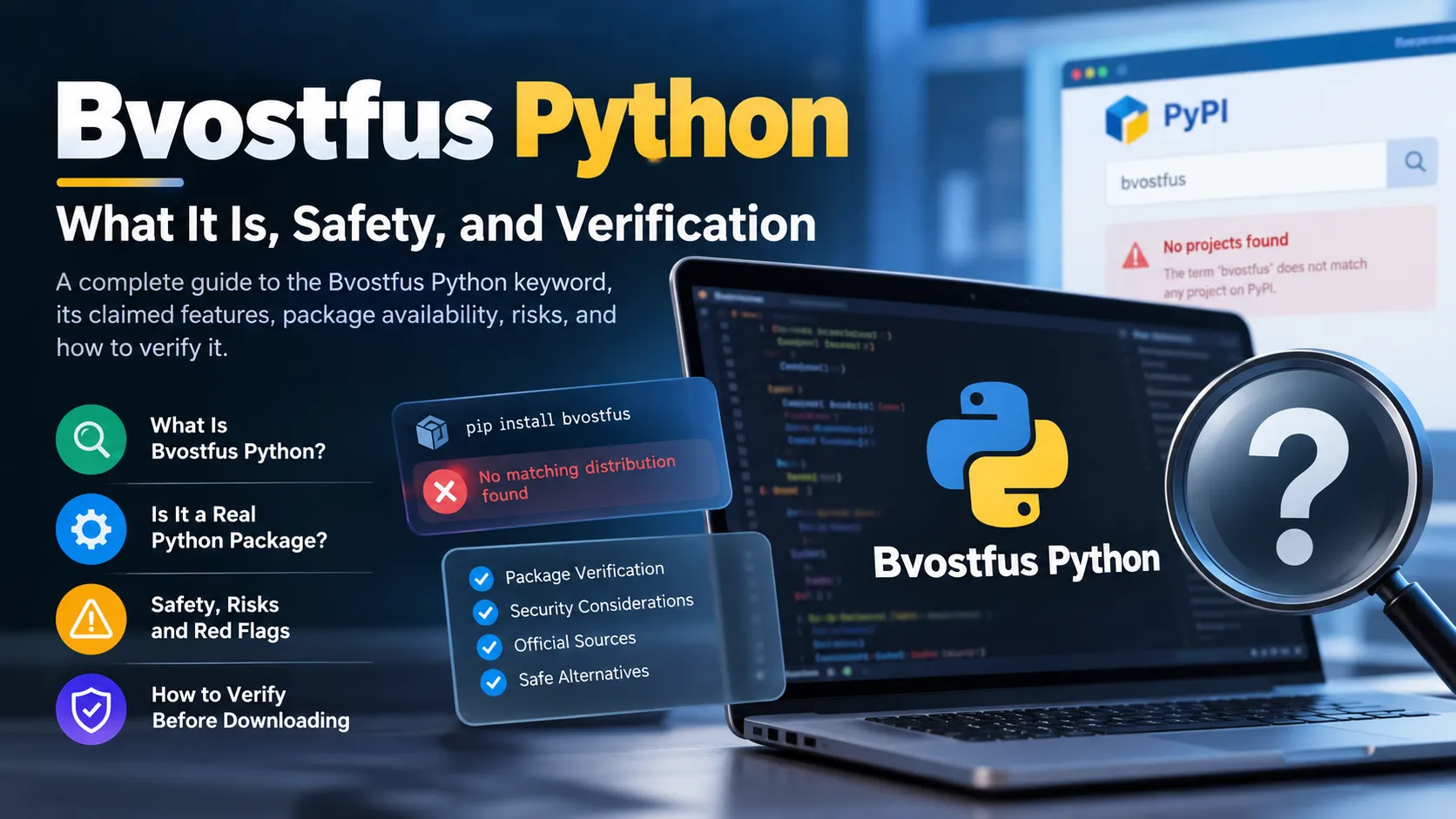
Bvostfus Python is not currently verifiable as an official Python component, established public framework, or package distributed through the Python Package Index. As of September 30, 2026, direct checks for the project names bvostfus and bvostfus-python on PyPI return 404 errors, while Python’s official module index contains no module by that name.
The term nevertheless appears across a growing number of technology articles, sometimes described as software for automation, configuration management, dependency handling, or Python development. The problem is that those descriptions are not backed by a consistent public codebase, package release, technical specification, or identifiable development organization.
That makes Bvostfus Python less a conventional software product and more an unverified technology term whose meaning has been shaped by online articles.

What Is Bvostfus Python?
Bvostfus Python is a phrase used online for an alleged Python-related development tool or software project. There is currently not enough primary technical evidence to identify it as a genuine publicly released Python framework.
The strongest evidence comes from the places where a Python project would normally leave a trace. The exact bvostfus and bvostfus-python project addresses on the Python Package Index currently return “Not Found.” Python’s official module documentation also contains no entry for Bvostfus.
The situation is made more confusing by Bvostfus-branded websites. One current Bvostfus.com article acknowledges that descriptions of the alleged software conflict and says no single authoritative technical specification confirms the features being attributed to it. The same page advises users to verify a package, repository, documentation, maintainers, and release history before treating it as established software.
So the most accurate description is:
Bvostfus Python is an online technology term associated with claims about Python software, but no established public Python package or official framework under that exact name can currently be verified.
That leaves open the possibility that Bvostfus could be an internal project, unpublished experiment, brand name, placeholder, or private tool. There is simply no reliable public evidence supporting the broader claims commonly made about it.

What Can Actually Be Verified About Bvostfus Python?
The available evidence is clearer when the claims are separated from what can be independently checked.
| Verification point | Current finding |
|---|---|
| Official Python standard-library module | No Bvostfus entry found |
PyPI project named bvostfus | Project URL returns 404 |
PyPI project named bvostfus-python | Project URL returns 404 |
| Confirmed public release history | Not established |
| Identifiable package maintainer | Not established |
| Consistent technical documentation | Not established |
| Publicly confirmed installation method | Not established |
| Online articles discussing the term | Yes |
| Bvostfus-branded websites | Yes |
Python’s official Module Index lists standard-library modules ranging from abc and asyncio to venv and zipfile. A search of that index finds no Bvostfus entry.
This does not prove that nobody anywhere has used the word “Bvostfus” in private code. It does show that the term should not be presented as part of Python itself.
Why Are Websites Calling It New Python Software?
Search results for Bvostfus Python contain unusually inconsistent descriptions.
Some pages have associated it with:
- automation
- dependency management
- configuration management
- pattern matching
- toolkit integration
- development workflows
- code organization
An older cached version of a Bvostfus.com article, for example, described the supposed software as a platform that combined pattern matching, configuration management, automation, and toolkit integration.
More recent material on the same domain is substantially more cautious. It now says those capabilities are claims appearing across websites and acknowledges that there is no single technical specification verifying them.
That change illustrates the central problem with the keyword. Descriptions of Bvostfus Python have often appeared before independently verifiable software documentation.
A real developer tool normally allows basic questions to be answered clearly:
Who maintains it?
Where is its source code?
What is its current version?
How is it installed?
Which Python versions does it support?
What license does it use?
What APIs does it expose?
Where is its changelog?
Those questions currently have no reliable package-specific answers for Bvostfus Python.
Is Bvostfus Python a Python Package?
There is no publicly verifiable PyPI distribution called bvostfus or bvostfus-python as of September 30, 2026.
This distinction matters because PyPI is the primary public repository used for Python distributions. The official Python Packaging User Guide explains that pip commonly installs packages from PyPI using a project name supplied to pip install.
The official Python Packaging User Guide also explains that a distribution package is software that can be installed into a Python environment and distinguishes it from an import package used inside source code.
For Bvostfus, neither a verified distribution nor documented import package has been established.
Does pip install bvostfus Work?
It should not be treated as an official installation command.
Because no bvostfus project currently exists at the corresponding PyPI project address, copying such a command from an unrelated blog does not constitute verified installation documentation.
The same applies to:
pip install bvostfus-pythonThe corresponding PyPI project URL also returns 404 at the time of checking.
Package availability can change, however. Someone could register a previously unused name in the future. That is why readers should re-check the package identity, publisher, source repository, release history, and documentation instead of assuming a future package with the same name is connected to articles published today.

Could Bvostfus Be a Private Python Project?
Yes, that remains possible.
Python software does not have to be published on PyPI. The Python Packaging User Guide documents installations from local source trees, version-control repositories, and alternative package indexes.
A company could therefore operate an internal package called Bvostfus without publishing it publicly.
The important distinction is that no such private project can be independently verified from the public evidence currently available. A hypothetical private implementation should not be used to justify claims that a particular public framework exists.
If you encountered bvostfus inside a company’s codebase, the correct source of truth would be that project’s internal documentation, repository configuration, pyproject.toml, requirements files, or development team.
Also Read: Sosoactive: What It Is, History and Current Status
Is Bvostfus.com the Official Software Website?
Bvostfus.com is a real publishing website that contains several articles targeting phrases such as “Bvostfus Python,” “install Bvostfus Python,” “Bvostfus Python issue,” and “update software Bvostfus Python.”
That does not by itself establish the site as the official home of a software package.
Its current article about “new software Bvostfus Python” explicitly says the project’s public status is uncertain and advises readers to look for an official source, repository, version history, documentation, dependencies, and maintainers.
In other words, even the Bvostfus-branded publication does not currently provide the package artifacts or definitive technical documentation expected from an established Python framework.
Why Unverified Python Package Names Deserve Caution
Installing an unfamiliar Python package is not the same as opening a normal webpage. Package installation can cause code from a distribution to be processed on your system and may introduce additional dependencies.
Official pip documentation warns that default package installation does not provide every possible protection against malicious or tampered software and documents additional security mechanisms such as hash checking.
The pip secure-install documentation recommends mechanisms such as pinned requirements and --require-hashes when stronger integrity guarantees are required.
Package-name confusion is also a real security category. PyPI’s security documentation specifically recognizes typo-squatting and dependency-confusion behavior as valid reasons for reporting malicious projects.
The PyPI security guidance therefore matters when dealing with obscure names such as Bvostfus, particularly if installation instructions appear on a website without corresponding package documentation.
This does not mean Bvostfus itself has been demonstrated to be malware. There is no verified package to make that assessment about. The concern is more basic: users should not install software whose identity and origin have not been established.
How to Check Bvostfus Python Before Downloading Anything
A few checks can quickly reveal whether the situation changes in the future.
1. Check the exact package name
Package names matter. A typo can lead to an unrelated distribution.
Python packaging rules allow letters, numbers, periods, underscores, and hyphens in distribution names, with several forms normalized during package lookup.
If you saw “Bvostfus” in a tutorial, requirements file, screenshot, or error message, compare the spelling carefully with the original source.
2. Look for a genuine PyPI project
A legitimate public release should normally show useful metadata such as its version, publication files, project links, and release history.
At present, neither of the obvious Bvostfus project addresses produces such a page.
3. Identify the source repository
Look for a repository operated by the same developer or organization that publishes the package.
Do not treat a repository containing the same word as proof of ownership. Check commit history, packaging files, releases, contributors, license information, and whether PyPI links back to that repository.
4. Look for real documentation
Documentation should explain concrete behavior, not merely say that software is “powerful,” “efficient,” or “easy to use.”
For a Python framework, useful documentation normally includes:
- supported Python versions
- installation requirements
- API reference
- working code examples
- configuration format
- dependencies
- changelog
- migration instructions
- issue tracker
These elements currently cannot be verified for Bvostfus Python.
5. Test unfamiliar software in isolation
Python’s packaging documentation recommends virtual environments so project dependencies can be isolated from other Python installations.
A standard environment can be created with:
python -m venv .venvor, depending on the platform:
python3 -m venv .venvCreating a virtual environment does not make an unknown package trustworthy. It simply reduces interference with your main Python environment while you investigate legitimate software.

What If You Encounter a Bvostfus Python Error?
First determine whether bvostfus actually appears in your code or dependency files.
Search the project for:
bvostfusPay particular attention to:
requirements.txt
pyproject.toml
setup.py
setup.cfg
Pipfile
poetry.lock
import statements
CI/CD configuration
Docker files
If it appears as an import, such as:
import bvostfusand Python raises ModuleNotFoundError, that error only tells you the interpreter cannot locate a module with that import name. It does not prove that a public package called Bvostfus should exist.
If the term came from a tutorial rather than your code, verify the tutorial before changing your environment.
If it came from a private company repository, consult the repository’s own documentation because the dependency may come from an internal package index rather than PyPI.
Bvostfus Python vs a Normal Public Python Project
The difference is easier to see when compared with the usual software-distribution model.
| Normal public Python project | Bvostfus Python currently |
|---|---|
| Identifiable package or project | No verified public package |
| Release versions | Not established |
| Maintainer or organization | Not established |
| Installation documentation | No authoritative method verified |
| Package files | Not found on PyPI |
| Source repository | No clearly established official repository |
| API documentation | Not established |
| Changelog | Not established |
| Supported Python versions | Unknown |
| License | Unknown |
| Security policy | Unknown |
None of these missing details proves that the word Bvostfus can never become a software project. They show why claims about its capabilities should currently be treated as unconfirmed.
Is Bvostfus Python Fake?
Calling it simply “fake” goes further than the evidence supports.
A better description is unverified as a public Python software project. There are genuine websites and articles using the Bvostfus name, so the term itself plainly exists online. What cannot currently be verified is the software product described by some of those articles.
Several explanations remain possible:
- Bvostfus began as an unpublished or private project.
- It may be a project name that never reached public release.
- The phrase may have originated as a typo or placeholder.
- Articles may have expanded an obscure keyword into descriptions unsupported by primary technical evidence.
- A future project could eventually adopt the same name.
Without a verifiable maintainer, repository, package release, and technical documentation, choosing among those explanations would be speculation.
What Should Developers Use Instead?
The right alternative depends on what someone expected Bvostfus to do.
If you need package installation and dependency handling, use established Python packaging tools with public documentation. If you need application frameworks, automation libraries, testing tools, configuration management, or data-processing packages, choose projects whose source code, maintainers, releases, licenses, security practices, and documentation can be independently checked.
The official Python Packaging Authority maintains extensive guidance covering pip, virtual environments, dependency management, building packages, and publishing distributions.
The key lesson is not that every obscure project should be avoided. New Python projects appear regularly. The difference is that legitimate emerging software should eventually produce verifiable technical evidence.
Frequently Asked Questions
Is Bvostfus Python a real Python framework?
No established public Python framework called Bvostfus can currently be verified. PyPI does not provide project pages for bvostfus or bvostfus-python, and the term is absent from Python’s official module index.
Can I install Bvostfus Python with pip?
There is no verified PyPI package under the obvious Bvostfus names as of September 30, 2026. For that reason, commands claiming to install it should not be treated as official instructions unless a legitimate project and maintainer can first be identified.
Is Bvostfus Python malware?
There is no evidence presented here establishing Bvostfus Python as malware. The problem is that there is no verified public package to inspect or assess. Users should therefore avoid unknown downloads presented under the name until their origin and contents can be confirmed.
Why does Bvostfus Python appear in so many articles?
The term has become a searchable technology keyword, and numerous websites have published pages about it. Their descriptions often differ, while primary evidence such as package files, release documentation, and a maintained official repository remains absent or unclear.
Could Bvostfus Python become a real package later?
Yes. A developer could release software under that name in the future. Any future package should be evaluated on its own maintainer identity, source code, release history, documentation, dependencies, and security record rather than assuming it is connected to older articles.
What should I do if bvostfus appears in my Python project?
Check where the reference originated. Search dependency files, source code, project documentation, and package-index configuration. If it belongs to an internal project, ask the project’s maintainer for the correct repository or private package source instead of assuming it should exist publicly on PyPI.
Also Read: HRMS Globex: Login, Employee Portal and Verified Features
