


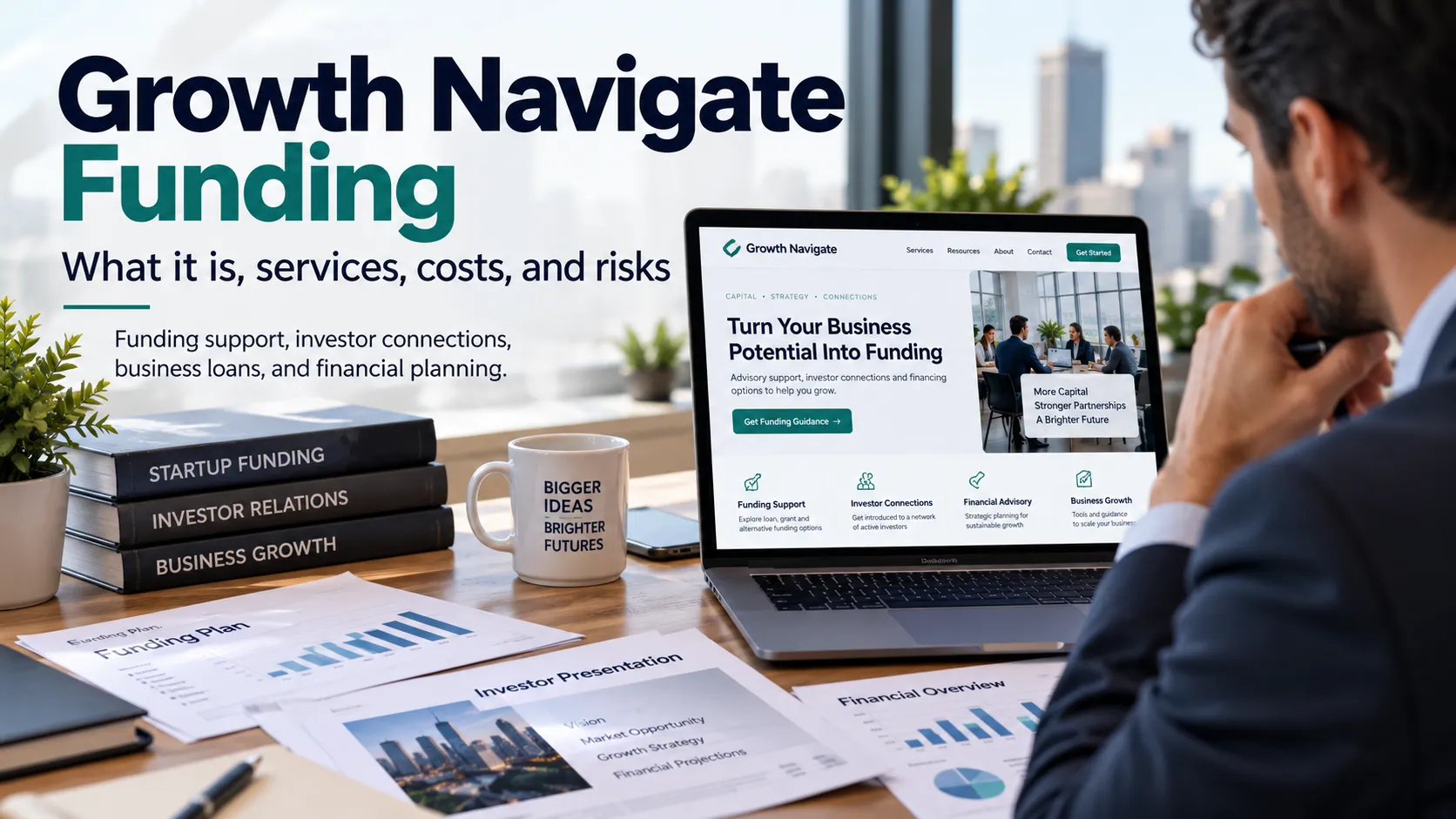
Growth Navigate funding most commonly refers to business-funding and capital-raising support promoted by GrowthNavigate.com. It is not a distinct government funding program, standardized loan product, or formally recognized category of startup finance.
As of September 29, 2026, Growth Navigate describes itself as a financial-growth advisory business that helps companies pursue investors and loans, prepare funding materials, improve financial planning, and scale more efficiently. Its public website makes substantial claims about experience and successful partnerships, but some of those claims are company-provided and are not accompanied by independently verifiable transaction records on the pages reviewed.

Growth Navigate Funding Explained
Growth Navigate presents itself as a financial-growth advisory business that helps companies prepare for funding, connect with potential capital sources, improve financial planning, and build strategies for business expansion.
What Is Growth Navigate Funding?
Growth Navigate funding is best understood as fundraising and financial advisory assistance, rather than a type of financing in itself.
GrowthNavigate.com says its business-funding service can help companies connect with investors, pursue business loans, prepare pitch decks, structure deals, and position themselves for capital. Its broader services also include business coaching, financial planning, risk management, investment strategy, and fintech implementation.
That distinction matters because the phrase is increasingly used online as though it were a financial product.
Official U.S. Securities and Exchange Commission and Small Business Administration resources describe recognized funding routes such as loans, venture or angel investment, Regulation D offerings, Regulation Crowdfunding, Regulation A, Small Business Investment Companies, and certain grants. They do not identify “Growth Navigate funding” as a separate regulatory or government financing category.
In practical terms:
| Question | Current answer |
|---|---|
| Is Growth Navigate funding a government program? | No |
| Is it a specific loan product? | No |
| Does GrowthNavigate.com market funding assistance? | Yes |
| Does the site mention investors and business loans? | Yes |
| Does it guarantee funding? | No |
| Are standard public prices shown? | No |
| Is there a published minimum credit score or revenue requirement? | Not on the main funding pages reviewed |
What Does Growth Navigate Offer?
The company presents funding as one part of a wider financial-growth service.
Business Funding and Capital Acquisition
This is the service most directly connected with the growth navigate funding search.
Growth Navigate says it helps businesses with:
- investor connections
- venture-capital and angel-investor fundraising
- business loans
- pitch-deck preparation
- deal structuring
- financial positioning before a raise
Its funding page states that it works with businesses seeking venture capital, angel investment, or loans and helps them prepare materials and navigate the process.
The wording suggests that Growth Navigate primarily operates as an advisor or intermediary, rather than simply lending its own balance-sheet capital. The reviewed public pages do not clearly identify Growth Navigate itself as the direct lender for a standard loan product.
Financial Planning and Risk Management
Growth Navigate also markets cash-flow planning and financial-system development.
This can be relevant before fundraising because investors and lenders commonly examine financial projections, existing debt, cash burn, revenue trends, and the proposed use of funds.
The SBA similarly advises companies seeking loans to prepare information about their business plan, funding amount, use of proceeds, credit history, financial projections, and potentially collateral.
Business Coaching and Financial Advisory
Growth Navigate says it works on revenue strategy, cost control, profitability, and scaling.
For a founder, this is different from actually obtaining financing. Advisory work may improve financial readiness or fundraising materials, but it does not itself create an obligation for a lender or investor to provide capital.
Growth Navigate acknowledges this distinction in its own terms.
Its Terms and Conditions state that the company offers business-funding consulting, financial advisory, investment-strategy guidance, and fintech services but does not guarantee a specific funding result or financial outcome.
Investment Strategy and Wealth Building
The company also advertises guidance around reinvestment, diversification, wealth preservation, and financial strategy.
Its website says these services are intended to help businesses decide how profits and capital should be deployed after they have been generated or raised.
This part of the service should not be confused with the fundraising process itself.
Fintech and Digital Transformation
Growth Navigate additionally promotes automation, payment-system improvements, financial tracking, AI, and other financial technology.
The idea is that stronger operational and financial systems can make a company easier to manage as it scales.

How the Growth Navigate Funding Process Appears to Work
Growth Navigate describes a four-stage general process.
The first stage is analysis and customization, where the business’s financial position and objectives are examined. This is followed by strategic advisory, implementation or execution, and continuing support.
For funding specifically, a typical engagement would therefore be expected to involve several practical steps.
A founder would first define how much capital is needed and why. The company could then help improve financial information, prepare a pitch or funding narrative, identify appropriate financing routes, and potentially connect the business with investors or lenders.
The final financing decision remains with the actual investor, lender, or other capital provider.
Growth Navigate’s terms make clear that a successful funding outcome is not guaranteed.
What Types of Funding Could a Business Pursue?
The right capital structure depends more on the business than on the adviser being used.
Business Loans
Debt allows the founder to raise money without necessarily selling ownership, but the loan must generally be repaid with interest.
For eligible U.S. small businesses, the SBA supports several financing programs. Its current loan resources include 7(a), 504, and microloan programs. The 7(a) program is SBA’s primary business loan program and can support uses including working capital, equipment, real estate, refinancing, and certain ownership changes.
SBA Lender Match can also connect a business with participating lenders, although the SBA explicitly says a match does not guarantee an eventual loan offer.
Angel and Venture-Capital Investment
Equity financing involves investors receiving an ownership interest or another form of security in exchange for capital.
The SEC identifies friends and family, angel investors, and venture-capital funds as common sources of early-stage capital. The agency also stresses that labels such as “seed” or “Series A” do not themselves determine the legal exemption used for a securities offering.
Many private fundraising transactions rely on Regulation D.
Depending on the exemption used, rules regarding accredited investors, solicitation, disclosure, and filings can apply.
Crowdfunding
Regulation Crowdfunding provides another route for eligible companies.
The SEC states that qualifying companies can raise up to $5 million under Regulation Crowdfunding and that transactions must take place through an appropriately registered broker-dealer or funding portal.
Investment Capital Through SBICs
The SBA also licenses Small Business Investment Companies, or SBICs.
These are privately owned investment funds operating within the SBA program that provide debt or equity capital to qualifying businesses. SBA says more than 300 SBICs are available within the program.
Business Grants
Grants are frequently misunderstood.
The SBA explicitly states that it does not generally provide grants for starting or expanding an ordinary business. Its direct grant programs are more limited and include areas such as research, exporting, manufacturing support, and entrepreneurship-development programs.
Any business-funding adviser promising easy government startup grants therefore deserves careful scrutiny.
Also Read: HRMS Globex: Login, Employee Portal and Verified Features
How Much Does Growth Navigate Funding Cost?
GrowthNavigate.com does not publish a standard pricing table for its funding service on the public pages reviewed.
Its Terms and Conditions say fees are determined by the client’s agreement with the company. They also state that payments are non-refundable unless a written agreement says otherwise.
That makes the engagement agreement particularly important.
Before paying, a company should obtain written answers covering:
- upfront or monthly advisory fees
- whether any fee depends on successfully raising capital
- cancellation terms
- refund conditions
- what investor introductions are included
- whether pitch decks and financial models remain the client’s property
- the exact duration of the engagement
- which legal entity is receiving payment
A founder should not assume that an advisory fee includes lending costs, investor legal fees, securities counsel, accounting work, or the interest and fees charged by an eventual lender.
An Important Regulatory Question About Investor Introductions
Fundraising intermediaries operate in an area where the details of the service and compensation structure can matter legally.
The SEC explains that activities that may require broker-dealer registration can include finding investors for companies or funding rounds. Factors include whether a person participates in solicitation, negotiation, or execution and whether compensation depends on the amount or success of a securities transaction.
That does not mean every fundraising consultant must be a broker-dealer.
Services such as financial modeling, pitch-deck consulting, general strategy, or business coaching can be materially different from acting as a securities broker. The regulatory analysis depends on what the adviser actually does.
For any adviser offering investor introductions, a founder should therefore ask:
- Who will actually introduce or solicit investors?
- Is that person or firm registered where required?
- Is the compensation fixed, or tied to the amount of capital raised?
- Will the adviser negotiate securities terms?
- Who handles investor money?
- Which securities-law exemption will the company rely on?
Legal counsel should review the structure where securities are being offered.

Growth Navigate’s Public Claims and What Can Be Verified
Some distinctions are important when evaluating the company.
Growth Navigate’s funding page currently advertises 100+ successful partnerships and 15+ years of financial expertise. Its About page identifies Samantha Steele as Director of Financial Strategy and Sayush Khandelwal as Head of Finance & Tech.
These statements come from Growth Navigate itself.
The public funding page also displays customer testimonials and generalized success language. However, the pages reviewed do not provide detailed supporting transaction data such as named funded companies, disclosed funding rounds, SEC filings linked to particular clients, investor confirmations, or independently audited fundraising totals.
That does not establish that the claims are false. It simply means readers should distinguish company marketing claims from independently verified evidence.
Do Not Confuse the Similar Growth Navigate Websites
The search term has become more confusing because several websites now use similar names.
GrowthNavigate.com is the website discussed primarily in this article. It markets funding, financial advisory, planning, investment strategy, and fintech services.
Separate domains including GrowthNavigateFunding.com, GrowthNavigateFunding.net, and GrowthNavigate.net also appear in current search results.
For example, GrowthNavigateFunding.com describes itself as a startup-funding advisory service and claims more than $450 million in capital secured, 300+ funded startups, a 92% success rate, and a network of more than 1,000 investors. Those figures are claims published by that separate website.
GrowthNavigateFunding.net publishes very similar figures and says it was founded in 2013.
The public evidence reviewed does not clearly establish that all of these similarly named domains are operated by the same legal entity. Users should therefore verify the exact domain, company name, contract, payment recipient, and representatives before sharing financial information or paying for services.
Privacy and Financial Information
Potential clients should also understand what information may be collected.
Growth Navigate’s privacy policy says the business may collect names, email addresses, phone numbers, company details, technical information, and business financial data relevant to consulting or funding services. It says information can be shared with service providers, disclosed when legally required, or transferred as part of certain business transactions.
The policy also says the company uses security measures but cannot guarantee absolute security.
Founders should avoid sending highly sensitive financial documents before confirming who will receive them and how they will be stored.
A proper fundraising data room may contain bank information, cap tables, tax records, contracts, financial statements, intellectual property documents, employee details, and forecasts. Access to those files should be controlled carefully.
Is Growth Navigate Funding Legit and Safe to Use?
GrowthNavigate.com is an active website with service descriptions, named team members, contact information, Terms and Conditions, a Privacy Policy, and regularly published content. Those are useful transparency signals.
They are not, however, substitutes for transaction-level due diligence.
Several performance statements on the site are self-reported, and its terms explicitly state that financial or funding outcomes are not guaranteed.
For a meaningful engagement, a founder should verify the legal contracting entity, adviser credentials where relevant, fees, references, deliverables, and any registration required for investor-solicitation activities.
The safest approach is neither to assume the service is unreliable nor to accept every marketing statement without verification.
What to Check Before Hiring Growth Navigate or Any Funding Adviser
A serious funding adviser should be able to explain precisely what it will and will not do.
Ask for a written engagement agreement before making payment. The agreement should identify the legal entity, scope, price, refund policy, termination rights, and compensation structure.
For investor fundraising, ask whether the adviser merely prepares materials or also solicits investors, negotiates terms, or receives transaction-based compensation. Those distinctions can have regulatory significance under SEC rules.
You should also request evidence relevant to the service being purchased.
For example, a founder seeking a Series A adviser could ask for anonymized but verifiable examples of previous transactions, typical investor profiles, expected preparation requirements, and references that can be independently contacted.
Never pay simply because an adviser promises guaranteed capital. Legitimate funding decisions depend on the business, financial condition, market, investor appetite, credit profile, proposed terms, and applicable law.
Who Might Consider Growth Navigate Funding Services?
The service may be relevant to founders who know they need outside capital but need help preparing for a lender or investor process.
That can include companies that need a stronger pitch deck, more defensible financial projections, a clearer capital strategy, or help identifying appropriate funding sources.
An adviser can be especially useful where a founder understands the product well but lacks experience with fundraising terminology, financial modeling, investor materials, or due diligence.
It is less useful to hire a funding consultant before knowing why the money is needed.
A business should first establish its required amount, expected use of proceeds, runway, repayment capacity if borrowing, and willingness to surrender equity if pursuing investors.
Growth Navigate Funding vs. Going Direct
Using an adviser is not the only option.
A business seeking debt can approach banks, credit unions, SBA lenders, or use the SBA’s official Lender Match service.
A startup pursuing investment can build direct relationships with angels, venture-capital firms, accelerators, family offices, or SBICs. Securities counsel can help structure the offering correctly.
The trade-off is straightforward.
An adviser may save time and improve preparation, but introduces an additional cost and requires careful vetting. Going directly to funding sources can reduce advisory expenses, although the founder must handle more of the research, documentation, outreach, and negotiation.
FAQ
Is Growth Navigate funding a loan?
No. Growth Navigate funding is not itself a particular loan. GrowthNavigate.com describes its service as helping businesses pursue several forms of capital, including investors and business loans.
Does Growth Navigate provide the funding directly?
Its public materials focus primarily on consulting, capital acquisition, investor connections, deal preparation, and financial advisory. The pages reviewed do not present a standardized Growth Navigate loan issued directly by the company.
How much does Growth Navigate funding cost?
GrowthNavigate.com does not currently publish standard funding-service prices on the main public pages reviewed. Its Terms and Conditions state that fees are specified in the client’s agreement and are non-refundable unless otherwise provided in writing.
Does Growth Navigate guarantee business funding?
No. Growth Navigate’s own terms explicitly state that it does not guarantee specific funding results or financial outcomes.
Is Growth Navigate funding the same as SBA funding?
No. SBA financing consists of defined government-backed programs and other official capital resources. Growth Navigate is a private advisory service. SBA programs currently include 7(a), 504, microloans, investment-capital programs, and limited grants.
What should I prepare before looking for business funding?
At minimum, know the amount required, how the money will be used, and how the business expects to generate a return or repay debt. Depending on the funding route, you may also need a business plan, financial statements, projections, ownership information, a cap table, credit information, investor materials, and supporting due-diligence documents. The SBA specifically lists the business plan, use of funds, credit history, projections, and potentially collateral among common loan-preparation considerations.
