


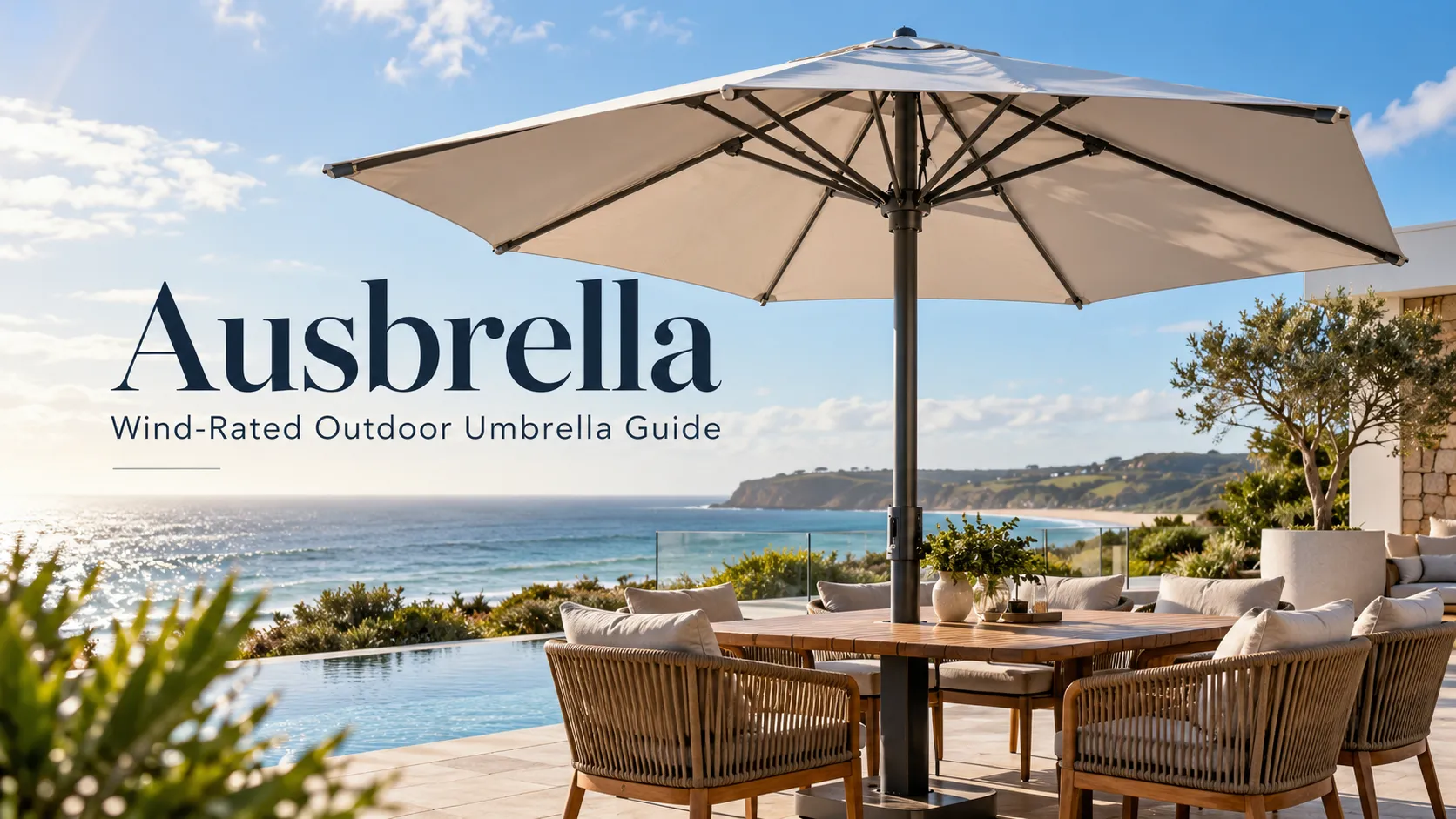
Ausbrella is a premium Australian-made outdoor market umbrella range produced by Awnet, designed for locations where wind resistance, structural strength, and long-term commercial use matter. The range includes the Storm 135 and the heavier-duty Hurricane 160+, with Awnet reporting wind-tunnel testing at Monash University and engineering certification for high-wind applications.
Unlike a lightweight patio umbrella bought primarily for occasional backyard shade, Ausbrella is positioned for resorts, councils, hospitality venues, pools, exposed outdoor spaces, and premium residential installations. Its defining feature is a reinforced multi-wall aluminium mast design intended to improve strength without relying on an extremely heavy solid pole.
What Is Ausbrella?
Ausbrella is a range of folding outdoor umbrellas created by Chris Pierias and manufactured by Awnet in Melbourne, Australia. Awnet describes itself as an Australian-owned manufacturer of market umbrellas, café barriers, and related outdoor products, with its manufacturing operation based in Dandenong, Victoria.
Awnet says Pierias developed Ausbrella after identifying a need for a stronger and safer market umbrella capable of remaining structurally stable in demanding outdoor environments. The design uses a reinforced central mast combined with interlocking frame components and a secured canopy system.
The important distinction is that Ausbrella is a large fixed or semi-fixed shade umbrella, not a handheld rain umbrella.
Typical applications include:
- Restaurants and cafés
- Hotels and resorts
- Council-managed public spaces
- Pool areas
- Outdoor dining zones
- Commercial courtyards
- High-end residential patios
- Locations exposed to stronger-than-normal winds
Awnet currently identifies itself as a division of Asigns Pty Ltd.
How the Ausbrella Design Works
The main engineering idea behind Ausbrella is its reinforced centre mast.
Ordinary market umbrellas often use a relatively simple hollow aluminium or timber pole. The Ausbrella design instead incorporates inner and outer tubular structures connected by reinforcing sections, producing what Awnet calls its twin-skin pole.
The underlying Australian patent documentation describes a mast with an inner tubular portion, an outer tubular portion, and interconnecting web sections. The design is intended to provide improved structural resistance while retaining the practical advantages of a comparatively lightweight mast.
Other Ausbrella features listed by Awnet include:
- Reinforced aluminium centre pole
- Interlocking umbrella arms
- Eight radial arms on the Storm design
- Stainless-steel fixtures
- Bolted fabric canopy
- Rope-free opening mechanism
- In-ground stainless-steel socket
- Engineering certification
- Australian manufacture
The bolted canopy is notable because the fabric is mechanically secured to the frame rather than simply resting over it. Awnet says this provides greater security in demanding conditions.
Ausbrella Storm 135 vs Hurricane 160+
There are two principal Ausbrella configurations currently promoted by Awnet.
| Feature | Ausbrella Storm 135 | Ausbrella Hurricane 160+ |
|---|---|---|
| Primary purpose | High-strength general outdoor use | Very high-wind locations |
| Published wind rating | 135 km/h | More than 160 km/h |
| Centre mast | Twin-skin pole | Double twin-skin pole |
| Engineering certification | Yes | Yes |
| Wind-tunnel tested | Yes | Yes |
| Opening design | No ropes or pulleys | No ropes or pulleys |
| Canopy attachment | Bolted | Bolted |
| Published warranty | 5 years | 5 years |
| Australian made | Yes | Yes |
Sources: Awnet’s individual Storm and Hurricane specifications.
Ausbrella Storm 135
The Storm model is the standard high-strength Ausbrella.
Awnet states that it is engineered for winds of up to 135 km/h and uses the twin-skin mast design. The company also says a 2.9-metre round Storm umbrella was tested in the Monash University wind tunnel at 135 km/h.
Awnet positions the Storm as appropriate for most Australian regions.
There is a small specification inconsistency worth noting. Awnet’s main Ausbrella overview currently refers to the Storm range as having a 140 km/h rating, whereas the dedicated Storm product page repeatedly describes it as Storm 135 and states a design rating of 135 km/h. Because the model-specific page is more detailed, 135 km/h is the clearer published specification to rely on unless Awnet confirms otherwise.
Ausbrella Hurricane 160+
The Hurricane is the stronger version.
Awnet says the Hurricane 160+ uses a double twin-skin centre pole and was tested to more than 160 km/h. According to the manufacturer, the umbrella reached the wind tunnel’s approximately 161 km/h maximum during testing.
Awnet specifically markets the Hurricane toward locations exposed to Australia’s more severe wind conditions and states that the model was designed with Region C conditions in mind. Its main Ausbrella page references metropolitan Brisbane and coastal areas extending north from around Coffs Harbour toward Broome as examples of locations within the relevant high-wind region.
This should not be interpreted to mean that every Hurricane installation is automatically suitable for every site. Local terrain, surrounding buildings, fixing methods, installation height, cyclone classification, soil or slab conditions, and engineering requirements can change the actual loads placed on an umbrella.
Was Ausbrella Really Wind-Tunnel Tested?
Awnet states that both Ausbrella ranges were tested through Monash University’s Mechanical and Aerospace Engineering wind-tunnel facilities. The manufacturer also says the umbrellas were assessed by Don Moore Engineering.
The dedicated Storm page says its test reached 135 km/h, while the Hurricane page states that testing reached approximately 161 km/h. Awnet notes that engineering certification and the Monash test report can be requested directly from the company.
That distinction matters because Awnet frequently markets Ausbrella as the “world’s strongest umbrella.” This is a manufacturer marketing claim rather than an independently established universal ranking of every commercial umbrella sold worldwide.
What can be stated more confidently is that the manufacturer publishes unusually high tested wind figures for the product and identifies specific engineering and wind-tunnel testing behind those figures.
What Does a 160 km/h Rating Actually Mean?
A high wind-test figure does not mean an umbrella should routinely be left open in every storm approaching that wind speed.
Laboratory testing examines a controlled configuration. Real outdoor installations involve additional variables such as:
- Gust direction
- Turbulence
- Terrain
- Nearby structures
- Mounting strength
- Anchor condition
- Canopy wear
- Loose fittings
- Age of components
- Debris impacts
- Uneven wind loading
A 160 km/h laboratory result therefore should not be treated as permission to ignore severe-weather warnings or site-specific engineering instructions.
For commercial or public-space installations, the anchoring system can be just as important as the frame itself.
The Ausbrella Patent Explained
Awnet’s marketing pages frequently reference Australian patent number 2014200765 in connection with the twin-skin mast design. The patent history is slightly more complicated than the website wording suggests.
Australian application AU2014200765A, titled A Mast and Umbrella, lists Christopher Pierias as the inventor and has a priority date of 13 February 2013. The patent document describes the multi-wall mast construction used to strengthen market umbrellas.
However, the original AU2014200765 application is recorded in Google Patents as abandoned.
A later divisional application, AU2018202191A, based on the same priority family, proceeded to granted patent AU2018202191B2, published as granted on 5 December 2019 and shown as active in the available patent record.
So describing the engineering as having patent protection is broadly consistent with the later granted family member, but simply stating that application 2014200765 itself is currently an active granted patent would be inaccurate.
Also Read: AnimeOwl: What Happened, Is It Still Available, and Is It Safe?
Materials and Construction
Awnet says its market umbrellas use aluminium structures and solution-dyed acrylic canvas, with Ausbrella receiving a reinforced version of the company’s frame technology.
The Ausbrella Storm page specifically identifies:
- Twin-skin centre pole
- Eight radial arms
- Interlocking frame system
- Acrylic canvas
- Stainless-steel components
- In-ground stainless-steel socket
The Hurricane uses an even stronger double twin-skin pole.
Awnet says its broader acrylic canvas supply is selected for characteristics including UV resistance, tear resistance, resistance to rot, and colour durability.
Actual canvas colour, configuration, printing, and other options should be confirmed when ordering because commercial umbrellas are often configured for individual projects.
How Ausbrella Opens
Ausbrella does not use the conventional exposed rope-and-pulley arrangement found on many market umbrellas.
Awnet describes the range as having an easy opening system with no ropes or pulleys.
This is potentially useful in commercial environments because ropes are another component that can wear, fray, become tangled, or require replacement.
It also gives the umbrella a cleaner appearance around the central pole.
How Ausbrella Is Installed
Awnet lists a matching in-ground stainless-steel socket as part of the Ausbrella concept.
Fixed anchoring is particularly relevant for high-wind umbrellas. A strong canopy and frame achieve little if the supporting base or substrate cannot resist the forces transmitted through the pole.
For that reason, prospective buyers should confirm:
- The required model for their wind region.
- Whether the umbrella is being installed into concrete, pavement, soil, decking, or another substrate.
- The required footing or socket specification.
- Any local council requirements.
- Whether a structural engineer needs to approve the installation.
A standard portable umbrella base should not automatically be assumed suitable merely because it physically accepts a pole.
Ausbrella Warranty
Awnet currently states that Ausbrella umbrellas carry a five-year warranty on the frame and acrylic canvas cover.
That is longer than the three-year warranty Awnet advertises on several of its standard café umbrella products.
Buyers should still obtain the current written warranty terms before purchase. Warranty duration alone does not explain exclusions relating to incorrect installation, accidental damage, abnormal weather events, wear, modifications, misuse, or maintenance.
Ausbrella Pricing
Awnet does not publish a standard retail price for Ausbrella on the current product pages reviewed for this article. Customers are directed to contact the company for more information or a quotation.
This makes sense for a commercial-grade product because final cost can depend on:
- Umbrella model
- Canopy size
- Shape
- Fabric selection
- Printing or branding
- Frame finish
- Installation method
- Socket or anchoring hardware
- Freight
- Installation requirements
For comparison, Awnet publicly lists its more conventional Café Umbrella range from A$590, but that figure should not be used as an Ausbrella price because the two products have substantially different structures and specifications.
Who Is Ausbrella Best Suited For?
Ausbrella makes the most sense when wind resistance and commercial durability are more important than buying the cheapest shade umbrella available.
Good potential applications
Hospitality venues: Restaurants, cafés, breweries, wineries, and hotels with exposed outdoor dining spaces may value the heavier construction.
Councils and public spaces: Awnet specifically markets Ausbrella toward council areas where equipment may remain outside for long periods and public safety is important.
Resorts: Pool decks and resort courtyards often need umbrellas capable of coping with frequent opening, closing, sunlight, and weather exposure.
Wind-exposed homes: Premium residential properties near coastlines or open areas may benefit from a structurally stronger umbrella.
Commercial projects: Architects and facility operators requiring documented engineering information may find the availability of testing and certification useful.
When Ausbrella May Be More Than You Need
Not every patio requires a 135 or 160+ km/h wind-tested umbrella.
For a sheltered residential courtyard where an umbrella is used occasionally and stored during poor weather, a conventional quality market umbrella can be considerably cheaper and simpler.
Awnet itself sells standard café umbrellas starting from A$590 with published wind testing above 120 km/h, showing that Ausbrella sits at the stronger, more specialized end of its own product range.
The practical question is therefore not simply whether Ausbrella is stronger. It is whether the additional structural capability is necessary for the particular site.
Ausbrella vs Conventional Market Umbrellas
| Consideration | Ausbrella | Typical Standard Market Umbrella |
|---|---|---|
| Intended use | Commercial, exposed and premium installations | General residential or light commercial use |
| Central mast | Reinforced twin-skin design | Usually conventional hollow pole |
| Highest published Ausbrella test | More than 160 km/h | Varies widely |
| Fixed socket option | Core part of design | Depends on product |
| Canopy | Bolted to frame | Attachment system varies |
| Opening mechanism | No rope or pulley | Rope, pulley, crank or push-up common |
| Engineering documentation | Manufacturer says available | Product dependent |
| Purchase process | Quote based | Frequently retail priced |
| Portability | Secondary consideration | Often more portable |
This comparison is general. Commercial umbrellas from other manufacturers can also have engineered frames and substantial wind ratings.
Important Limitations to Consider
Ausbrella’s greatest strength can also create practical trade-offs.
A reinforced commercial umbrella is likely to require more planning than a normal patio model. Fixed installation may involve construction work, and relocating an in-ground system is clearly less convenient than moving a portable umbrella base.
Wind ratings also need to be interpreted correctly. A laboratory-tested umbrella is still part of a complete installation consisting of the canopy, frame, mast, socket, footing, substrate, and surrounding environment.
Finally, several of the strongest performance statements currently available come from Awnet itself. Buyers evaluating Ausbrella for a safety-critical commercial installation should request the actual engineering certificate, wind-tunnel report, installation requirements, and current warranty documentation rather than relying only on website marketing material.
Is Ausbrella Still Available?
Yes. As of September 2026, Awnet continues to list Ausbrella Storm 135 and Ausbrella Hurricane 160+ as current products on its Australian website.
Awnet also continues to manufacture market umbrellas and café barriers from its Melbourne operation and lists Ausbrella as its premium high-wind umbrella range.
FAQ About Ausbrella
What is Ausbrella?
Ausbrella is an Australian-made range of reinforced outdoor market umbrellas manufactured by Awnet. It is designed primarily for commercial, council, resort, poolside, and other wind-exposed outdoor locations.
How much wind can an Ausbrella withstand?
Awnet publishes a 135 km/h design rating for the Storm 135 and states that the Hurricane 160+ has been wind-tunnel tested at speeds exceeding 160 km/h. Real-world performance still depends on correct installation, anchoring, terrain, condition, and environmental factors.
Is Ausbrella really the world’s strongest umbrella?
Awnet markets Ausbrella using that phrase, but there is no universal independent ranking covering every commercial umbrella manufacturer worldwide. Its documented distinguishing feature is its unusually high manufacturer-reported wind-tunnel performance, particularly the Hurricane 160+.
Where is Ausbrella made?
Awnet states that Ausbrella is made in Australia, with the company’s integrated manufacturing operation located in Melbourne, Victoria.
Does Ausbrella have a warranty?
Yes. Awnet currently advertises a five-year warranty on the Ausbrella frame and acrylic canvas cover. Buyers should obtain the complete current warranty conditions before ordering.
How much does an Ausbrella cost?
Awnet does not currently display a fixed Ausbrella retail price on its product pages. Pricing is quote-based and can vary according to the model, canopy configuration, installation, anchoring, branding, freight, and project requirements.
Also Read: Björksly: Meaning, Uses, Ecology, and How Birch Scrub Is Managed
