


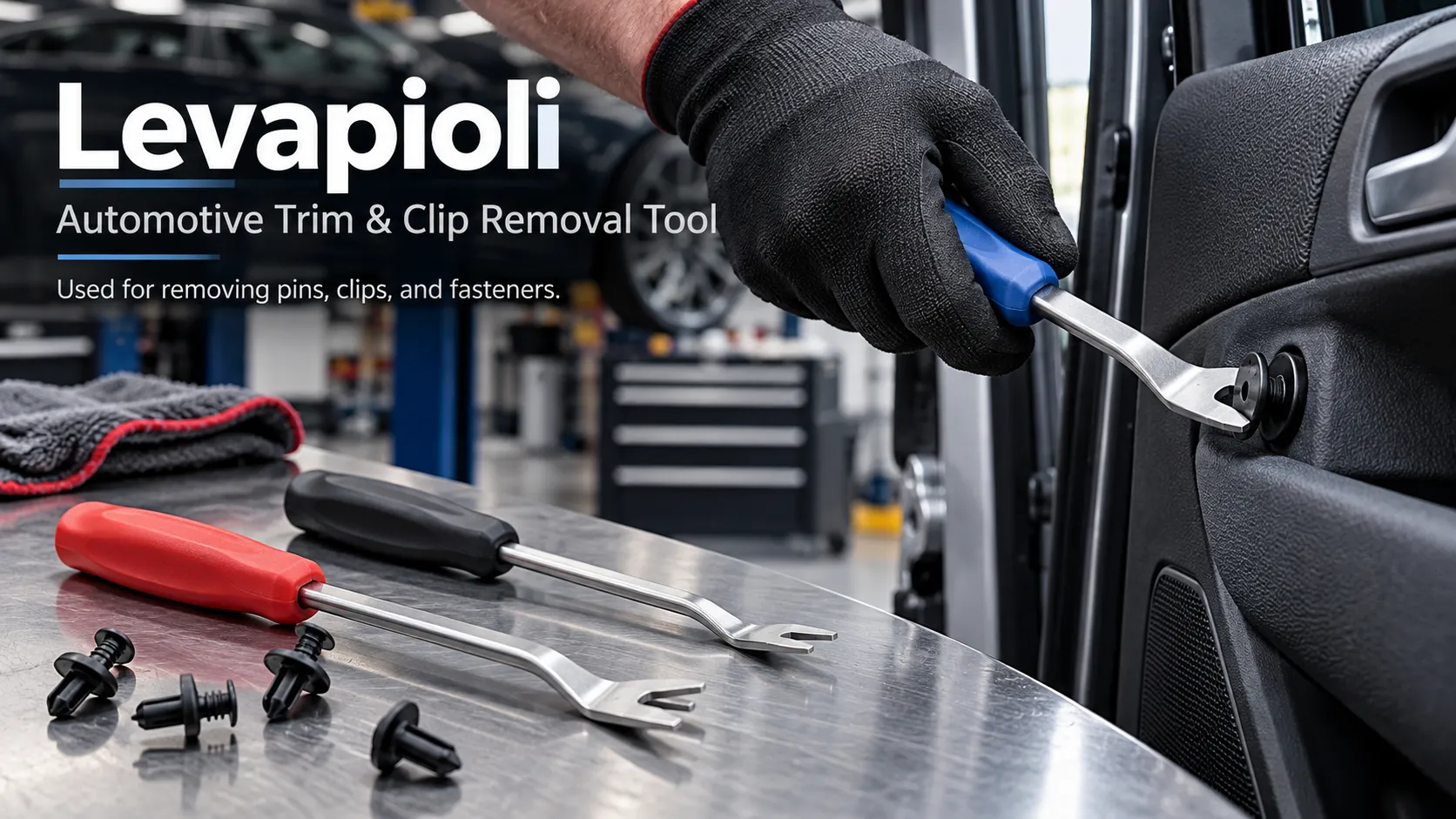
Levapioli is an Italian workshop term used for tools designed to lift or remove pins, clips, fasteners, and similar components, particularly during automotive bodywork and trim repair. Current manufacturer documentation strongly supports this technical meaning, despite recent websites giving the word unrelated definitions such as a food, cultural concept, or internet term.
Italian professional tool manufacturer Beta Utensili currently sells several products explicitly named levapioli, including stainless-steel versions and sets made from nylon or metal. Fasano Tools also lists levapioli among its professional automotive bodywork equipment.
What Is Levapioli?
A levapioli is essentially a specialized removal or levering tool. In automotive work, it is used where pins, clips, trim fasteners, plastic fittings, panels, and similar components need to be loosened without simply pulling them out by hand.
Beta Utensili places its levapioli range in its Autoriparazione > Carrozzeria, or automotive repair and bodywork, product category. Its current range includes individual stainless-steel tools, a five-piece nylon set, a five-piece metal set, pin extractors, and related tools for plastic clips and delicate trim components.
In English-speaking workshops, an equivalent tool may be described with names such as:
- trim removal tool
- panel clip remover
- fastener remover
- clip puller
- pin remover
- trim pry tool
These English descriptions are functional equivalents rather than exact translations for every levapioli design.
What Does the Word Levapioli Mean?
The construction of the word makes sense in Italian technical usage. Treccani defines levare with meanings that include raising, taking away, removing, and extracting something. It defines piolo as a peg or projecting cylindrical element fixed into another structure.
Taken together, levapioli can therefore be understood functionally as a tool for lifting or removing pegs or pins.
That explanation should not be confused with a proven historical etymology of the complete compound word. The individual Italian roots are documented, while the strongest evidence for levapioli itself comes from modern professional tool catalogs.
Evidence That Levapioli Is a Real Automotive Tool Term
The clearest evidence comes from manufacturers rather than general-interest blogs.
Beta Utensili currently lists products including:
| Product | Documented description |
|---|---|
| Beta 1479U/13 | Levapioli with stainless-steel blade |
| Beta 1479U/32 | Levapioli with stainless-steel blade |
| Beta 1479N/S5 | Set of five nylon levapioli |
| Beta 1479LB/C5 | Set of five metal levapioli |
| Beta 1479 | Extractor for pioli |
| Beta 1478 series | Pliers and tools for plastic pins and pressure clips |
Beta’s bodywork section lists these products alongside tools intended for dashboards, delicate components, plastics, seals, and automotive clips.
Its 2025 general catalog also identifies the 1479U/13 and 1479U/32 as “levapioli lama inox”, meaning levapioli with a stainless-steel blade. Both are listed at 220 mm overall length with a 95 mm working section.
The terminology is not limited to one manufacturer. Fasano Tools lists an FG 100/52A module containing eight levapioli and an FG 100/68 module containing five pin-lifting tools with stainless-steel blades as part of its professional bodywork range.
That independent industry usage makes the automotive interpretation considerably better documented than the alternative meanings that have recently appeared online.
What Is a Levapioli Used For?
The basic purpose is controlled removal. A levapioli allows force to be applied around or beneath a fastener rather than pulling blindly on the surrounding panel.
Typical automotive jobs can involve:
Removing Trim Clips
Modern vehicles use numerous plastic push clips and retainers. They may secure interior trim, liners, covers, panels, and other components.
A suitably shaped levapioli can be positioned around or underneath the fastener so that upward pressure is applied closer to its mounting point.
Working on Door and Interior Panels
Interior panels frequently combine screws, hooks, clips, and hidden retaining points. Once the appropriate screws or covers have been removed, trim tools can help release clips more precisely.
The exact procedure depends on the vehicle. A levapioli should not be treated as permission to force a panel when the position or type of fastener is unknown.
Dashboard and Console Work
Beta’s automotive range includes dedicated levering tools for dashboards and delicate parts alongside its levapioli products, showing that controlled trim removal forms part of the same professional bodywork-tool category.
Such tools can be relevant during radio, switch-panel, ventilation-trim, or interior-component servicing, although the correct procedure should always follow the particular vehicle’s service instructions.
Removing Plastic Fasteners
Push-type fasteners can become brittle with age and may be damaged if force is concentrated on one side. A forked or appropriately shaped removal tool can distribute force more evenly around the fastener.
This does not guarantee that an old clip will survive. Replacement clips are often needed during vehicle repair, particularly when plastic has deteriorated.
How Does a Levapioli Work?
Most versions rely on a very simple mechanical principle: leverage.
The working end is inserted underneath or around the part that needs to be released. The handle then allows controlled force to be applied to lift the fastener from its mounting hole or separate the trim from its retaining clip.
A typical process is:
- Identify the clip or fastener and determine how it releases.
- Choose a tool whose opening and profile fit the fastener.
- Insert the working end as close to the fastener’s base as possible.
- Apply gradual pressure rather than a sudden pull.
- Stop if the panel bends excessively or the fastener does not move.
- Check for another screw, locking tab, electrical connector, or hidden retaining point.
The last step is important. Automotive panels often contain several different attachment methods, and excessive leverage can damage the panel even when the tool itself is appropriate.
Also Read: Motivian: Company, Services, Qualco Deal and Current Status

Metal vs Nylon Levapioli
Professional ranges include both metal and non-metallic versions because no single material is ideal for every surface.
| Type | Main advantage | Main limitation | Typical situation |
|---|---|---|---|
| Nylon | Gentler around visible plastics and trim | Less rigid under heavy loads | Interior and delicate trim |
| Metal | Greater rigidity and leverage | Can mark soft surfaces if misused | Tighter or stronger fasteners |
| Stainless-steel blade | Durable and resistant to corrosion | Requires careful positioning | Workshop and bodywork use |
| Multi-piece set | Multiple shapes for different clips | More expensive than one tool | Frequent professional repair |
Beta officially offers both five-piece nylon and five-piece metal levapioli sets, while its 1479U series uses stainless-steel blades.
When Nylon Makes More Sense
Nylon tools are useful when the surrounding material is more important than maximum leverage. A softer tool is generally less likely to leave the kind of obvious surface mark that a hard metal edge can create on decorative plastic.
However, nylon is not automatically safe. Excessive force can still break clips, crack panels, or damage the tool.
When Metal Makes More Sense
Metal levapioli are useful when greater rigidity is required. They flex less and can transfer more force to stubborn components.
That advantage also increases the need for care. Paint, soft plastic, leather-covered trim, and decorative surfaces can be damaged by poorly positioned metal tools.
Levapioli vs a Screwdriver
A flat screwdriver can sometimes fit beneath a trim component, but it is not purpose-designed for clip removal.
A levapioli typically provides a working profile better suited to positioning force around a pin or fastener. Depending on its design, it may have a forked, slotted, curved, thin, or broad working end.
This distinction matters because concentrated pressure from a screwdriver can:
- leave marks in plastic
- scratch painted areas
- bend decorative trim
- damage the head of a clip
- apply force too far away from the fastener
A screwdriver remains the correct tool for screws. It is simply not an ideal substitute for every automotive trim-removal job.
Choosing the Right Levapioli
The best choice depends less on the name printed on the tool and more on the fastener being removed.
Check the Fastener First
Some clips pull outward. Others have a center pin that must be lifted first. Some release sideways or require dedicated pliers.
Trying to remove every clip in the same way is one of the easiest ways to break them.
Match the Tool Opening to the Pin
For forked tools, the opening should normally fit around the fastener without placing all the force on one narrow edge.
A tool that is too wide may not reach the correct point. One that is too narrow may damage the fastener.
Consider the Surface
Use particular caution around:
- glossy interior trim
- soft-touch plastics
- painted panels
- leather or synthetic upholstery
- wood-effect or metallic decorative inserts
A nylon trim tool or protective layer may be more appropriate on easily marked surfaces.
Buy a Set for Regular Automotive Work
Different vehicles use different clips, profiles, access angles, and fastener sizes. This is one reason professional manufacturers sell levapioli as multi-piece sets rather than a single universal shape.
Beta offers five-piece nylon and metal sets, while Fasano lists modules containing multiple levapioli for professional bodywork workstations.
Are Levapioli Only for Cars?
Their clearest documented professional context is automotive repair and bodywork. Beta categorizes the tools under automotive bodywork, and Fasano includes them in professional bodywork assortments.
The underlying principle, however, is not unique to automobiles. A suitable removal tool could potentially be useful anywhere similar removable pins or clips are used.
That does not mean every levapioli is approved for every mechanical application. Tool shape, material, fastener design, and required force still determine whether a specific tool is appropriate.
Why Are Some Websites Calling Levapioli a Food?
This is where current search results become misleading.
A number of recently published pages describe Levapioli as a grilled minced-meat dish resembling Balkan ćevapi, while others give it completely different cultural or conceptual meanings. At least some of those articles acknowledge that the supposed Levapioli dish does not have the established culinary documentation associated with genuine Balkan dishes such as ćevapi.
By contrast, the automotive meaning can be tied directly to physical products, manufacturer part numbers, professional catalogs, and established tool categories.
For example, Beta’s documentation identifies:
- 1479U/13 and 1479U/32 stainless-steel levapioli
- 1479N/S5 five-piece nylon set
- 1479LB/C5 five-piece metal set
Fasano Tools separately uses the same term in its automotive bodywork range.
Based on verifiable evidence available in September 2026, Levapioli is far better supported as an Italian automotive/bodywork tool term than as the historical name of a traditional food.
Common Mistakes When Using a Levapioli
Even the correct tool can cause damage when used incorrectly.
Using Too Much Force
If a clip refuses to move, more pressure is not always the answer. There may be a screw, locking mechanism, or secondary fastener that has not yet been released.
Levering Against a Fragile Edge
Thin decorative trim can crack when used as the fulcrum. The tool should be positioned so that pressure is transferred through a suitably supported area.
Starting Without Knowing What Is Behind the Panel
Door panels, pillars, dashboards, and consoles can conceal electrical connectors, wiring, sensors, speakers, and other components. Some areas of vehicles may also contain safety-system components.
For complicated interior disassembly, consult the vehicle manufacturer’s repair procedure rather than relying only on the visible clips.
Using Metal on Delicate Trim
A rigid steel blade can be useful, but it can also damage visible surfaces. A nylon tool is often the more cautious starting point when the surrounding material scratches easily.
Is Levapioli a Brand Name?
No evidence from the professional sources examined indicates that Levapioli itself is one specific brand.
Multiple manufacturers and sellers use the term descriptively for a category of tools. Beta Utensili and Fasano Tools, for example, both use levapioli within their automotive tool ranges.
A particular levapioli can still have a brand, model number, dimensions, material, and intended application. The word itself functions as the tool description in these documented examples.
Levapioli FAQ
What is a Levapioli?
A Levapioli is a removal or levering tool documented in Italian automotive and bodywork catalogs. It is used for working with pins, clips, fasteners, trim, and related components. Beta Utensili and Fasano Tools both use the term in their professional automotive ranges.
What is Levapioli called in English?
There is no single English term covering every design. Depending on the tool, comparable names include trim removal tool, clip remover, panel clip remover, fastener remover, pin remover, or trim pry tool.
Is Levapioli an Italian word?
It is demonstrably used in Italian professional tool terminology. The components also make linguistic sense: Treccani records levare with meanings including lifting and removing, while piolo refers to a peg-like component.
Is Levapioli a Balkan food?
Current authoritative evidence does not establish Levapioli as the traditional name of a Balkan dish. Some recent websites use the word for food resembling ćevapi, but professional Italian tool catalogs provide much clearer documentary evidence for the automotive-tool meaning.
Are nylon or metal Levapioli better?
Neither material is universally better. Nylon is useful around delicate surfaces, while metal provides greater rigidity and leverage. Professional manufacturers sell both types because different jobs require different tool properties.
Can a Levapioli remove car door-panel clips?
A suitable levapioli can be useful for automotive panel and trim fasteners, but the correct method depends on the particular clip and vehicle. Check for screws, locking pins, wiring, and other retaining mechanisms before applying force.
Also Read: Ciulioneros: Meaning, Origin, and What the Term Really Refers To
