


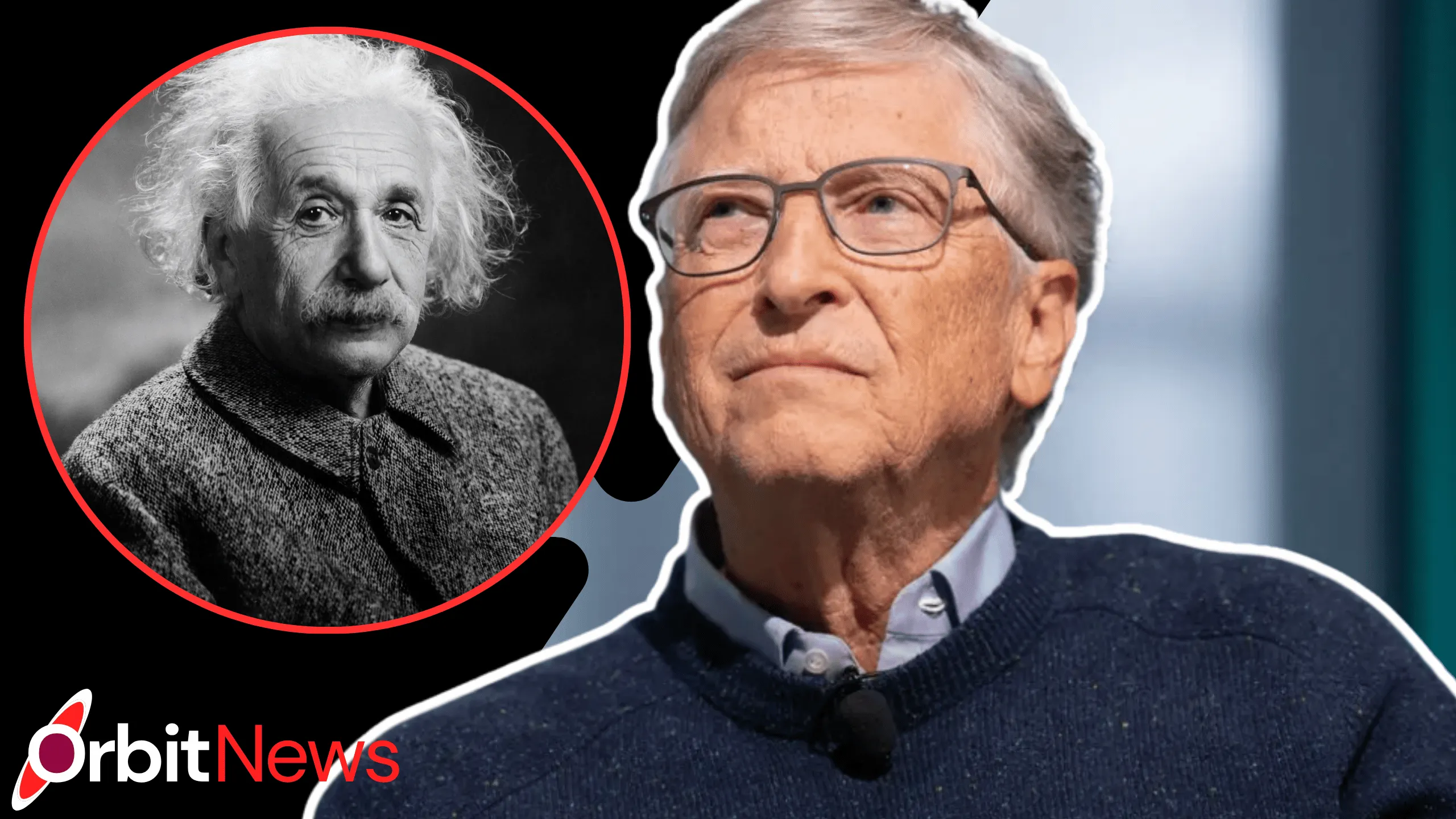
Albert Einstein and Bill Gates never met and had no personal or professional relationship. Einstein died on April 18, 1955, while Gates was born on October 28, 1955, a little more than six months later.
The two names are nevertheless often compared because both became symbols of extraordinary intellectual achievement and innovation. The comparison has limits, however. Einstein transformed theoretical physics, while Gates helped turn personal-computer software into a mass-market industry and later became one of the world’s most prominent philanthropists.
Did Albert Einstein and Bill Gates Ever Meet?
No. Albert Einstein and Bill Gates could not have met because their lives did not overlap.
Einstein was born in Ulm, Germany, on March 14, 1879. He died in Princeton, New Jersey, on April 18, 1955, at the age of 76. Gates was born in Seattle, Washington, on October 28 of that same year.
There is also no reliable historical evidence of a family relationship, professional connection, correspondence, collaboration, or other direct link between them.
Their connection is better understood as an intellectual comparison between two influential figures from different stages of modern scientific and technological history.
| Albert Einstein | Bill Gates |
|---|---|
| Born March 14, 1879 | Born October 28, 1955 |
| Died April 18, 1955 | Living |
| Theoretical physicist | Software entrepreneur and philanthropist |
| Best known for relativity and foundational work in quantum physics | Best known for co-founding Microsoft |
| Nobel Prize in Physics, 1921 | Built and led one of the defining companies of the PC era |
| Worked primarily in scientific research | Worked primarily in software, business, technology and philanthropy |
| Institute for Advanced Study faculty member | Chair and board member of the Gates Foundation |
Who Was Albert Einstein?
Albert Einstein was a theoretical physicist whose work fundamentally changed scientists’ understanding of space, time, energy, gravity and light.
After studying in Switzerland, Einstein worked at the Swiss Patent Office in Bern. The year 1905 became particularly important in his career because he published several groundbreaking papers while still working at the patent office. His work addressed special relativity, Brownian motion, mass-energy equivalence and the quantum properties of light.
Einstein later developed the general theory of relativity, which provided a new description of gravity based on the geometry of spacetime.
Einstein’s Nobel Prize Was Not for Relativity
One common misconception is that Einstein received his Nobel Prize specifically for relativity.
He was awarded the 1921 Nobel Prize in Physics for his services to theoretical physics, particularly his discovery of the law of the photoelectric effect. The prize was formally presented in 1922.
His explanation proposed that light could transfer energy in discrete quantities. This became an important step in the development of quantum physics.
The photoelectric effect is not merely historical. Related principles are important in technologies involving the interaction of light and electronic materials. Nobel Prize educational material notes applications including solar panels, light sensors and digital camera technology.
Einstein’s Later Career
After Adolf Hitler and the Nazi Party came to power in Germany, Einstein settled permanently in the United States.
He joined the Institute for Advanced Study in Princeton in 1933 and remained associated with the institute until his death in 1955. During those years, he continued working toward a unified theory that could describe fundamental physical forces within a common framework.
Einstein also became involved in issues extending beyond physics, including nuclear weapons, civil liberties, peace and the protection of people threatened by Nazi persecution.
Also Read: Rihanna and Safra Catz
Who Is Bill Gates?
Bill Gates is an American software entrepreneur and philanthropist best known as the co-founder of Microsoft.
Gates and his childhood friend Paul Allen founded Microsoft in 1975 after recognizing the potential of a new generation of microcomputers. Their early work centered on developing BASIC software for the Altair 8800.
Microsoft eventually became one of the most influential companies in personal computing. Products such as MS-DOS and Microsoft Windows helped establish software platforms used across homes, businesses and institutions.
Gates later reduced his day-to-day involvement with Microsoft. In 2008, he shifted his main professional attention toward philanthropy.
What Bill Gates Is Doing Today
As of 2026, Gates serves as chair and a board member of the Gates Foundation. His other work includes climate and clean-energy technologies, Alzheimer’s research, healthcare innovation and technology through organizations and initiatives including Gates Ventures, Breakthrough Energy and TerraPower.
His philanthropic plans have also changed significantly in recent years.
In May 2025, Gates announced that he intended to give virtually all of his remaining wealth to the Gates Foundation over the following two decades. The foundation plans to spend roughly an additional $200 billion before permanently closing at the end of 2045.
For 2026, its governing board endorsed an annual payout of $9 billion, with major goals involving maternal and child health, infectious diseases and poverty reduction.
What Is the Connection Between Albert Einstein and Bill Gates?
There is no direct historical connection, but there are several meaningful indirect similarities.
Both became associated with major transformations in human knowledge. Einstein changed the theoretical framework through which physicists understand nature. Gates helped develop and commercialize software during the rise of personal computing.
The nature of their achievements was very different.
Einstein primarily created scientific theories. Gates combined programming knowledge, product strategy, entrepreneurship and organizational leadership to build a technology company.
Gates Has Publicly Referenced Work About Einstein
There is at least one documented intellectual connection through Gates’ reading.
When Bill Gates recommended Walter Isaacson’s biography of Leonardo da Vinci, he described it as a worthy follow-up to Isaacson’s biographies of Albert Einstein and Steve Jobs, which Gates praised.
That does not establish Einstein as a direct personal influence on Gates, but it does show that Gates was familiar with and favorably regarded a major modern biography of Einstein.
It is more accurate to describe this as an intellectual or literary connection rather than a personal relationship.
Albert Einstein and Bill Gates Compared
The clearest comparison is not about deciding who was “smarter.” There is no scientifically meaningful way to reduce achievements in theoretical physics, computer programming, entrepreneurship and organizational leadership to a single intelligence ranking.
Their accomplishments came from different fields and required very different skills.
Approach to Innovation
Einstein often attacked fundamental conceptual problems.
His work asked questions such as what happens to measurements of space and time when observers are moving relative to one another, how gravity should be understood and how light exchanges energy with matter.
Gates focused heavily on making computing useful and widely accessible.
Microsoft’s early strategy was built around the idea that increasingly affordable microprocessors would create a large market for software. Gates and Allen recognized the significance of the Altair 8800 and developed software for it at the beginning of the personal-computer revolution.
Scientific Discovery vs Commercial Technology
Einstein was not primarily an inventor of consumer products. His greatest contribution was explaining fundamental features of physical reality through mathematics and theoretical reasoning.
Gates’ impact was much more closely tied to practical computing.
Microsoft created and commercialized software platforms used by large numbers of computer manufacturers, businesses and consumers. Gates therefore worked at the intersection of computer programming, product development and business strategy.
This distinction matters because calling Gates “the Einstein of computers” can be misleading. Gates is an important figure in computing history, but Einstein’s role was that of a foundational theoretical scientist rather than a technology entrepreneur.
Also Read: Dustin Hoffman and Safra Catz
Did Einstein’s Science Help Make Modern Computers Possible?
There is an indirect connection, but it should not be exaggerated.
Einstein contributed substantially to early quantum theory through his work on light quanta and the photoelectric effect. The American Physical Society describes his 1905 explanation of the photoelectric effect as an important milestone in the development of quantum physics.
Quantum mechanics later became fundamental to understanding the behavior of electrons in materials, which is essential to modern semiconductor physics.
However, it would be inaccurate to say that Einstein invented the computer, the semiconductor or the technologies used by Microsoft. Modern computing emerged from contributions by many physicists, mathematicians, engineers, computer scientists and companies across decades.
Einstein belongs to the deeper scientific history behind modern electronics rather than to the direct history of Microsoft.
Their Different Forms of Global Influence
Einstein’s influence is deeply embedded in modern physics.
His theories remain essential in areas ranging from astrophysics and cosmology to gravitational research. His work on photons also helped shape the development of quantum theory. More than a century later, his scientific papers remain part of the foundations on which modern physics is built.
Gates’ influence is more visible in modern computing and philanthropy.
Microsoft helped make standardized personal-computer software a central part of everyday business and home computing. Gates subsequently redirected much of his attention and financial resources toward global health, development, education and scientific innovation.
The Gates Foundation says it invested more than $102 billion during its first 25 years in areas including global health, development, U.S. education and economic mobility.
Did Albert Einstein and Bill Gates Have Similar Views on Using Knowledge for Society?
Some broad parallels can be drawn, but their philosophies should not be treated as identical.
Einstein increasingly used his international prominence to speak about war, nuclear weapons, civil liberties and humanitarian concerns. The Institute for Advanced Study records his involvement in protecting victims of Nazi persecution, supporting nuclear disarmament and advocating international cooperation.
Gates has taken a more institutional and financially driven approach. Through the Gates Foundation and related initiatives, he has funded research, vaccines, health programs, agricultural development, education and technological approaches to climate change.
Both therefore extended their influence beyond their original professional fields, but they did so in different historical circumstances and through very different mechanisms.
Albert Einstein and Bill Gates Timeline
| Year | Event |
|---|---|
| 1879 | Albert Einstein born in Ulm, Germany |
| 1905 | Einstein publishes several landmark scientific papers |
| 1921 | Einstein awarded the Nobel Prize in Physics |
| 1933 | Einstein joins the Institute for Advanced Study in Princeton |
| April 18, 1955 | Einstein dies in Princeton |
| October 28, 1955 | Bill Gates born in Seattle |
| 1975 | Gates and Paul Allen found Microsoft |
| 2000 | Gates Foundation established in its modern form |
| 2008 | Gates shifts his primary work toward philanthropy |
| 2025 | Gates announces an accelerated plan to give away virtually all his remaining wealth |
| 2026 | Gates Foundation reaches its planned $9 billion annual payout |
| 2045 | Gates Foundation is scheduled to close permanently |
What the Albert Einstein and Bill Gates Comparison Really Means
The most accurate way to connect Albert Einstein and Bill Gates is through their places in the history of innovation, not through a personal relationship.
Einstein helped reshape humanity’s understanding of the physical universe. Gates helped reshape how millions of people interacted with computers and later directed extraordinary financial resources toward health, development and technological research.
Their careers demonstrate two very different routes to large-scale influence: discovering fundamental principles and building systems that put technology into widespread use.
Frequently Asked Questions
Did Albert Einstein and Bill Gates know each other?
No. Einstein died on April 18, 1955, and Gates was born on October 28, 1955. Their lives never overlapped.
Was Bill Gates influenced by Albert Einstein?
There is no strong evidence that Einstein was a primary direct influence on Gates’ career. Gates has, however, publicly praised Walter Isaacson’s biography of Einstein, showing an interest in Einstein’s life and intellectual legacy.
Was Bill Gates born the same year Albert Einstein died?
Yes. Both events occurred in 1955. Einstein died on April 18, while Gates was born on October 28.
Who was smarter, Albert Einstein or Bill Gates?
There is no reliable scientific basis for declaring one of them smarter. Einstein’s achievements centered on theoretical physics, while Gates’ accomplishments involved programming, software entrepreneurship, technology strategy and organizational leadership. Claims based on supposed internet IQ scores should not be treated as a serious comparison without reliable evidence.
Did Einstein contribute to computer technology?
Not directly in the sense of designing computers or software. His work contributed to the foundations of quantum physics, which later became important for understanding electronic and semiconductor technologies, but modern computers resulted from the work of many later scientists and engineers.
What is Bill Gates doing in 2026?
Gates is chair and a board member of the Gates Foundation and remains involved in global health, technology, clean energy, climate innovation and Alzheimer’s research. The foundation has committed to a $9 billion annual payout in 2026 and plans to spend down its resources before closing at the end of 2045.
Also Read: Eminem and Safra Catz
