


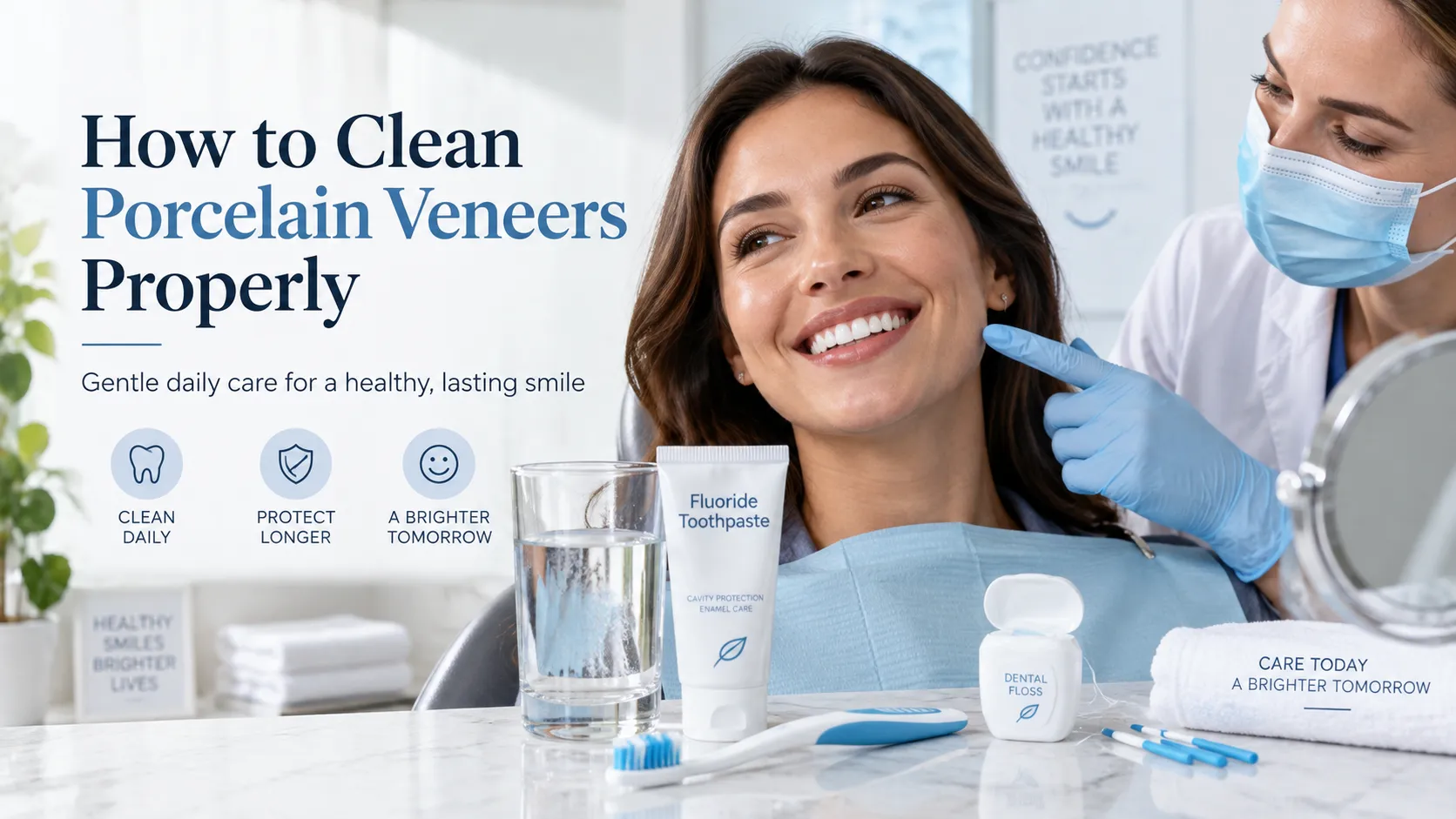
Porcelain veneers should be cleaned twice a day with a soft-bristled toothbrush and fluoride toothpaste, while the spaces between the teeth should be cleaned daily with floss or another suitable interdental cleaner. Gentle cleaning around the gumline is especially important because the natural tooth underneath and around a veneer can still develop decay and gum problems.
If you searched for how to clean porcelain veneers properly contribute to our blog, the most important point is that veneers do not require an elaborate cleaning routine. What matters is consistent plaque removal without unnecessarily damaging the veneer surface, its margins, the surrounding gums, or the natural tooth supporting it.
Porcelain veneers are thin ceramic shells bonded to the front of teeth. They are strong and relatively stain-resistant, but they are not indestructible. The American Dental Association notes that veneers can chip, crack, wear or loosen over time, and cavities can still develop underneath or around them.
How to Clean Porcelain Veneers Properly
A good daily routine combines gentle brushing with careful cleaning between the teeth. You do not need to scrub porcelain aggressively to keep it clean.
The American Dental Association recommends brushing twice daily for two minutes with fluoride toothpaste and cleaning between the teeth once a day. A soft-bristled toothbrush is preferred because it cleans effectively while reducing the risk of gum abrasion.
1. Brush Twice a Day With a Soft Toothbrush
Choose a toothbrush with soft bristles and a head that comfortably reaches all areas of your mouth.
Hold the toothbrush at approximately a 45-degree angle toward the gumline and use gentle, short strokes. Clean the front, back and chewing surfaces of the teeth rather than focusing only on the visible porcelain.
This angle matters because plaque tends to collect close to the gumline, including around the margins where veneers meet natural tooth structure.
The ADA specifically recommends soft bristles because they reduce the likelihood of damaging or irritating gum tissue.
An electric toothbrush is also reasonable if you prefer one. The important factors are good technique and avoiding excessive pressure.
2. Use Fluoride Toothpaste
Having porcelain veneers does not eliminate the need for fluoride.
The veneer itself cannot develop a cavity, but the natural tooth surrounding and supporting it can. The ADA therefore recommends brushing veneers with fluoride toothpaste twice daily.
Fluoride helps protect exposed natural enamel and tooth structure from decay. This becomes particularly important around veneer margins, where plaque accumulation can affect both the tooth and nearby gums.
For routine care, choose a reputable fluoride toothpaste and preferably one carrying the ADA Seal of Acceptance.
3. Be Careful With Highly Abrasive Products
Cleaning harder does not necessarily mean cleaning better.
Dental toothpastes contain abrasive ingredients that help remove plaque and surface stains. However, formulations vary considerably, and abrasive cleaning products can affect dental materials differently. The ADA explains that toothpaste abrasivity is influenced by ingredients such as silica, calcium carbonate and aluminum oxides.
Laboratory research published in 2024 also found that simulated brushing with some whitening toothpastes increased surface roughness in certain CAD/CAM ceramic materials. The amount of change depended on the material and toothpaste, so the findings should not be interpreted as proof that every whitening toothpaste damages every porcelain veneer. They do support taking a cautious approach to unnecessary abrasive polishing products.
Cleveland Clinic recommends a non-abrasive fluoride toothpaste for people with veneers.
If you are uncertain whether a whitening, polishing or stain-removing toothpaste is appropriate for your particular veneers, ask the dentist who placed or maintains them.
How to Floss Around Porcelain Veneers
You should normally floss teeth with porcelain veneers just as you would natural teeth.
The ADA recommends cleaning between the teeth every day because toothbrush bristles cannot effectively reach every interproximal surface. Interdental cleaning removes food debris and plaque associated with tooth decay and gum disease.
Use a gentle technique:
- Guide the floss slowly between the teeth instead of snapping it against the gums.
- Curve it into a C shape against the side of one tooth.
- Gently move it up and down along the tooth surface and slightly below the gumline.
- Repeat against the neighboring tooth before moving to the next space.
This is consistent with the ADA’s recommended flossing technique.
A properly bonded veneer should not prevent normal flossing. However, if floss repeatedly catches, tears or cannot pass through a particular contact, do not force it aggressively. Ask your dentist to examine the area. A rough margin, excess bonding material or another restoration issue may need professional attention.
Can You Use a Water Flosser With Porcelain Veneers?
Yes, a water flosser can be an alternative or additional way to clean between teeth, particularly for people who find conventional floss difficult to manipulate.
ADA-accepted water flossers have been shown to remove plaque and can help reduce gingivitis. They may also be useful around dental work where access is difficult.
A water flosser does not make brushing unnecessary. It should be viewed as part of an oral-hygiene routine rather than a replacement for cleaning the visible tooth surfaces.
Your dentist or hygienist can recommend the most appropriate interdental method based on how closely your teeth are spaced and the condition of your gums.
Pay Special Attention to the Gumline
The visible porcelain surface is only one part of veneer maintenance. Gum health is equally important.
Research on porcelain laminate veneers has generally found satisfactory periodontal outcomes when restorations are properly designed and patients maintain good oral hygiene. A review of clinical literature found that veneers were compatible with healthy gingival tissues when oral hygiene was optimal.
Long-term clinical studies also show why monitoring the gumline matters. One retrospective study of porcelain laminate veneers found varying degrees of gingival inflammation among patients and some gingival recession, although average pocket depths around restored and unrestored surfaces were not significantly different.
These findings do not mean veneers necessarily cause gum disease. They reinforce the importance of controlling plaque and having the margins of veneers checked during routine dental examinations.
Look out for:
- persistent redness or swelling
- repeated bleeding during brushing or flossing
- gum recession
- persistent bad breath
- tenderness around a veneered tooth
These symptoms deserve dental evaluation rather than simply more aggressive brushing.
Should You Use Mouthwash With Porcelain Veneers?
Mouthwash can be used with veneers when it suits your oral-health needs, but it is optional for many people and cannot replace brushing or interdental cleaning.
Therapeutic mouthrinses may contain ingredients designed to reduce plaque, gingivitis, tooth decay or bad breath. Fluoride-containing rinses may provide additional cavity protection in appropriate patients.
The best product depends on your individual needs. For example, a person with a higher risk of tooth decay may benefit from a different rinse than someone primarily managing gum inflammation or dry mouth.
Do not assume that an expensive “veneer mouthwash” is required. Discuss the choice with your dentist if you have gum disease, dry mouth, recurrent cavities or extensive dental restorations.
Do Whitening Products Clean Porcelain Veneers?
Whitening products do not bleach porcelain veneers to a lighter shade.
The ADA states that tooth-whitening treatments do not work on veneers, crowns or fillings in the same way they work on natural tooth structure.
This has an important practical consequence. If your natural teeth become lighter after bleaching, previously matched veneers may no longer match them.
Whitening toothpaste can sometimes remove superficial stains from natural teeth, but it cannot change the underlying shade of porcelain. Some whitening formulations also rely on abrasives, so they should not automatically be considered the best way to “polish” veneers.
If a veneer appears darker than it once did, the discoloration may be associated with surface deposits, the bonding margin, surrounding natural tooth structure or another issue that requires professional examination.
Avoid DIY Scrubs and Harsh Cleaning Methods
Do not clean porcelain veneers with household abrasives or improvised whitening mixtures.
Baking soda mixtures, activated charcoal powders, acidic fruit preparations and similar DIY treatments are frequently promoted online. The ADA reports insufficient evidence supporting charcoal oral-care products for safe and effective whitening and warns that abrasive or acidic DIY techniques can damage natural tooth structure.
Veneers are professionally finished restorations. There is little reason to expose them, their margins and nearby enamel to uncontrolled polishing powders or acidic mixtures.
Also avoid attempting to scrape tartar from around veneers with metal instruments, pins or other sharp household objects. Hardened tartar should be removed by a dental professional.
Can Coffee, Tea and Red Wine Stain Porcelain Veneers?
Porcelain veneers generally resist staining better than composite restorations and natural enamel, but they are not completely maintenance-free.
Cleveland Clinic describes porcelain veneers as stain-resistant while still advising moderation with dark-colored beverages such as coffee, tea and red wine. The ADA similarly advises caution with foods and beverages that can discolor veneers.
Another issue is that the veneer is only part of the visible tooth. Natural enamel and bonding margins may change appearance differently over time.
After strongly colored drinks, rinsing the mouth with water is a simple way to clear residual pigments. Maintaining routine brushing is more important than aggressively scrubbing immediately after every coffee or tea.
Foods and Habits That Can Damage Veneers
Cleaning is only part of veneer care. Physical damage can shorten the life of an otherwise healthy restoration.
Avoid using veneered front teeth to:
- bite fingernails
- open packages
- tear labels
- chew ice
- crack hard foods or objects
- hold pins or other objects
The ADA advises people with veneers to avoid nail biting and chewing hard objects or foods.
For particularly hard foods, cutting them into smaller pieces and chewing with the back teeth can reduce unnecessary stress on anterior veneers.
If you participate in contact sports or activities with a risk of facial injury, an appropriate mouthguard can help protect the teeth and restorations.
What If You Grind Your Teeth?
Grinding and clenching can place unusually high forces on porcelain restorations.
The ADA notes that people who clench or grind their teeth should discuss this with their dentist because these forces may affect whether veneers are appropriate in the first place.
If you already have veneers and grind your teeth, your dentist may evaluate your bite and determine whether a professionally fitted night guard or another treatment is appropriate.
Do not buy or modify an appliance solely because a website claims every veneer patient needs one. Bruxism management should be individualized.
Professional Cleaning Is Still Necessary
Even excellent home hygiene cannot remove every dental deposit.
Plaque that remains on teeth can mineralize into tartar, also known as calculus. Once tartar forms, the ADA states that professional dental cleaning is needed to remove it.
Professional appointments also allow the dentist or hygienist to examine areas that are difficult to evaluate at home, including veneer margins and the surrounding gum tissue.
They can look for:
- plaque and tartar accumulation
- gum inflammation or recession
- decay near the veneer margin
- small chips or cracks
- marginal discoloration
- looseness
- changes in the bite
Clinical research shows that porcelain laminate veneers can perform well for many years, but outcomes depend on several factors including restoration design, bonding, remaining tooth structure and maintenance. A 2024 review of laminate-veneer studies reported satisfactory survival and success for several commonly used ceramic materials.
How often you require examinations and professional cleaning should be based on your individual dental and periodontal needs rather than an arbitrary schedule.
Signs a Veneer Needs a Dentist Rather Than More Cleaning
Not every change in a veneer’s appearance is caused by dirt or staining.
Arrange a dental assessment if you notice:
- a veneer moving or feeling loose
- a visible crack or chip
- a new gap at the margin
- persistent pain or sensitivity
- floss suddenly catching around one veneer
- swollen or bleeding gums that do not improve
- significant gum recession
- a change in your bite
- persistent discoloration around the edge of the restoration
The ADA notes that veneers can chip, crack, wear or loosen and may eventually require rebonding, repair or replacement.
Trying to polish, glue or reshape a damaged veneer at home can make the problem more difficult to treat.
A Simple Daily Porcelain Veneer Cleaning Routine
For most people, effective veneer maintenance is straightforward.
Morning: Brush for two minutes with a soft-bristled toothbrush and fluoride toothpaste.
During the day: Rinse with water after strongly colored foods or drinks when convenient. Avoid chewing hard objects with veneered teeth.
Evening: Brush again for two minutes and clean between every tooth using floss or another appropriate interdental cleaner.
As advised by your dentist: Use any recommended mouthrinse, night guard or other protective appliance and attend professional examinations and cleanings.
The goal is not to polish the porcelain aggressively. It is to maintain a healthy environment around the entire restoration.
Why Good Cleaning Matters Even Though Porcelain Cannot Decay
A porcelain veneer does not develop dental caries because it is a ceramic restoration. The tooth supporting it, however, remains biologically vulnerable.
The ADA explicitly warns that cavities can still develop underneath or around veneers.
Plaque can also affect the gums bordering the veneer. If inflammation progresses or gum tissue recedes, previously hidden restoration margins may become visible, potentially affecting both oral health and appearance.
This is why the healthiest veneer routine is essentially an excellent natural-tooth routine with added care to avoid unnecessary abrasion and physical damage.
Frequently Asked Questions
What is the best way to clean porcelain veneers every day?
Brush twice daily for two minutes using a soft-bristled toothbrush and fluoride toothpaste. Clean between the teeth once daily using floss or another appropriate interdental cleaner.
Can I use normal toothpaste on porcelain veneers?
Yes, but a non-abrasive fluoride toothpaste is a sensible choice. Fluoride remains important because the natural tooth around and underneath the veneer can still develop decay. Cleveland Clinic specifically recommends non-abrasive fluoride toothpaste for veneers.
Can flossing pull a porcelain veneer off?
Routine, gentle flossing should be part of veneer care. Do not snap floss against the gums, and have a dentist examine any contact where floss repeatedly catches, shreds or cannot pass normally.
Can porcelain veneers become yellow?
Porcelain is relatively stain-resistant, so a significant color change should not automatically be assumed to be ordinary staining. Surface deposits, changes in nearby natural teeth, discoloration around the margins or other restoration issues can alter the overall appearance. A dentist can determine the cause.
Can teeth whitening make porcelain veneers white again?
Bleaching products cannot change the inherent color of porcelain veneers. The ADA states that conventional tooth whitening does not work on veneers, crowns or fillings.
How often should porcelain veneers be professionally cleaned?
There is no single cleaning interval that is appropriate for every patient. Regular dental examinations and professional cleanings should be scheduled according to your dentist’s assessment of your cavity risk, gum health, plaque and tartar accumulation, and the condition of the veneers.
Also Read: Is Dental Contouring Painful Contribute to Our Blog
