


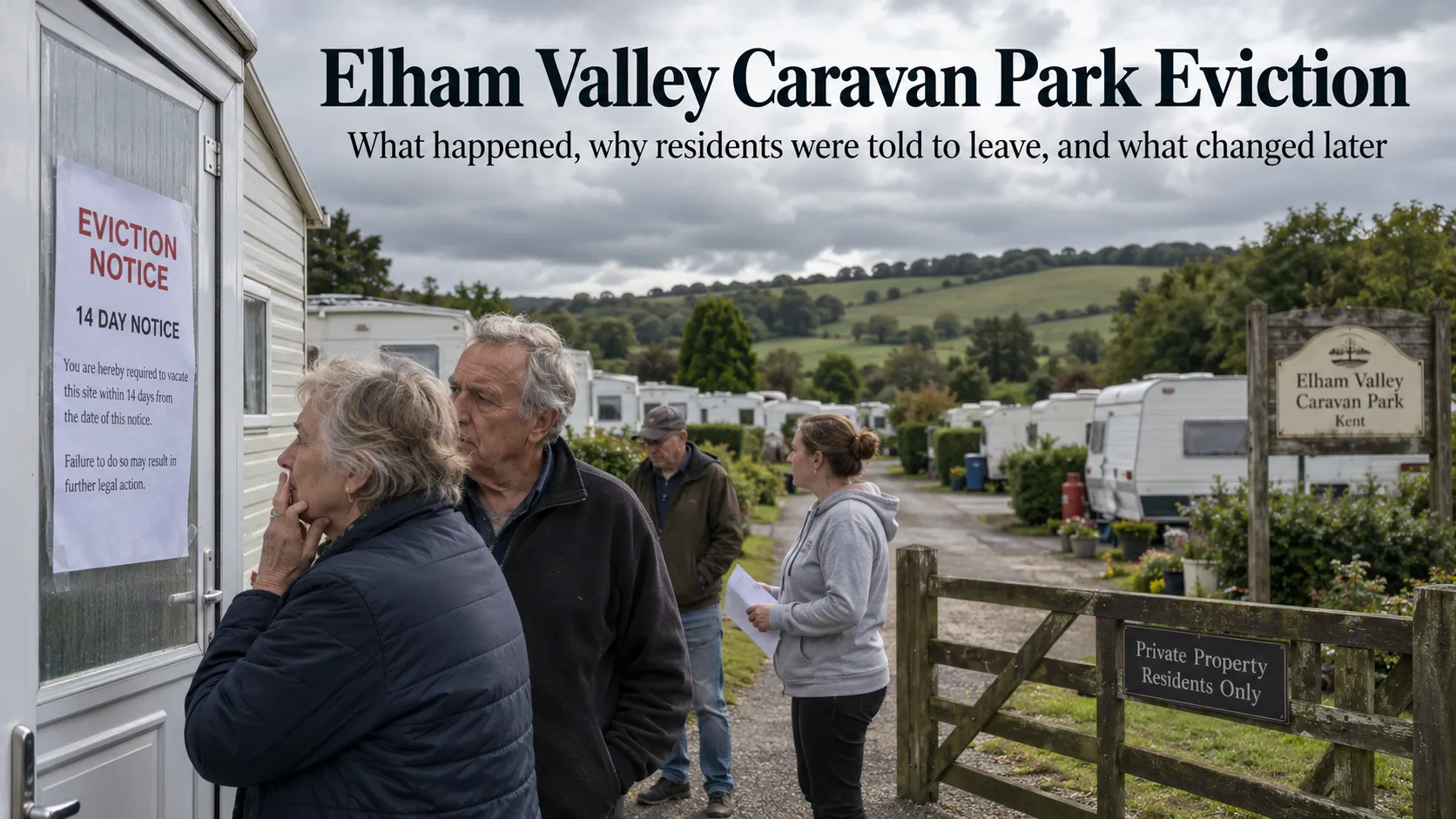
The Elham Valley Caravan Park eviction refers to eviction notices given to residents of a caravan site near Elham in Kent in August 2025, reportedly telling them they had 14 days to leave. Around 19 caravans were occupied at the time, and some people had treated the site as their home for years.
The story is more complicated than a straightforward council eviction. The immediate notices appeared during a receivership and attempted sale of the property, while separate disputes had been running for years over planning permission, permanent residential occupation and the site’s caravan licence. Later records also show an important change: by mid-2025 the site had obtained a lawful development certificate permitting touring caravans to be used for unrestricted human habitation.
What Is Elham Valley Caravan Park?
Elham Valley Holiday Park, also known in council records as Goldpark Leisure Caravan and Camping Site, is on Canterbury Road at Wingmore in the Elham Valley, Kent.
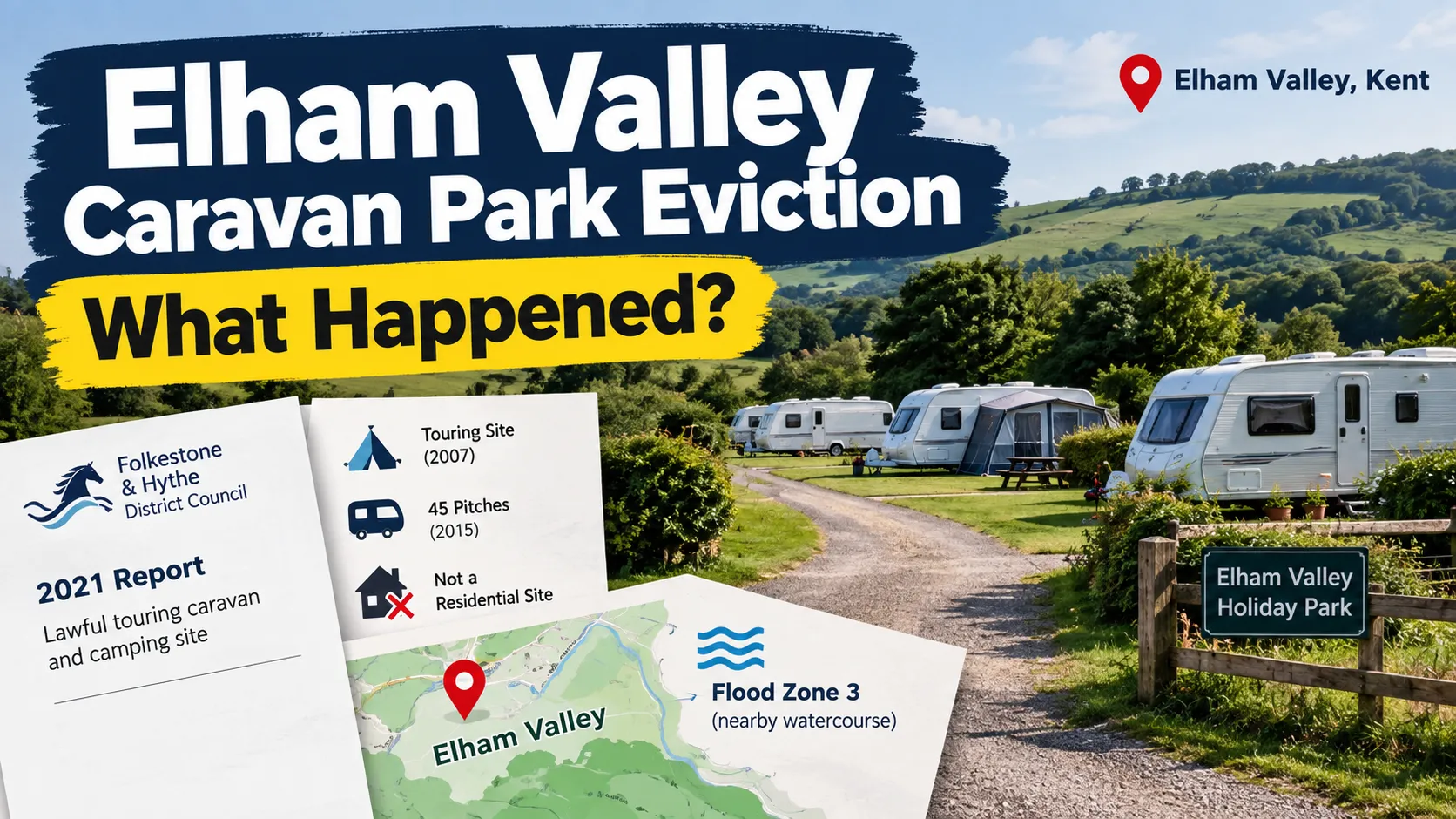
A 2021 Folkestone and Hythe District Council report described the land as a lawful touring caravan and camping site. It sits outside a defined settlement boundary and within the protected North Downs landscape. Much of the site is also within Flood Zone 3 because of the nearby Nail Bourne watercourse.
The site’s planning history stretches back to 2007, when a Certificate of Lawful Use was granted for camping and touring caravans. In 2015, the then Shepway District Council issued a replacement caravan site licence permitting a 45-pitch camping and touring caravan site.
That distinction between a touring site and a residential site became central to everything that followed.
Why Were People Living There Permanently?
Although the original lawful use was for camping and touring caravans, people gradually began using caravans on the site as their main homes.
Council records show that a complaint about residential occupation was received in January 2018. Officers found evidence that at least one caravan or converted vehicle was being used as a permanent residence, and a June 2018 visit indicated that three units appeared to be lived in.
The council considered this a material change from the authorised use of the land. Its legal department told the owners in 2019 that the residential use should cease, but it continued.
After ownership changed, the council contacted the new owners again in 2020. Enforcement was delayed during Covid restrictions. By February 2021, a response to a Planning Contravention Notice confirmed that nine individuals were living permanently in touring caravans or campervans at the park.
This is important because permanent occupation was not simply an issue that appeared during the 2025 eviction dispute. Authorities had been examining residential use for several years.
The 2021 Planning Enforcement Decision
On 23 March 2021, Folkestone and Hythe District Council’s Planning and Licensing Committee considered formal enforcement action.
Council officers argued that turning the touring park into permanent residential accommodation conflicted with countryside planning policies. They also raised concerns about landscape impact, flood risk and potential effects connected with the Stodmarsh protected area.
The committee resolved that an enforcement notice should require:
the residential use to cease, the relevant caravans and associated residential items to be removed, and a 12-month compliance period to be provided.
The decision was approved by 10 councillors, with two abstentions.
At that point, the council’s position was clear: permanent residential occupation was not considered part of the site’s lawful planning use.
However, the legal planning position later changed.
A Major Change in 2025: Residential Occupation Became Lawful
One of the most important facts in understanding the Elham Valley Caravan Park eviction is missing from many online summaries.
Planning application 21/1933/FH sought a lawful development certificate for the stationing of touring caravans, under the earlier 2007 certificate, for unrestricted human habitation. Elham Parish Council recorded the proposal as early as November 2021 and raised no objection at that meeting.
By July 2025, parish council records showed that Folkestone and Hythe District Council had determined application 21/1933/FH as “Lawful.”
That changed the planning picture significantly.
October 2025 parish council minutes stated explicitly that the land had been issued with a Lawful Development Certificate permitting unrestricted human habitation. The minutes added that the council’s licensing team had advised the new owners to seek a mixed-use caravan site licence covering both touring and residential caravans.
Planning permission and caravan-site licensing are separate legal regimes, however. Having lawful planning status for residential occupation does not automatically resolve whether the correct caravan site licence is in force.
What Triggered the August 2025 Eviction Notices?
The immediate trigger was closely connected to the site’s financial and ownership situation.
Companies House records show that Yieldcom Limited, which had owned the property, entered receivership arrangements in December 2024. Alexander Kinninmonth and James Prior of FRP Advisory Trading Limited were appointed as receivers on 6 December 2024.
This point deserves clarification because some secondary reports describe Yieldcom as having “gone into liquidation.” The official Companies House record available for the relevant period identifies the insolvency case as a receiver/manager appointment, not a company liquidation.
A registered charge over Elham Valley Holiday Park had previously been created in favour of Onyx Asset Finance Limited. Companies House specifically identifies the charged property as Elham Valley Holiday Park, Canterbury Road, Wingmore.
The receivers therefore became central to what happened next.
Residents Were Given 14 Days to Leave
Local reporting in August 2025 said notices were attached to residents’ caravans telling them they had 14 days to leave.
KentOnline’s reporting, subsequently distributed through its podcast and video channels, described approximately 19 occupied caravans at the park, with some residents having lived there for as long as a decade. Residents feared they could become homeless.
Secondary reporting identified Trethowans LLP as acting in connection with the receivers and reported that notices were delivered around 12 August 2025. It also identified FRP Advisory as the firm handling the receivership. The FRP connection is independently confirmed by Companies House.
The notices reportedly characterised the remaining occupiers as trespassers.
That wording created a serious dispute because several occupants maintained that they had previously paid to live there and had treated the park as their established home.
Was the Council Responsible for the Eviction?
Not directly, based on the evidence available.
The 2021 council enforcement action concerned planning law. The August 2025 notices came against the background of the private receivership and proposed sale of the property.
There was, however, a separate caravan licensing issue.
Reporting at the time stated that Folkestone and Hythe District Council had revoked the existing caravan site licence in July 2025. Elham Parish Council’s September 2025 minutes independently refer to a “revoked license” and record concerns that residents appeared to believe a licence was still operating.
Local reporting said the licence problems involved issues including fire safety, refuse management and overcrowding. Those specific reasons are reported claims rather than findings reproduced in the council records reviewed for this article, so they should not be treated as independently verified here.
Planning Permission and a Site Licence Are Not the Same Thing
This distinction explains much of the apparent contradiction in the case.
A lawful development certificate deals with whether a particular use of land is lawful for planning purposes. A caravan site licence deals with how a caravan site may legally operate, including health, safety and site-management requirements.
The park could therefore have lawful planning status permitting unrestricted habitation while still having problems with its caravan site licence.
That appears to be exactly what happened during 2025.
By October, parish council minutes stated that the new owners had applied for another caravan site licence. The licensing team had reportedly recommended a mixed-use licence, reflecting the fact that residential occupation could no longer simply be restricted through planning conditions.
Timeline of the Elham Valley Caravan Park Eviction
| Date | Development |
|---|---|
| 2007 | Certificate of Lawful Use granted for camping and touring caravans. |
| June 2015 | Replacement licence authorised a 45-pitch camping and touring caravan park. |
| January to June 2018 | Council investigated reports of permanent residential occupation. |
| June 2019 | Council said residential use was a planning breach and requested that it cease. |
| January 2021 | Planning Contravention Notice served on Yieldcom Limited. |
| February 2021 | Information supplied to the council confirmed nine permanent residents. |
| March 2021 | Council authorised an enforcement notice against permanent residential use. |
| November 2021 | Parish council considered application 21/1933/FH for unrestricted habitation. |
| December 2024 | FRP Advisory practitioners appointed as receivers in relation to Yieldcom. |
| By July 2025 | Application 21/1933/FH recorded as lawful, permitting touring caravans for unrestricted human habitation. |
| August 2025 | Residents in around 19 caravans received notices giving them 14 days to leave. |
| September 2025 | Parish council minutes referred to the caravan site licence as revoked. |
| October 2025 | New owners had applied for a site licence; a mixed residential and touring licence was recommended. |
| November 2025 | Sanderson Weatherall confirmed the approximately two-acre, 45-pitch park had been sold on behalf of the receivers. |
| December 2025 | Companies House recorded the FRP receivers as having ceased to act. |
What Happened to the Caravan Park After the Eviction Notices?
The most important confirmed development is that the property was sold.
On 20 November 2025, property consultancy Sanderson Weatherall announced that it had completed the sale of Elham Valley Caravan Park on behalf of the receivers. It described the property as an approximately two-acre, 45-pitch touring park with electric hook-ups and an amenity building containing toilets and showers.
Companies House subsequently recorded that the FRP receivers ceased acting in December 2025.
The October parish council record had already referred to “new owners” applying for a caravan site licence, suggesting plans were underway to regularise the site’s future operation.
Publicly accessible authoritative records reviewed for this article do not clearly establish the eventual outcome for every resident who received an eviction notice. Claims that all occupants were physically evicted after exactly 14 days should therefore be treated cautiously unless supported by later court, council or first-hand records.
Did the 14-Day Notice Automatically Mean Residents Had to Be Physically Removed?
Not necessarily.
Caravan occupation law in England depends heavily on the site’s legal status, the resident’s agreement, whether the person owns or rents the caravan, and whether the site qualifies as a legally protected residential site.
Shelter’s legal guidance explains that a person renting a mobile home on a protected residential site generally cannot be evicted without a court order. Protected status normally depends on both appropriate planning permission and a site licence allowing year-round residence.
Rights can be considerably weaker on an unprotected or holiday site. Even then, some occupiers may have contractual rights or, depending on the circumstances, arguments under the Protection from Eviction Act 1977.
Because Elham Valley’s planning and licensing status was changing during precisely the same period as the notices, it would be unsafe to declare that every resident either definitely had or definitely lacked protection from eviction.
Individual agreements and legal status would have needed to be examined.
Why the Elham Valley Case Became So Complicated
Three different issues became intertwined.
First was planning law. The council originally considered permanent residential occupation unlawful, but a later lawful development certificate recognised unrestricted human habitation.
Second was caravan-site licensing. The existing licence was subsequently described as revoked, and the new owners were later advised to apply for a mixed-use licence.
Third was property ownership and receivership. Yieldcom’s receivers were attempting to realise the value of a secured asset, eventually resulting in the sale of the park.
Those processes operate under different legislation and do not automatically produce the same answer. A site may have lawful planning use while lacking an appropriate licence, and an occupier may have contractual or statutory rights even when an owner wants possession.
That is why describing the case simply as “the council evicted people from an illegal caravan park” would be misleading.
Current Position
The latest reliable public records establish that the park was sold in November 2025 and that the receivers ceased acting the following month. They also establish that unrestricted human habitation of touring caravans had become lawful for planning purposes and that the new owners were pursuing a new caravan site licence.
What is less clear from available authoritative material is the final status of each person who lived there during the August 2025 dispute and whether the mixed-use licence application was ultimately granted on the terms discussed in the October parish council meeting.
Any claim about the park’s present residents or the final outcome of individual eviction cases should therefore be verified against newer licensing or court records rather than inferred from the original 14-day notices.
FAQ
Why were residents being evicted from Elham Valley Caravan Park?
The immediate eviction notices arose during the receivership and sale process involving the property’s owner, Yieldcom Limited. Around 19 occupied caravans were reported at the site when residents received notices giving them 14 days to leave in August 2025.
Was permanent living at Elham Valley Caravan Park illegal?
The answer changed over time. Folkestone and Hythe District Council considered permanent residential occupation unauthorised in 2021, but by July 2025 application 21/1933/FH had been recorded as lawful for the stationing of touring caravans for unrestricted human habitation.
Did Elham Valley Caravan Park lose its licence?
Parish council records from September 2025 refer to the caravan site licence as having been revoked. By October, the new owners had applied for another licence and the licensing team had recommended a mixed-use arrangement covering touring and residential caravans.
Was Yieldcom Limited liquidated?
Official Companies House information does not describe the relevant 2024 event as liquidation. It records the appointment of receivers or managers, with FRP Advisory practitioners appointed in December 2024 and ceasing to act in December 2025.
Was Elham Valley Caravan Park sold?
Yes. Sanderson Weatherall confirmed in November 2025 that the 45-pitch park had been sold following an informal tender process conducted on behalf of the receivers.
Could residents legally be evicted after only 14 days?
A 14-day notice by itself does not answer that question for every resident. Eviction rights depend on whether the site was legally protected, the type of occupation agreement, whether the resident owned or rented the caravan, and potentially other housing legislation. Residents facing a similar situation should obtain individual housing-law advice rather than assume the deadline on a notice establishes their full legal rights.
Also Read: Rubbish Pile Outside Property Crawley | What Happened in Britten Close
