



Ginni Rometty and Evan Spiegel are influential American technology leaders, but they are not relatives, spouses, or known business partners. Their clearest documented connection in 2026 is professional: both are members of the Aspen Institute Economic Strategy Group, a bipartisan group of business leaders, economists, and policymakers focused on major U.S. economic challenges.
Their careers are especially interesting to compare because they represent two very different routes to technology leadership. Rometty spent nearly four decades rising through IBM before becoming its first female chief executive. Spiegel helped build Snapchat while at Stanford and remains the founder-led CEO of Snap Inc. more than a decade later.
What Connects Ginni Rometty and Evan Spiegel?
There is a genuine professional link between Ginni Rometty and Evan Spiegel, although it should not be overstated. Both are currently listed as members of the Aspen Institute Economic Strategy Group, commonly known as AESG. The group brings together senior executives, economists, academics, and former policymakers to examine long-term economic problems and develop evidence-based policy ideas.
Spiegel was formally announced as one of four new AESG members on February 10, 2026. At the time, the organization identified him as co-founder and CEO of Snap Inc. Rometty was already part of the group and is currently identified there as the former chairman, president and CEO of IBM and co-chair of SkillsRight.
That shared membership does not establish a private partnership, joint company, investment relationship, or personal connection between the two.
There is also an earlier public-event overlap. Both Rometty and Spiegel were announced among the prominent technology executives expected to participate in the planned 2020 Viva Technology program, alongside executives such as Microsoft’s Brad Smith. That reflects their presence in the same international technology-leadership circles rather than evidence of a close working relationship.
| Fact | Ginni Rometty | Evan Spiegel |
|---|---|---|
| Main company association | IBM | Snap Inc. |
| Best-known role | Former IBM chairman, president and CEO | Co-founder and CEO of Snap |
| Leadership route | Long-term corporate career | Founder and entrepreneur |
| Education | Northwestern University | Stanford University |
| Current major role | Co-chair, SkillsRight | CEO, Snap Inc. and Specs Inc. |
| Aspen Economic Strategy Group | Member | Member since 2026 |
| Primary technology focus | Enterprise computing, cloud, AI, workforce transformation | Social communication, AR, AI and wearable computing |
| Family relationship to each other | None documented | None documented |
Who Is Ginni Rometty?
Virginia “Ginni” Rometty is best known for becoming the first woman to lead IBM. She joined the company as a systems engineer in 1981 after studying computer science and electrical engineering at Northwestern University and spent nearly 40 years at IBM before retiring at the end of 2020.
Her route to the top was very different from the founder-driven careers common in Silicon Valley. Rometty moved through technical, consulting, sales, marketing, strategy, and executive positions inside an established multinational business.
She became IBM’s president and CEO in January 2012 and subsequently served as chairman. IBM identifies her CEO tenure as running from 2012 through 2020.
IBM’s transformation under Rometty
Rometty’s central challenge was not creating a technology company from scratch. It was repositioning a century-old corporation as computing shifted toward cloud services, artificial intelligence, open-source software, cybersecurity, and new data-driven business models.
IBM says that during her leadership the company reinvented more than half of its portfolio, acquired 65 companies and built a $21 billion hybrid-cloud business. IBM also says it divested businesses representing nearly $10 billion in annual revenue as it concentrated on higher-value technology and services.
The largest transaction was IBM’s purchase of Red Hat. The acquisition closed in July 2019 at an equity value of approximately $34 billion, making it the biggest acquisition in IBM’s history and a defining part of the company’s hybrid-cloud strategy.
This distinction matters when evaluating Rometty’s record. Her tenure was fundamentally about corporate transformation rather than simply maximizing the size of IBM’s existing businesses.
Her focus moved beyond IBM
Since leaving IBM, Rometty has concentrated heavily on workforce policy, skills-based hiring and corporate governance.
She co-founded OneTen in 2020. In April 2026, OneTen evolved into SkillsRight, an organization focused on helping employers implement skills-first hiring and workforce strategies. SkillsRight currently identifies Rometty and former Merck chairman and CEO Ken Frazier as its co-chairs.
She also remains active in major corporate governance. JPMorgan Chase lists Virginia M. Rometty as a director, and shareholders reelected her to the board at the company’s May 2026 annual meeting. As of July 2026, she chairs JPMorgan Chase’s Corporate Governance & Nominating Committee.
Rometty is also the author of Good Power: Leading Positive Change in Our Lives, Work, and World, published by Harvard Business Review Press in March 2023. The book combines memoir with her views on leadership, technology and organizational change.
Who Is Evan Spiegel?
Evan Spiegel is the co-founder and CEO of Snap Inc., the company behind Snapchat. Snap’s current corporate profile states that Spiegel has served as chief executive and as a member of the company’s board since May 2012.
Born in 1990, Spiegel attended Stanford University and worked on what became Snapchat while he was a student. He left before completing the degree as the company expanded, then later returned to finish the requirements for his bachelor’s degree in engineering with a product-design concentration.
Snapchat became particularly influential because it pushed social communication away from permanent public profiles toward camera-based, temporary and private visual exchanges. Snap Inc. subsequently expanded into advertising, augmented reality, creator content, subscriptions and wearable computing.
Spiegel still exercises unusual control over Snap
Spiegel is not simply a hired chief executive. Snap’s corporate structure gives its founders extraordinary voting influence.
A 2026 SEC filing states that Spiegel and co-founder Robert Murphy together control more than 99% of Snap’s voting power. The filing further states that Spiegel alone can exercise voting control over the company’s outstanding capital stock in many circumstances. Publicly traded Class A shares generally carry no voting rights.
That makes Spiegel’s position substantially different from the role Rometty held at IBM. Rometty ran IBM within a conventional large-company governance structure. Spiegel combines the jobs of operating chief executive, founder and controlling shareholder.
Evan Spiegel’s Position at Snap in 2026
Spiegel remains directly involved in operating Snap during a significant period of change.
Snap reported $1.599 billion in second-quarter 2026 revenue, a 19% increase from the same quarter a year earlier. It generated $121 million of free cash flow but still recorded a $164 million GAAP net loss for the quarter. The company reported 971 million monthly active users.
In a September 8, 2026 message marking 15 years of Snap, Spiegel said Snapchat had reached 493 million daily users in Q2. He also acknowledged an important limitation in Snap’s financial history: the company has not yet produced a full year of GAAP net income profitability.
That combination illustrates the central issue facing Spiegel. Snap has achieved enormous global reach, but he is still trying to turn that scale into stronger and more consistent profitability.
Specs is becoming a major part of Spiegel’s strategy
Augmented-reality glasses have become one of Spiegel’s biggest long-term bets.
In January 2026, Snap created Specs Inc. as a wholly owned subsidiary. Snap said the separate structure was intended to provide greater operational focus, make partnerships and possible minority investment easier, and give the wearable-computing operation a clearer identity and valuation.
The Aspen Economic Strategy Group now describes Spiegel as CEO of both Snap Inc. and Specs Inc.
As of September 15, 2026, Snap has scheduled the public launch of its new Specs augmented-reality glasses for September 16, 2026 in Los Angeles. Spiegel has framed Specs as an attempt to move computing away from conventional screens and toward eyewear capable of understanding and augmenting the physical world.
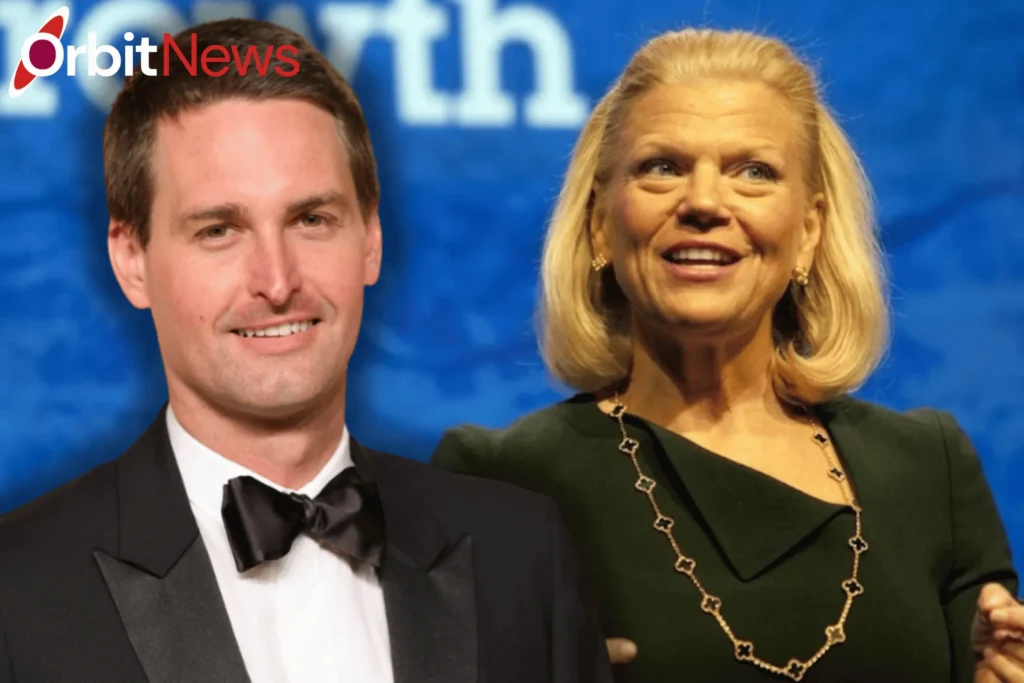
Ginni Rometty and Evan Spiegel Represent Two Models of Tech Leadership
The strongest reason to compare Rometty and Spiegel is not a personal relationship. It is how sharply their careers illustrate different eras and structures in the technology industry.
Rometty’s career is a case study in institutional leadership. She accumulated responsibility over decades, learned multiple parts of IBM’s business and eventually led a large-scale transformation of an existing global enterprise.
Spiegel represents founder-led technology leadership. He helped create the core product, remained CEO through its expansion into a public company and retained unusually strong voting authority over corporate decisions.
Their innovation priorities also differ.
Rometty’s IBM strategy concentrated on enterprise technologies such as hybrid cloud, AI, data, cybersecurity, quantum computing and open-source infrastructure. Spiegel’s work has centered on consumer communication, cameras, digital advertising, augmented reality and increasingly AI-powered wearable computing.
Yet both careers have gradually expanded beyond pure technology products. Rometty now works extensively on how companies identify and develop human skills. Spiegel has increasingly participated in economic-policy and philanthropic organizations in addition to running Snap.
His February 2026 appointment to the Aspen Economic Strategy Group is particularly relevant here because it places him in the same policy-oriented professional network as Rometty.
Their Approaches to AI Are Different but Increasingly Important
Artificial intelligence is now relevant to both executives, although from very different angles.
During Rometty’s IBM years, AI became part of the company’s broader enterprise-technology strategy. Since leaving IBM, she has continued discussing responsible technology and the effect of automation and AI on jobs, skills and organizational leadership. Her workforce work increasingly focuses on matching people to jobs according to capabilities rather than relying exclusively on college credentials.
At Snap, Spiegel is applying AI more directly to consumer products and advertising. His September 2026 strategy message described multimodal AI models as potentially important for understanding user intent and generating better product and advertising recommendations. He has also emphasized AI as a key technology behind the usefulness of Specs.
The comparison highlights a broader shift in technology. Rometty dealt largely with AI adoption inside businesses and institutions, while Spiegel is working on embedding AI into everyday communication, advertising and physical-world computing.
Are Ginni Rometty and Evan Spiegel Related?
No reliable source establishes a family relationship between them.
Rometty is married to Mark Rometty, according to her official biography. Spiegel is married to Australian model and entrepreneur Miranda Kerr.
Spiegel and Kerr married in 2017 and have three sons together, Hart, Myles and Pierre. Their household also includes Flynn, Kerr’s son from her previous marriage to Orlando Bloom. The Aspen Economic Strategy Group’s current biography describes Spiegel as living in Los Angeles with Miranda and the four children.
There is therefore no factual basis for describing Rometty and Spiegel as spouses, relatives or members of the same family.
Are They Business Partners?
There is no evidence that Rometty and Spiegel jointly founded, own or operate a business.
Their shared membership in the Aspen Economic Strategy Group is a professional association, not a business partnership. AESG contains a broad collection of executives, economists and policymakers, so two people appearing on its membership roster does not imply a direct commercial relationship.
The same caution applies to their appearances in wider technology forums. Executives can participate in the same conference, council or policy organization without having a private business arrangement.
How Their Financial Profiles Differ
A meaningful personal-wealth comparison is difficult because the quality of publicly available information is very different for the two executives.
Spiegel’s wealth is easier to estimate because much of it is linked to publicly traded Snap shares. Forbes estimated his real-time net worth at approximately $2.3 billion on September 14, 2026, although that figure changes with Snap’s share price and should be treated as an estimate rather than a fixed amount.
Snap’s SEC filings also show an unusual executive-pay structure. Spiegel received a $1 base salary in 2025, while his reported total compensation was about $4.25 million, almost entirely categorized as other compensation rather than salary or stock awards.
Rometty’s current personal net worth is not disclosed in an authoritative public filing. Various websites publish speculative figures, but those estimates do not provide enough verifiable information about her investments, private assets and liabilities to support a precise current number. Treating an unsupported estimate as equivalent to Spiegel’s market-linked Forbes figure would therefore be misleading.
Current Status in 2026
Ginni Rometty is no longer involved in running IBM. Her current work is centered on SkillsRight, corporate boards, workforce transformation, public-policy discussions and leadership initiatives. SkillsRight lists her as co-chair, while JPMorgan Chase continues to list her among its directors.
Evan Spiegel remains an active founder-CEO. He continues to lead Snap Inc., is closely involved with Specs Inc., and retains substantial control over Snap through its multi-class share structure.
Their careers therefore occupy different stages. Rometty has moved from day-to-day corporate management toward governance and workforce policy. Spiegel remains responsible for the operating performance and long-term product direction of the company he helped create.
FAQ
Why are Ginni Rometty and Evan Spiegel mentioned together?
They are both major figures in the U.S. technology industry and are currently members of the Aspen Institute Economic Strategy Group. Their careers also provide a useful comparison between long-term corporate leadership and founder-led technology entrepreneurship.
Are Ginni Rometty and Evan Spiegel related?
No. There is no credible evidence that they have a family relationship. Rometty is married to Mark Rometty, while Spiegel is married to Miranda Kerr.
Did Ginni Rometty work at Snapchat or Snap Inc.?
No. Her principal corporate career was at IBM, where she worked from 1981 until her retirement in 2020. There is no evidence that she has held an executive or board position at Snap.
Is Evan Spiegel still CEO of Snap in 2026?
Yes. Snap’s current leadership information identifies Spiegel as co-founder and CEO, a position he has held since May 2012. He is also identified in 2026 as CEO of Specs Inc.
What does Ginni Rometty do now?
Rometty is co-chair of SkillsRight and serves on major boards, including JPMorgan Chase. She is also involved in economic-policy and leadership organizations, including the Aspen Economic Strategy Group.
Do Ginni Rometty and Evan Spiegel work together?
They share membership in the Aspen Economic Strategy Group, but there is no public evidence showing that they jointly operate a company or maintain a direct business partnership. Their documented connection is best described as participation in the same economic-policy and technology-leadership network.
Also Read: Mark Zuckerberg and Shawn Mendes
