


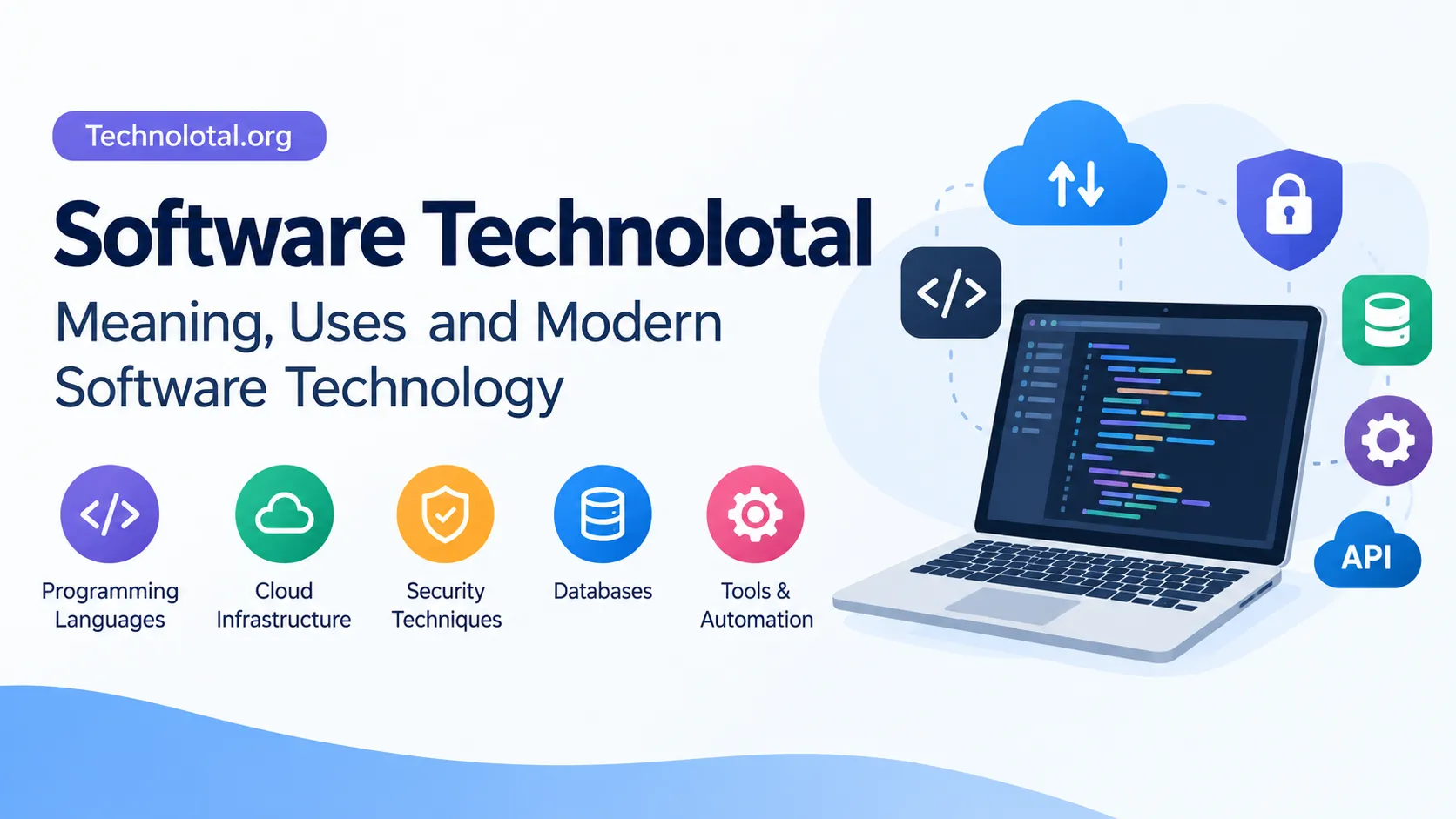
Software technolotal is best understood as an informal online phrase connected with modern software technology and the website Technolotal.org. It is not a recognized programming language, software product, engineering standard, or development framework.
The clearest documented use of the phrase comes from Technolotal.org, which published an article titled Software Technolotal: A Practical 2026 Guide To Modern Software Approaches And Where They’re Headed on July 2, 2026. The site itself describes Technolotal as a technology publication focused on technology discussions, updates, and digital subjects rather than a software platform or standards organization.
For readers searching the term, the useful subject behind it is software technology: the languages, architectures, development practices, cloud infrastructure, security techniques, databases, APIs, testing systems, automation tools, and operational processes used to create and maintain software.
What Does Software Technolotal Mean?
There is no standardized technical definition of “software technolotal.” In practical terms, the phrase appears to function as an umbrella label for technologies and practices associated with modern software development.
A more established concept is software technology. Carnegie Mellon University’s Software Engineering Institute has defined software technology broadly enough to include concepts, processes, methods, algorithms, and tools whose primary purpose is developing, operating, or maintaining software and software-intensive systems.
That definition is much more useful than treating software technolotal as a new technical discipline. Modern software is not simply source code. Building a reliable application may involve programming languages, databases, frameworks, cloud services, testing, deployment automation, monitoring, security controls, APIs, infrastructure, and long-term maintenance.
| Term | What it means | Status |
|---|---|---|
| Software technolotal | Informal phrase associated with modern software topics and Technolotal.org | Not a standardized technical term |
| Software technology | Tools, methods, processes and technologies used to develop and operate software | Established concept |
| Software engineering | Systematic engineering discipline for designing, developing and maintaining software | Established discipline |
| Software development | Practical process of creating and maintaining software | Established activity |
| Technolotal.org | Website publishing technology and software-related content | Technology publication |
Is Software Technolotal a Program or Software Platform?
No evidence indicates that Software Technolotal is a downloadable application, operating system, development environment, programming language, SaaS product, or commercial software platform.
Technolotal.org uses the phrase in editorial content covering software approaches. Its software section also contains articles about software infrastructure, updates, payroll software and other technology subjects, which indicates that “software technolotal” is being used as content terminology rather than as the name of a specific product.
Someone searching for a Software Technolotal download, installer, APK, Windows application, license, or official development tool is therefore probably interpreting the phrase too literally.
What Software Technolotal Covers in Practice
If the phrase is interpreted as modern software technology, its scope is broad. A contemporary application can depend on several different technical layers working together.
Programming Languages and Frameworks
Programming languages provide the instructions that computers execute or interpret. Common software projects may use languages such as JavaScript, TypeScript, Python, Java, C#, C++, Go, Rust, Swift or Kotlin depending on what is being built.
Frameworks and libraries sit on top of those languages and provide reusable components. They can handle tasks such as user interfaces, authentication, web routing, database communication, networking and application structure.
The right language or framework depends on the project. A technology that works well for a small web application may not be suitable for an embedded system, large financial platform or performance-sensitive infrastructure service.
Databases and Data Management
Most useful software needs somewhere to store information.
Relational databases organize information into structured tables and typically use SQL. Other systems may use document databases, key-value stores, graph databases, distributed data platforms or specialized analytical databases.
Database decisions influence reliability, application performance, scalability, backup strategy and security. Choosing a database based only on popularity can create expensive technical problems later.
APIs and Software Integration
An application programming interface, or API, defines how separate software components communicate.
For example, an online store may use one API for payments, another for delivery tracking and another for customer authentication. APIs also allow front-end applications, mobile apps and external services to communicate with back-end systems without directly accessing their internal code.
API-driven design has become particularly important because modern applications often depend on many independently developed services.
Cloud Computing and Cloud-Native Software
Cloud infrastructure is now a major part of modern software technology.
Instead of purchasing and maintaining every physical server internally, organizations can use computing, databases, storage, networking and managed services from cloud environments. Applications can also be designed specifically for dynamic infrastructure where computing resources change according to demand.
Cloud-native technologies commonly include containers, orchestration systems, automated infrastructure, distributed services and declarative configuration.
Kubernetes is one prominent example. The Cloud Native Computing Foundation’s 2026 annual survey reported that 82% of container users in its survey were running Kubernetes in production, illustrating how far container orchestration has moved from experimentation into mainstream infrastructure.
That does not mean every application needs Kubernetes. Smaller systems can often operate more efficiently with simpler infrastructure. Software architecture should follow actual requirements rather than technology trends.
Modern Software Architecture
There is no single architecture that is correct for every software project.
A traditional monolithic application may package many features into one deployable system. This can make development and operations relatively simple, especially for smaller applications.
A microservices architecture divides a system into multiple independently operating services. This approach may help large teams scale particular components separately, but it also introduces network communication, distributed monitoring, deployment and data-consistency challenges.
Event-driven architectures allow components to respond to events rather than relying entirely on direct requests between services. They are useful for certain asynchronous workloads, integrations and large distributed systems.
Software technolotal should therefore not be interpreted as requiring microservices, serverless computing or any other particular architecture. The appropriate design depends on complexity, traffic, reliability requirements, development skills, operating costs and organizational structure.
CI/CD and Automated Software Delivery
Modern development increasingly treats software delivery as a repeatable process rather than an occasional manual event.
Continuous integration encourages teams to combine code changes frequently and validate those changes with automated processes. Continuous delivery and continuous deployment extend automation toward packaging and releasing software.
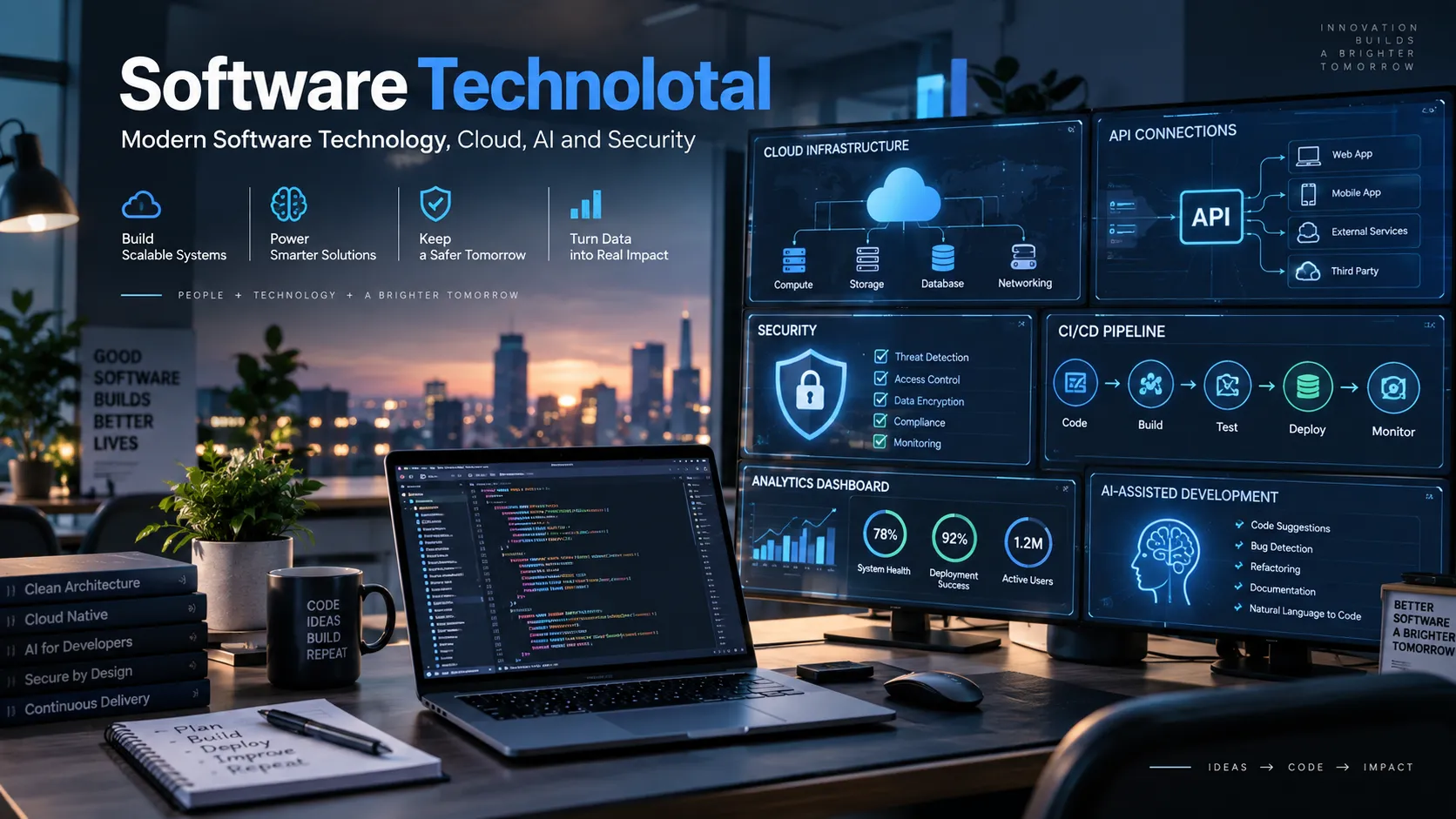
A typical CI/CD pipeline may perform code compilation, automated tests, dependency checks, security checks, packaging and deployment steps.
Automation does not guarantee good software. Poorly tested code can simply reach production faster if pipelines are badly designed.
How Software Delivery Is Measured in 2026
DORA, Google’s software-delivery research program, currently identifies five software delivery performance metrics. They measure both throughput and instability:
- Change lead time
- Deployment frequency
- Failed deployment recovery time
- Change fail rate
- Deployment rework rate
DORA explains that these measurements evolved from the earlier “four keys” model. Its updated Quick Check added deployment rework rate and 2025 research benchmarks in April 2026.
The metrics are most useful for evaluating improvement within a particular application or service. DORA warns against using them as simplistic competition scores across unrelated teams and systems.
Observability and Software Reliability
Releasing software is only part of its lifecycle. Teams also need to understand what happens while applications are running.
Observability gives developers and operators information about system behavior. Common signals include:
- application and infrastructure metrics
- logs
- distributed traces
- errors
- latency
- resource consumption
- alerts
- service availability
These signals help teams determine why an application is slow, why requests are failing or whether a dependency is experiencing problems.
Observability becomes particularly valuable in distributed applications because a single customer request may pass through several services, databases and external systems.
Security Is Part of Software Technology
Security should be built into software development rather than added after an application has already been completed.
The U.S. National Institute of Standards and Technology maintains the Secure Software Development Framework, or SSDF. The currently finalized Version 1.1 organizes secure-development practices into four broad areas: preparing the organization, protecting software, producing well-secured software and responding to vulnerabilities.
NIST also published a draft of SSDF Version 1.2 in December 2025, containing updated practices, tasks and examples for secure and reliable software development. As of September 2026, NIST still lists Version 1.2 as a draft while Version 1.1 remains the finalized core publication.
Practical software security can involve secure authentication, authorization, dependency management, vulnerability scanning, secure coding, encryption, secret management, code review, infrastructure security and a process for fixing discovered vulnerabilities.
This matters because a vulnerability can originate almost anywhere in the software lifecycle. A secure application requires more than installing security software on a server.
AI Is Changing Software Development
Artificial intelligence is one of the most important current developments in software engineering, particularly through AI coding assistants and agent-based development tools.
Developers can use AI systems to generate code, explain unfamiliar code, create tests, document functions, search large codebases, suggest refactoring approaches and help investigate errors.
The technology also introduces a critical issue: generated code still requires validation.
DORA’s 2025 State of AI-assisted Software Development research found that AI acts primarily as an amplifier of an organization’s existing strengths and weaknesses. The research argues that successful AI adoption depends on underlying engineering systems and organizational practices rather than simply providing developers with AI tools.
The report also found very high AI adoption among surveyed technology professionals while identifying verification, delivery stability and organizational capability as important concerns.
AI therefore changes how software can be produced, but it does not eliminate the need for software engineering knowledge, testing, architecture, security review and human judgment.
Platform Engineering Is Becoming More Important
As development environments become more complicated, organizations increasingly create internal platforms that provide developers with standardized ways to build and deploy software.
A platform might offer approved deployment pipelines, cloud environments, security controls, observability tools, development templates and infrastructure services.
The purpose is not simply to centralize technology. A well-designed platform reduces repeated setup work and gives developers a safer, more consistent path from code to production.
DORA’s 2025 research places platform engineering among the organizational capabilities relevant to effective AI-assisted software development, reinforcing the idea that developer productivity depends on the surrounding system rather than individual tools alone.
Software Supply Chain Security Matters
Modern developers rarely write every component themselves. Applications commonly rely on open-source libraries, packages, containers, build systems and third-party services.
This creates a software supply chain.
A vulnerability or malicious modification in one dependency can potentially affect many applications that depend on it. Teams therefore need to know what components their software contains, where those components came from and whether important security updates are available.
NIST’s SSDF specifically focuses on reducing vulnerabilities in released software and addressing their underlying causes as part of normal development practices.
Dependency monitoring, controlled build environments, signed artifacts, vulnerability management and careful third-party evaluation are increasingly important parts of modern software operations.
Software Technolotal and Technolotal.org
The unusual keyword becomes easier to understand when separated from the website behind it.
Technolotal.org describes itself as a destination for technology discussions, updates and exploration of digital developments. Its website includes software, technology, social-media and other editorial categories.
It should therefore be understood primarily as a technology-content website.
Technolotal.org should not be confused with organizations such as NIST, the Software Engineering Institute, DORA or the Cloud Native Computing Foundation. Those organizations publish technical frameworks, research, specifications or engineering guidance that can serve as stronger primary references for technical decisions.
How Businesses Should Evaluate Software Technology
The newest technology is not automatically the best technology.
Every database, framework, AI service, cloud platform and software tool introduces benefits as well as cost and maintenance requirements. Adding unnecessary technology can make a system harder to secure, troubleshoot and maintain.
Before choosing a new software technology, organizations should examine the problem it solves, required expertise, total operating cost, security model, integration requirements, vendor dependence, scalability, reliability and long-term maintainability.
A relatively simple system operated by a knowledgeable team can often be safer and more reliable than an elaborate architecture built around fashionable technologies.
Benefits of Modern Software Technology
Modern software tools can significantly improve how organizations build and operate digital services when they are used appropriately.
Automation can shorten repetitive development work. Cloud infrastructure can make resources easier to provision. APIs can connect applications. CI/CD can make software releases more repeatable. Observability can expose production problems quickly, while security frameworks can help teams reduce avoidable vulnerabilities.
The value, however, comes from combining technology with good engineering practices.
Tools alone cannot compensate for unclear requirements, weak architecture, poor testing or inadequate security.
Limitations and Risks
The software industry changes rapidly, and constant change creates its own problems.
Organizations can accumulate technical debt by switching tools too frequently. Cloud services may become expensive if resources are poorly managed. Distributed systems can be difficult to debug. Third-party dependencies introduce supply-chain risks, and AI-generated code may contain subtle errors or insecure patterns.
Complexity itself is a risk.
Teams should therefore ask whether new technology makes a system genuinely easier to build, operate and secure. If it creates more problems than it solves, the technically simpler option may be the better engineering decision.
What Software Technology Looks Like in 2026
Several developments are shaping software engineering in 2026, but they are connected rather than isolated trends.
Cloud-native infrastructure has become established in production environments. AI-assisted programming is moving deeper into normal development workflows. Platform engineering is helping organizations manage increasingly complex development environments. Security is becoming part of the full software lifecycle rather than a final review step. Software-delivery measurement is also becoming more precise.
At the same time, the fundamentals remain familiar: define the problem clearly, design an appropriate architecture, write maintainable code, test it, protect it, deploy it carefully, observe its behavior and continue improving it.
That broader lifecycle is the most useful way to interpret software technolotal.
Frequently Asked Questions
What is software technolotal?
Software technolotal is an informal online phrase referring broadly to modern software technology and software-development practices. Its most visible current use is associated with technology content published by Technolotal.org.
Is software technolotal an official technical term?
No recognized software engineering standard defines Software Technolotal as a separate technical discipline, programming language or framework. The established concept behind the phrase is software technology.
Can I download Software Technolotal?
Software Technolotal does not appear to be a downloadable program or application. It is better understood as terminology relating to software technology rather than a specific piece of software.
Is Software Technolotal the same as Technolotal.org?
Not exactly. Technolotal.org is a technology-content website. “Software technolotal” is a phrase used in its software-related content and has also appeared on other websites discussing modern software technology.
What technologies are included in modern software technology?
Modern software technology can include programming languages, frameworks, databases, APIs, cloud infrastructure, containers, CI/CD, testing systems, observability, cybersecurity, automation and AI-assisted development tools.
Is AI replacing software developers?
Current evidence does not support treating AI as a complete replacement for software engineering expertise. AI can accelerate or automate some development tasks, but DORA’s research emphasizes that outcomes still depend heavily on organizational practices, engineering systems, verification and human judgment.
Also Read: Tech Consulting Majority Stake Financial Sponsor Today | What the Latest Deals Actually Show
