



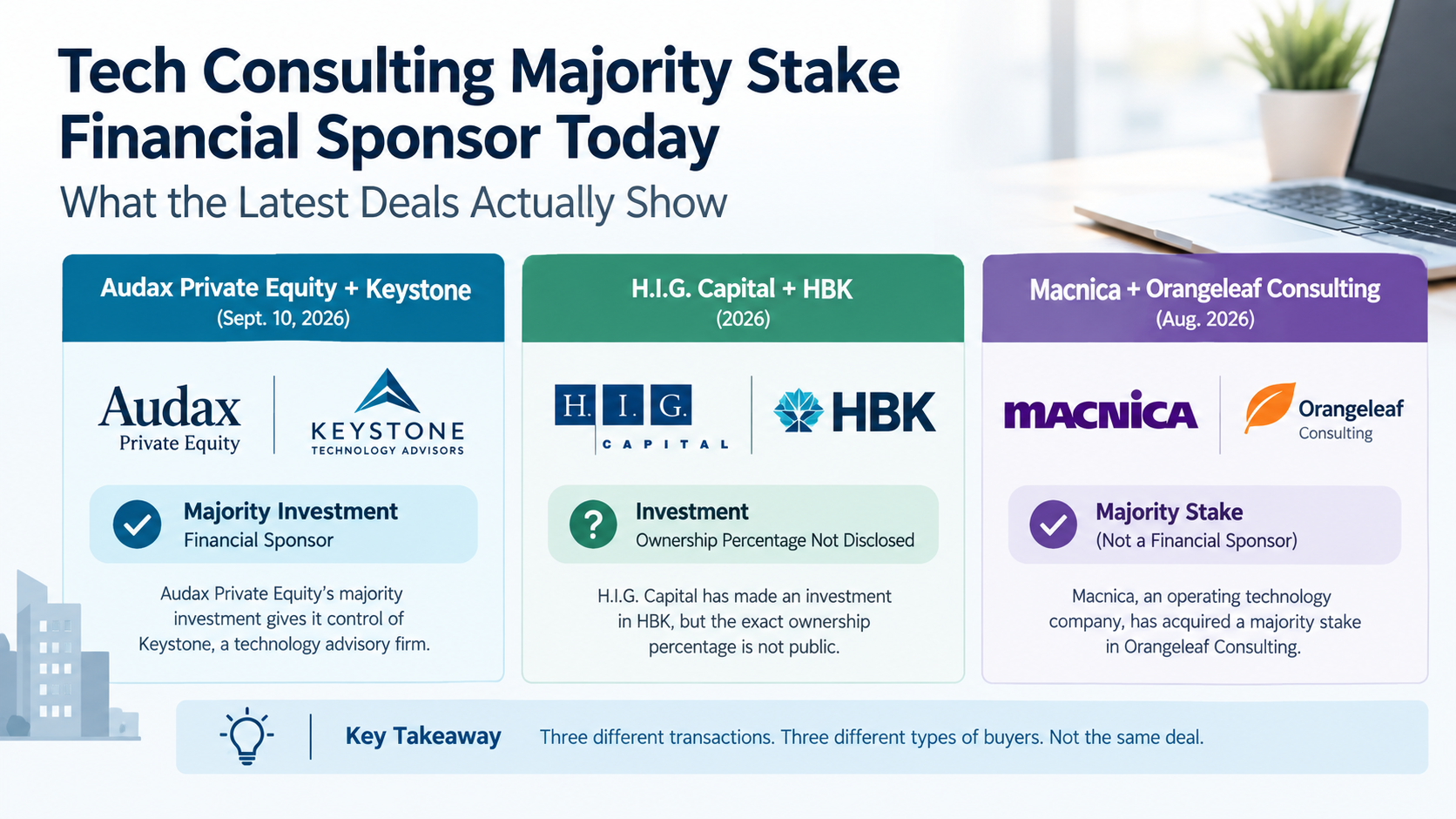
The search for tech consulting majority stake financial sponsor today does not point to one simple transaction. As of September 10, 2026, Audax Private Equity’s majority investment in Keystone is a confirmed recent example of a financial sponsor taking control of a technology advisory firm, while the newer H.I.G. Capital investment in HBK has an undisclosed ownership percentage.
That distinction matters. A separate August 2026 transaction involving Macnica and Orangeleaf Consulting is clearly described as a majority-stake deal, but Macnica is an operating technology company rather than a conventional financial sponsor. Understanding the difference prevents three separate transactions from being incorrectly reported as one type of deal.
What Does Tech Consulting Majority Stake Financial Sponsor Today Mean?
The phrase combines several M&A concepts that are often mixed together in search results.
Tech consulting refers broadly to firms providing technology strategy, digital transformation, implementation, data, AI, cloud, cybersecurity, software engineering or technology-related advisory services.
A majority stake generally means ownership of more than 50% of a company’s equity. It normally gives the buyer substantial influence over corporate decisions, although exact control rights depend on the transaction documents and governance structure.
A financial sponsor is typically a private equity, growth equity or other investment manager buying companies primarily as investments. H.I.G. Capital and Audax Private Equity fit this description. A company such as Macnica, which operates its own technology businesses and acquires another company for strategic integration, is better described as a strategic buyer.
This produces three relevant 2026 examples:
| Transaction | Buyer | Target Company | Majority Stake Confirmed? | Buyer Type | Deal Status |
|---|---|---|---|---|---|
| Audax Private Equity acquisition of Keystone | Audax Private Equity | Keystone | Yes | Financial sponsor | Closed January 2, 2026 |
| Macnica acquisition of Orangeleaf Consulting | Macnica | Orangeleaf Consulting Holding Co. | Yes | Strategic buyer | Agreement announced August 5, 2026 |
| H.I.G. Capital investment in HBK | H.I.G. Capital affiliate | HBK | Not publicly disclosed | Financial sponsor | Expected to close in Q4 2026 |
The result is more nuanced than the keyword suggests. Audax and Keystone provide the cleanest confirmed majority-stake financial-sponsor example, while H.I.G. and HBK are the newest major financial-sponsor transaction among these examples.
The Clearest Confirmed Deal: Audax Acquired a Majority Stake in Keystone
Audax Private Equity announced in January 2026 that it had acquired a majority stake in Keystone, a global technology and advisory firm focused on economics, strategy and complex digital ecosystems. The transaction closed on January 2, 2026.
This transaction closely matches the search intent behind tech consulting majority stake financial sponsor today because all three central elements are present.
Audax is a private equity investor. Keystone is a technology-focused advisory business. Audax explicitly described the stake as a majority interest.
What Does Keystone Do?
Founded in 2003, Keystone advises corporations, governments and other organizations dealing with complex technology markets. Its work combines technology expertise, strategy and economic analysis.
The firm works on issues involving areas such as artificial intelligence, digital platforms, competition, regulation and other technology-driven business questions. Keystone describes its model as combining advanced technology, strategic consulting and applied econometrics.
Audax said Keystone’s multidisciplinary capabilities were particularly relevant as businesses confront rapid changes in AI and digital platforms.
How Much Did Audax Pay?
The transaction value has not been publicly disclosed.
Keystone’s own announcement confirms the investment and completion date but says the financial terms were undisclosed. It would therefore be inaccurate to assign a purchase price or valuation to the company without verified transaction information.
What Happened to Keystone AI?
The transaction also involved a significant corporate restructuring.
Keystone separated its internally developed enterprise software business into an independent company called Keystone AI. Previous investor RLH Equity Partners sold its stake in Keystone’s consulting and advisory business while retaining an interest in the newly separated Keystone AI operation.
This distinction is important because Audax’s majority investment relates to Keystone’s technology and advisory platform, not simply the ownership of every technology asset previously operated inside the organization.
H.I.G. Capital and HBK: The Newer Financial-Sponsor Deal
A more recent transaction was announced on August 25, 2026, when an affiliate of H.I.G. Capital agreed to make a strategic growth investment in HBK.
H.I.G. is a major global alternative investment firm with approximately $75 billion of capital under management. The transaction will make it HBK’s first institutional partner and is expected to close during the fourth quarter of 2026, subject to customary closing conditions and regulatory approvals.
HBK combines several professional-services operations, including:
- HBK CPAs & Consultants
- HBKS Wealth Advisors
- Vertilocity, its technology advisory business
HBK operates across 27 offices in seven U.S. states and India and serves tens of thousands of clients, according to the official transaction announcement.
Did H.I.G. Buy a Majority Stake in HBK?
There is currently no reliable public disclosure confirming that H.I.G. acquired more than 50% of HBK.
Neither H.I.G.’s announcement nor HBK’s announcement identifies an exact ownership percentage. They describe the transaction as a strategic growth investment and say H.I.G. will become HBK’s first institutional partner.
Financial terms have also not been publicly disclosed. CPA Practice Advisor similarly reported that HBK is selling a stake to H.I.G. but said the transaction’s financial terms were unavailable.
Reporting H.I.G. as having bought 51%, 60%, 75% or any other specific percentage would therefore go beyond the available evidence.
This is especially important because search keywords are not transaction documents. The appearance of the words “majority stake” in a query does not prove that the underlying deal involved majority ownership.
Why HBK’s Structure Is More Complicated Than an Ordinary Tech Consulting Acquisition
HBK is not purely a technology consultancy. It also operates accounting, audit and wealth-management businesses.
Before the H.I.G. transaction closes, HBK plans to adopt an alternative practice structure designed to maintain CPA ownership of its attest operations while permitting outside investment in other businesses.
Under the announced structure, Hill, Barth & King LLC will continue providing attest services such as audits and reviews. That licensed CPA firm will remain owned and controlled by CPA partners.
Other operations will be separated organizationally:
HBK Advisory Group LLC will provide tax, accounting, consulting and technology services.
HBK Sorce Advisory LLC, doing business as HBKS Wealth Advisors, will continue providing wealth-management services.
This structure explains why describing the transaction simply as “private equity buys tech consulting company” loses important context. H.I.G. is investing in a broader professional-services platform whose technology advisory operation is only one part of the business.
Where Vertilocity Fits Into the H.I.G. Deal
Vertilocity is the part of HBK most directly relevant to technology consulting.
H.I.G.’s announcement identifies Vertilocity as HBK’s technology advisory practice. HBK itself offers a broader range of accounting, tax, wealth management, business consulting, valuation, transaction advisory and technology-related services.
The capital partnership can therefore potentially support technology expansion alongside HBK’s accounting and wealth operations.
HBK CEO Tom Angelo said the firm intends to invest further in its people, technology and client-service capabilities with H.I.G.’s resources. HBKS CEO Chris Allegretti similarly said the partnership provides additional resources to scale the business and invest in professionals and technology.
Those statements establish the announced strategy. They do not establish an undisclosed ownership percentage.
Macnica and Orangeleaf Consulting: A Majority Deal, but Not a Financial-Sponsor Deal
Another transaction is particularly relevant because it was announced just weeks before the H.I.G. investment.
On August 5, 2026, Japan-based Macnica announced an agreement to acquire a majority stake in Orangeleaf Consulting Holding Co., the parent of Orangeleaf Consulting.
Orangeleaf is a Malaysia-founded digital-transformation and enterprise-software consultancy with operations across Malaysia, Singapore and Japan. Its work includes helping enterprises modernize technology and develop internal digital capabilities.
Financial terms were not disclosed.
Why Macnica Is Not a Financial Sponsor
Macnica should not be confused with firms such as Audax or H.I.G.
Macnica was established in 1972 and operates businesses involving semiconductors, electronic components, networking and technology solutions. It has also expanded into cybersecurity, digital transformation, AI, smart manufacturing and other technology fields.
It is therefore an operating strategic acquirer.
Macnica is buying Orangeleaf to expand capabilities related to digital transformation, enterprise applications and manufacturing technology, rather than acting primarily as a private equity fund investing third-party capital.
Why Macnica Wanted Orangeleaf
The two organizations already had a relationship before the transaction.
Macnica and Orangeleaf entered a DX consulting alliance in 2024. Their collaboration included work around Siemens’ Mendix low-code platform, particularly for Japanese manufacturing companies seeking to modernize legacy systems and increase their internal digital-development capabilities.
The majority investment is intended to deepen that relationship.
Macnica specifically highlighted combining its expertise in areas such as AI, IoT and cybersecurity with Orangeleaf’s consulting capabilities to support manufacturers undergoing digital transformation.
That operating logic is characteristic of a strategic acquisition.
Financial Sponsor Versus Strategic Buyer
Understanding buyer type is essential when analyzing technology consulting M&A.
A financial sponsor such as Audax or H.I.G. normally purchases an ownership interest as an investment. It may provide capital, operating expertise, acquisition resources and governance support while eventually seeking a financial return on the investment.
A strategic buyer normally acquires another company because its products, clients, employees, intellectual property, geographic coverage or technology capabilities complement its existing operations.
The difference can affect everything from integration strategy to the eventual exit.
In these 2026 cases:
Audax + Keystone: financial sponsor and confirmed majority ownership.
H.I.G. + HBK: financial sponsor, but ownership percentage remains undisclosed.
Macnica + Orangeleaf: confirmed majority ownership, but the buyer is strategic.
Treating all three as equivalent private-equity majority acquisitions would be factually incorrect.
Why Investors Are Still Buying Technology Services Firms in 2026
The deals are part of a much broader technology-services M&A market.
EY reported 449 IT-services transactions with approximately $14.8 billion of disclosed deal value during the first half of 2026, compared with 456 transactions during the same period of 2025. Cloud, data and analytics, cybersecurity and managed-services companies were among the strongest areas of activity.
The market is changing because AI is affecting both demand and traditional consulting economics.
Companies need help deploying AI, modernizing older systems, improving cybersecurity and integrating increasingly complicated technology stacks. At the same time, AI automation can reduce the amount of human work required for some traditional consulting tasks.
EY described a two-speed market in which well-capitalized strategic buyers pursue scale and capabilities while private equity investors selectively consolidate specialized businesses and portfolio companies.
That selectivity helps explain why specialization matters.
A consulting firm with generic project work may face more pressure than one with differentiated expertise in AI, cybersecurity, regulated industries, data, complex enterprise systems or recurring managed services.
What Financial Sponsors Look for in Tech Consulting
There is no universal private-equity formula, but several characteristics can make technology-services companies more investable.
Recurring or repeatable revenue is valuable because it can provide better visibility than purely one-off projects. Specialized expertise can also reduce competition and make client relationships harder to replace.
A strong business may have deep relationships in a particular industry, such as financial services, healthcare or manufacturing. Other firms distinguish themselves through technology ecosystems such as Microsoft, Salesforce, AWS, Google Cloud, ServiceNow, SAP or specialized AI platforms.
Another important factor is whether a company can become a platform for acquisitions.
Private equity firms frequently pursue “buy and build” strategies in fragmented professional-services markets. A strong platform can acquire smaller specialists, enter new markets and broaden its services faster than would be possible through organic hiring alone.
AI has added another consideration. Investors now have to determine whether AI will strengthen a consulting firm’s margins and services or undermine its existing billable-hour economics.
What Majority Ownership Can Mean for a Consulting Firm
A majority investment does not automatically mean founders or existing executives leave.
Keystone continued under its management team after Audax’s investment. HBK has similarly stated that its partners will continue leading the business following H.I.G.’s investment.
Private equity transactions frequently involve existing shareholders retaining some equity because this keeps management economically involved in the company’s next stage of growth.
The practical impact depends on the individual deal. Potential changes may involve acquisition activity, geographic expansion, hiring, technology investment, performance targets and more formal financial reporting.
Customers should therefore focus less on the phrase “private equity owned” and more on what actually changes in leadership, services, contracts and client teams.
Tech Consulting Majority Stake Financial Sponsor Today: The Accurate Answer
As of September 10, 2026, there are three facts worth keeping separate.
Audax Private Equity’s investment in Keystone is a confirmed financial-sponsor majority transaction. Audax explicitly said it acquired a majority stake, and the deal closed on January 2, 2026.
H.I.G. Capital’s August 25 investment in HBK is a newer financial-sponsor transaction involving technology consulting through Vertilocity, but no majority percentage has been publicly confirmed. The transaction remains scheduled to close in the fourth quarter of 2026.
Macnica’s August agreement involving Orangeleaf Consulting is a confirmed majority-stake technology-consulting transaction, but Macnica is a strategic technology company rather than a traditional financial sponsor.
That is currently the most defensible interpretation of the keyword based on publicly available transaction announcements.
FAQ
Which financial sponsor acquired a majority stake in a tech consulting firm in 2026?
Audax Private Equity acquired a majority stake in Keystone, a global technology and advisory company. The transaction closed on January 2, 2026, and its financial terms were not disclosed.
Did H.I.G. Capital acquire a majority stake in HBK?
A majority stake has not been publicly confirmed. H.I.G. and HBK describe the transaction as a strategic growth investment but have not disclosed H.I.G.’s ownership percentage or the purchase price.
What tech consulting business is included in HBK?
Vertilocity is HBK’s technology advisory practice. HBK’s wider organization also includes accounting, tax, consulting and wealth-management businesses.
Who acquired a majority stake in Orangeleaf Consulting?
Macnica agreed to acquire a majority stake in Orangeleaf Consulting Holding Co. in August 2026. The financial terms and precise percentage beyond majority ownership were not disclosed publicly.
Is Macnica a private equity firm?
No. Macnica is an operating technology company whose businesses include semiconductors, electronic components, networking and technology solutions, with activities extending into areas such as AI, cybersecurity and digital transformation.
Why are financial sponsors interested in technology consulting?
Technology consulting firms can provide exposure to enterprise spending on AI, cybersecurity, cloud, data and digital transformation. EY’s H1 2026 deal analysis shows continued M&A activity despite economic uncertainty, with private equity investors selectively consolidating specialized technology-services businesses.
Also Read: Fivebpeol Explained | What It Is, What the Websites Offer, and What to Know in 2026
