



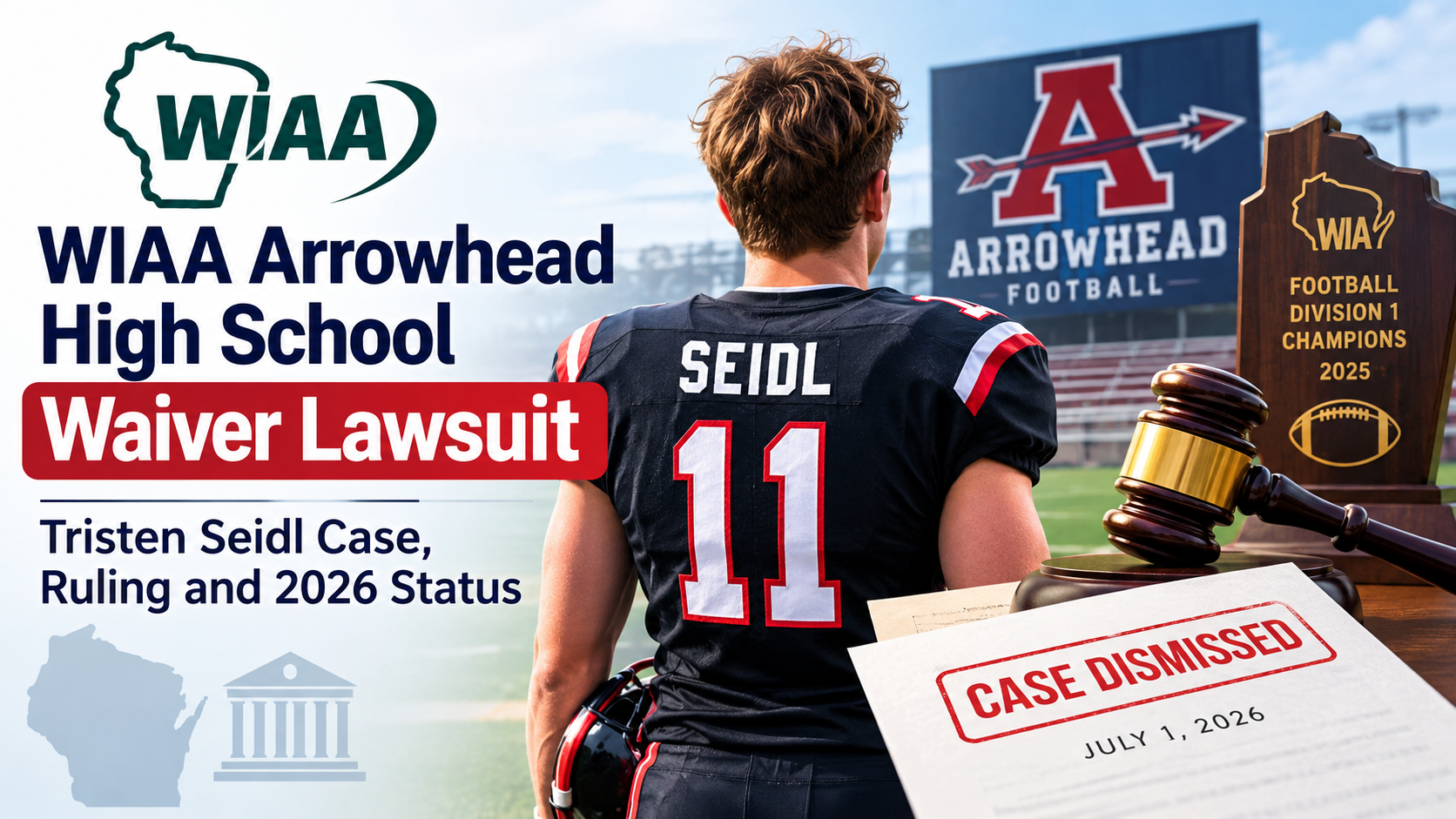
The WIAA Arrowhead High School waiver lawsuit centered on Arrowhead football player Tristen Seidl, whose family challenged the Wisconsin Interscholastic Athletic Association after it denied him immediate varsity eligibility following a school transfer caused by an unusual housing situation after a fire. A judge temporarily allowed Seidl to play in 2025, but the lawsuit was ultimately dismissed as moot on July 1, 2026 without a final ruling that the WIAA had wrongly applied its transfer rules.
The dispute became much larger than one student’s eligibility. Seidl played under the court order, Arrowhead went on to win Wisconsin’s 2025 Division 1 football championship, and the possibility of later WIAA sanctions created questions about whether that championship could be forfeited. As of September 2026, the WIAA’s own football archive still identifies Arrowhead as the 2025 Division 1 champion.
What Is the WIAA Arrowhead High School Waiver Lawsuit?
The case arose after Tristen Seidl transferred from Kettle Moraine High School to Arrowhead High School before his senior year. His parents, Blayne and Jenell Seidl, asked the WIAA to recognize circumstances surrounding the family’s relocation and allow their son to compete at the varsity level immediately.
The WIAA did not approve the request or the subsequent waiver based on extenuating circumstances. After the family’s internal appeal also failed, the Seidls filed a lawsuit in Waukesha County Circuit Court on August 19, 2025.
An important distinction is often lost in online summaries of the case. Arrowhead High School did not originally bring the lawsuit against the WIAA. Tristen’s parents brought the action on his behalf. Arrowhead Union School District was later brought into the litigation as an involuntary plaintiff and did not have its own attorney participating in the case until 2026.
A House Fire Created the Unusual Transfer Dispute
The underlying facts began well before Seidl enrolled at Arrowhead.
The Seidl family’s home in Dousman was damaged by a fire on October 7, 2023, while Tristen was a sophomore at Kettle Moraine. A separate federal insurance case involving his parents confirms the October 2023 fire and litigation over damage to the property.
According to reporting based on the WIAA lawsuit, the family subsequently lived in four temporary locations. Their fourth temporary residence, beginning in June 2024, was inside the Arrowhead Union High School District. Tristen nevertheless remained a Kettle Moraine student because the family expected its Dousman house eventually to become livable again.
That expectation changed in March 2025, when the family learned that the Dousman property could not simply be restored as they had anticipated and would have to be demolished. They then extended the lease on their residence in the Arrowhead district through June 1, 2026 and decided to make that location their permanent home for the remainder of Tristen’s high-school years.
The family enrolled Tristen at Arrowhead on May 31, 2025, according to the Milwaukee Journal Sentinel’s reporting on the case.
That timing became central to the disagreement.
What WIAA Transfer Rule Applied?
The WIAA’s transfer rule generally provides that a student transferring into a member school is subject to transfer restrictions for one calendar year unless the transfer became necessary because of a complete parental change of residence. For students entering 11th or 12th grade, that generally means restriction to nonvarsity competition for the one-year period.
The association also maintains a waiver process.
Its current eligibility guidance says a member school can request a waiver when documented extenuating circumstances exist. The WIAA describes relevant circumstances as events that are unforeseeable or unknowable and involve a significant, forced or involuntary change that mitigates application of the normal rule.
That distinction was exactly where the Seidl dispute developed.
Why did the WIAA deny Seidl’s eligibility?
According to reporting on communications involved in the case, the WIAA’s position was that Seidl did not transfer when the family first moved into the Arrowhead district in June 2024.
WIAA associate director Mel Dow told Arrowhead officials that the transfer should have occurred when the family originally moved into the new district. The Seidls’ position was different. They considered that home temporary in 2024 because they believed their original house would eventually be repaired and they would return to the Kettle Moraine area.
Only after learning in March 2025 that the original residence could not be restored as anticipated did they consider the Arrowhead-area residence permanent.
The family therefore argued that the facts represented exactly the kind of forced and unusual circumstances for which a waiver should exist.
Disputed Information on the Transfer Form Complicated the Case
The lawsuit also challenged information that appeared during the transfer process.
According to the Milwaukee Journal Sentinel, the Seidls alleged that Kettle Moraine athletic director Ryan Tomczyk initially stated on transfer documentation that Seidl’s move was associated with coaching changes. Tomczyk subsequently recanted that statement in an email to WIAA associate director Mel Dow.
That allegation mattered because an athletically motivated transfer would create very different concerns from a transfer caused by an involuntary family relocation.
It would be inaccurate, however, to say a court eventually found that the allegedly incorrect statement caused the WIAA to deny the waiver. The litigation never reached a final merits determination resolving that question.
WIAA Denied the Waiver and the Final Internal Appeal
After the original transfer determination, the family sought an extenuating-circumstances waiver.
That request was also denied. The family then appealed to the WIAA Board of Control, which rejected the appeal on August 15, 2025. Four days later, Blayne and Jenell Seidl filed their court action.
The lawsuit sought immediate relief because the football season was beginning and a court decision months later would have provided little practical help to a senior whose final season had already ended.
Seidl consequently missed Arrowhead’s first two games while the dispute remained unresolved.
Judge Temporarily Allowed Tristen Seidl to Play
The major turning point came on September 5, 2025.
Waukesha County Circuit Judge Paul Bugenhagen Jr. granted temporary injunctive relief preventing the WIAA from stopping Seidl from participating in Arrowhead varsity football while the underlying case continued.
The ruling was not the same as a final judgment that Seidl had always been eligible or that the WIAA had violated the law.
A preliminary or temporary injunction is designed to protect the parties while a dispute remains pending. In granting relief, Bugenhagen considered factors including the short duration of a high-school football season and the family’s argument that losing potential athletic and scholarship opportunities could create harm that could not later be repaired. Reporting also noted that the August 15 WIAA Board of Control vote against Seidl had not been unanimous.
Seidl became eligible under the court order in time for Arrowhead’s September 5 game against Waukesha West.
Arrowhead won 29-6.
Why the Temporary Injunction Created a Bigger Legal Risk
Allowing Seidl to play solved his immediate problem but created another one.
WIAA eligibility rules contain consequences for schools using athletes ultimately determined to be ineligible. Reporting on the association’s handbook identified potential penalties for team sports including forfeiting affected contests, changing conference or tournament standings, and returning team or individual awards.
That meant Arrowhead faced an unusual dilemma.
The school had a court order allowing Seidl to participate. Yet if that injunction were later reversed or otherwise ceased to protect his participation and Seidl were ultimately treated as ineligible, questions could arise over games in which he played.
The possibility became far more significant as Arrowhead advanced through the season.
Arrowhead Won the 2025 Division 1 State Championship
On November 21, 2025, Arrowhead defeated defending champion Bay Port 18-15 at Camp Randall Stadium to win the WIAA Division 1 state football championship.
The finish was dramatic. Ryan Heiman returned a squib kickoff 76 yards for a touchdown with 35 seconds remaining, giving Arrowhead the final three-point advantage. The Warhawks finished the season 13-1.
Seidl had been allowed to participate during the season because the September injunction remained in effect.
The championship transformed an eligibility lawsuit into a dispute capable of affecting an entire team’s season, its players and the WIAA’s official record book.
Could Arrowhead Lose the Championship?
That possibility became one of the biggest questions surrounding the lawsuit.
Before the case was dismissed, attorneys for the Seidl family argued that ending the litigation without permanently settling Seidl’s status could expose both him and Arrowhead to WIAA penalties. Media reports in June 2026 specifically identified possible loss of the championship as a concern.
The WIAA argued that eligibility enforcement remained its responsibility and expressed concern that a broad permanent ruling limiting its authority could affect thousands of athletes at hundreds of member schools.
By that stage, the case was no longer simply about whether one senior could play on Friday nights. His season was already finished.
Instead, the parties were confronting what legal effect the temporary order would have after the underlying reason for obtaining it had disappeared.
July 1, 2026 Ruling: The Lawsuit Was Dismissed as Moot
Judge Bugenhagen resolved that issue on July 1, 2026 by ruling that the case was moot.
His reasoning was straightforward. The 2025 football season had ended, Seidl had completed high school, and there was therefore no longer an active controversy over whether he should be allowed to compete during that season.
This distinction is critical to understanding the WIAA Arrowhead High School waiver lawsuit outcome.
The judge did not conduct a final merits trial and declare that the WIAA correctly denied the waiver.
He also did not issue a final ruling declaring that the WIAA wrongly denied it.
Instead, the immediate eligibility dispute had expired because the season was over.
What about potential WIAA punishment?
The Seidl family argued that possible sanctions gave the lawsuit continuing legal significance.
Judge Bugenhagen did not decide that issue either. According to reporting from the July 1 proceeding, he considered possible future penalties not yet ripe for judicial determination because the WIAA had not taken such disciplinary action at that point.
In legal terms, a dispute can be “moot” when events have eliminated the controversy the court was originally asked to resolve. A related issue can be considered unripe when it depends on a future event that has not yet occurred.
That left the sanction question outside the July 1 judgment.
Current Status: Arrowhead Is Still Listed as 2025 Champion
As of September 2026, the clearest official evidence about the championship is the WIAA’s own historical football archive.
It continues to list:
Division 1: Arrowhead 18, Bay Port 15
under its 2025 State Football Championships results.
An August 21, 2026 legal-sports report likewise stated that no WIAA sanction had publicly been announced following the dismissal.
Therefore, claims that Arrowhead has already been stripped of the 2025 championship are not supported by the current official record.
The more precise description is that the dismissal removed the temporary judicial protection and left open the theoretical possibility of WIAA action, but Arrowhead remained recognized by the association as the 2025 Division 1 champion at the time of this review.
Did the Judge Rule That WIAA Had No Authority Over Public-School Sports?
No.
This is another point on which some online accounts go too far.
The Seidl litigation raised broader arguments about the WIAA’s authority and judicial review of its decisions, but the July 2026 mootness ruling did not produce a definitive statewide judgment abolishing or substantially limiting WIAA authority.
The WIAA describes itself as an organization governed by its member schools. Its rules are established through its membership, while interpretation and enforcement are handled by the WIAA executive office and Board of Control.
A related Wisconsin Supreme Court case helps explain why the issue remains legally complicated.
Why Halter v. WIAA Matters to the Seidl Dispute
In Halter v. Wisconsin Interscholastic Athletic Association, decided April 8, 2025, the Wisconsin Supreme Court examined another athlete’s challenge to a WIAA eligibility-related decision.
That case involved wrestler Hayden Halter, who competed under temporary judicial protection after the WIAA determined that he had not properly served a suspension for unsportsmanlike conduct. His litigation continued even after he competed and won a state championship.
The Supreme Court eventually ruled that the WIAA had acted reasonably in interpreting and applying its rules in Halter’s case.
But the ruling contained an important limitation.
The majority assumed without deciding that the WIAA decision could be reviewed through certiorari and did not resolve whether the WIAA was a “state actor.” The court explained that resolving the state-actor question was unnecessary for the claims properly before it.
That meant Halter did not supply a simple answer to every institutional-authority argument later raised around the Seidl litigation.
Temporary Injunction Does Not Equal a Final Legal Victory
Much of the confusion surrounding the Arrowhead case comes from descriptions saying Seidl “won” against the WIAA.
He unquestionably won the immediate relief he needed.
The September 2025 injunction allowed him to compete during his senior season, and because the season happened before final litigation could be completed, that temporary victory had major practical importance.
Legally, however, an injunction and a final merits judgment are different.
The July 2026 dismissal meant no final judicial determination settled whether the WIAA’s original interpretation of the Seidl family’s circumstances was correct.
That is why neither of these statements is accurate:
“Courts ruled the WIAA’s transfer rule illegal.”
“Courts finally ruled Seidl was ineligible.”
Neither outcome occurred.
Timeline of the WIAA Arrowhead High School Waiver Lawsuit
| Date | Development |
|---|---|
| October 7, 2023 | Fire damages the Seidl family’s Dousman residence while Tristen attends Kettle Moraine. |
| June 2024 | Family moves to another temporary residence inside the Arrowhead district while expecting eventually to return home. |
| March 2025 | Family learns its Dousman home will need to be demolished rather than restored as expected. |
| May 31, 2025 | Tristen is enrolled at Arrowhead. |
| July 2025 | Transfer eligibility and extenuating-circumstances waiver requests are denied. |
| August 15, 2025 | WIAA Board of Control denies the family’s final internal appeal. |
| August 19, 2025 | Blayne and Jenell Seidl file suit in Waukesha County Circuit Court. |
| September 5, 2025 | Judge Paul Bugenhagen Jr. grants temporary relief allowing Seidl to play varsity football. |
| November 21, 2025 | Arrowhead beats Bay Port 18-15 for the WIAA Division 1 state championship. |
| June 2026 | Parties continue litigating whether the case remains live after Seidl’s season and graduation. |
| July 1, 2026 | Judge Bugenhagen rules the case moot and declines to decide speculative future sanctions. |
| September 2026 | WIAA’s official archive continues to list Arrowhead as the 2025 Division 1 champion. |
What the Case Means for Wisconsin Student Athletes
The Seidl dispute demonstrates how transfer rules can create difficult cases when a family relocation does not fit neatly into the usual timeline.
The WIAA’s rule recognizes both a complete parental change of residence and an extenuating-circumstances waiver process. Yet Seidl’s situation exposed the harder question of when a relocation becomes a permanent change of residence when a family is displaced temporarily and expects to return home.
For families considering a transfer, this case also shows why timing matters. The WIAA specifically says that a student who delays enrollment following a family move can become subject to the transfer rule. It also recommends that eligibility questions first be handled through a school’s athletic director.
Individual circumstances vary substantially, however. The Seidl litigation should not be treated as a rule guaranteeing waivers after fires, housing problems or other hardships.
It did not establish such a precedent.
What Remains Unresolved
Several broader questions received attention during the case without receiving definitive answers.
The litigation did not establish a general constitutional right to participate in varsity athletics. It did not invalidate Wisconsin’s transfer rule. It did not establish that every involuntary family move qualifies for a waiver. And it did not finally decide the larger question of exactly how courts may review every category of WIAA eligibility decision.
The Wisconsin Supreme Court’s 2025 Halter decision is especially important here. Although it upheld the WIAA’s rule application in that case, the court expressly avoided finally deciding whether the WIAA itself is the sort of entity whose decisions are generally subject to certiorari review and did not decide the state-actor issue.
The Seidl case therefore became significant without producing the sweeping legal precedent some descriptions of it suggest.
FAQ
What happened in the WIAA Arrowhead High School waiver lawsuit?
Tristen Seidl’s parents sued after the WIAA denied a waiver that would have allowed him immediate varsity eligibility following his transfer from Kettle Moraine to Arrowhead. A judge temporarily allowed him to play in September 2025, but the case was dismissed as moot on July 1, 2026 after his season and high-school career had ended.
Why did Tristen Seidl transfer to Arrowhead High School?
The transfer followed years of housing disruption after an October 2023 fire damaged the family’s Dousman home. The family initially expected to return there, but after learning in March 2025 that the property would need to be demolished, they made their Arrowhead-district residence permanent and transferred Seidl.
Did Tristen Seidl win the lawsuit against the WIAA?
He won temporary injunctive relief that allowed him to play during the 2025 season. He did not obtain a final merits judgment declaring that the WIAA’s original waiver denial was unlawful because the case was later dismissed as moot.
Was Arrowhead stripped of its 2025 football state championship?
Not according to the current official WIAA record. The WIAA’s football archive still lists Arrowhead’s 18-15 victory over Bay Port as the 2025 Division 1 state championship result.
Why could Arrowhead have faced penalties even though a judge allowed Seidl to play?
WIAA rules provide mechanisms for addressing situations in which an athlete previously ruled ineligible participates under a court injunction that later disappears or fails to result in final relief. Potential consequences discussed during the litigation included forfeitures and loss of awards, although the July 2026 judge did not rule that such sanctions must occur.
Did this lawsuit change Wisconsin’s WIAA transfer rules?
There is no final merits judgment from the Seidl case invalidating the transfer rule. The WIAA continues to publish transfer restrictions and an extenuating-circumstances waiver process in its eligibility guidance.
Also Read: Randall County DWI Sergeant Landrum | Arrest, Guilty Plea and Current Status

1 Comment
Pingback: CNLawBlog | What It Is, Who Runs It and How Reliable It Is in 2026